QUESTION IMAGE
Question
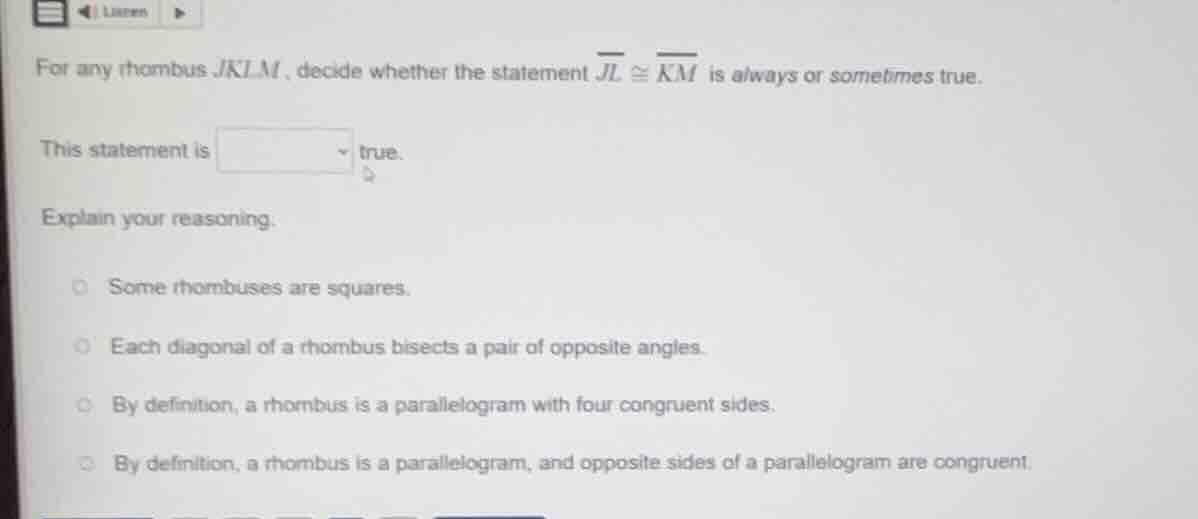
for any rhombus jklm, decide whether the statement (overline{jl} cong overline{km}) is always or sometimes true. this statement is (\boxed{quad}) true. explain your reasoning. - some rhombuses are squares. - each diagonal of a rhombus bisects a pair of opposite angles. - by definition, a rhombus is a parallelogram with four congruent sides. - by definition, a rhombus is a parallelogram, and opposite sides of a parallelogram are congruent.
A rhombus is a parallelogram with 4 congruent sides, but its diagonals are only congruent when it is a square (a special type of rhombus). For non-square rhombuses, the diagonals have different lengths. The reasoning that supports this is that some rhombuses are squares (the only case where the diagonals are congruent, while other rhombuses do not have congruent diagonals).

Snap & solve any problem in the app
Get step-by-step solutions on Sovi AI
Photo-based solutions with guided steps
Explore more problems and detailed explanations
This statement is sometimes true.
Correct reasoning option: Some rhombuses are squares.