QUESTION IMAGE
Question
apply: circle problem #4
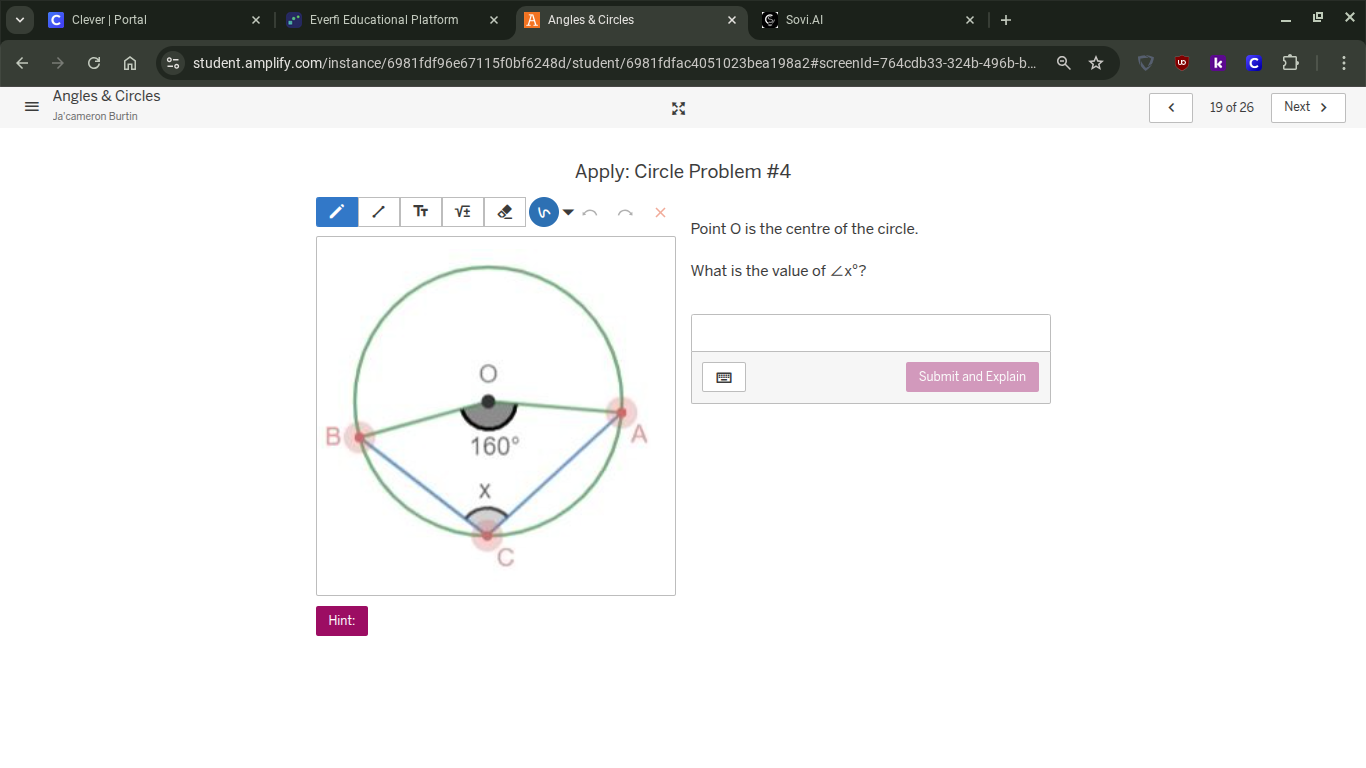
point o is the centre of the circle.
what is the value of $\angle x^\circ$?
(there is a circle with center o, points a, b, c on the circumference. angle aob is 160 degrees, and we need to find angle acb which is x degrees.)
Step1: Recall the property of triangles in a circle
In triangle \(OBC\) and \(OAC\), \(OB = OC = OA\) (radii of the circle), so triangle \(ABC\) is isosceles? Wait, no, actually, we can use the property that the sum of angles in a triangle is \(180^\circ\), and also, the central angle is \(160^\circ\), so the triangle \(OBC\) and \(OAC\) are isosceles with \(OB = OC\) and \(OA = OC\). Wait, more accurately, in triangle \(ABC\)? No, let's think again. The central angle \(\angle BOC\) is \(160^\circ\)? Wait, no, the angle at \(O\) is \(160^\circ\), so \(\angle AOB = 160^\circ\)? Wait, the diagram shows points \(B\), \(O\), \(A\) with angle \(160^\circ\) at \(O\), and point \(C\) on the circumference. So triangle \(ABC\) with \(O\) as center. So \(OB = OC = OA\) (radii). So triangle \(OBC\) and \(OAC\) are isosceles. Wait, actually, the triangle \(ABC\) is an isosceles triangle? No, let's use the property of the inscribed angle and central angle. Wait, no, here we have a triangle with two sides as radii? Wait, no, the angle at \(C\) is \(x\), and we need to find \(x\). Let's consider triangle \(OBC\) and \(OAC\). Wait, \(OB = OC\) and \(OA = OC\), so \(\angle OBC=\angle OCB\) and \(\angle OAC=\angle OCA\). But maybe a better approach: the sum of angles in a triangle is \(180^\circ\), and the central angle is \(160^\circ\), so the remaining angle at \(O\) for the triangle? Wait, no, the triangle \(ABC\) has \(O\) as the center, so \(OB = OC = OA\), so triangle \(OBC\) and \(OAC\) are isosceles. Wait, actually, the angle at \(O\) is \(160^\circ\), so the triangle \(ABC\) is formed by two radii \(OB\) and \(OA\), and the chord \(BC\) and \(AC\). Wait, maybe the triangle \(OBC\) and \(OAC\) are isosceles, but actually, the key is that in triangle \(ABC\), \(OB = OC = OA\), so \(AB = AC\)? No, wait, the angle at \(O\) is \(160^\circ\), so the triangle \(OAB\) is isosceles with \(OB = OA\), but no, the angle at \(O\) is \(160^\circ\), so the base angles at \(B\) and \(A\) would be \(\frac{180 - 160}{2}=10^\circ\) each? Wait, no, that's not right. Wait, maybe the triangle \(ABC\) is an isosceles triangle with \(OB = OC = OA\), so \(BC = AC\)? No, let's start over.
Wait, the center is \(O\), so \(OB\) and \(OA\) are radii, so \(OB = OA\). The angle \(\angle AOB = 160^\circ\). Then, the triangle \(ABC\) has \(C\) on the circumference. Wait, actually, the angle at \(C\) (angle \(x\)) is an inscribed angle? No, wait, the triangle \(ABC\) is formed by two chords \(BC\) and \(AC\), and the central angle \(\angle AOB = 160^\circ\). Wait, maybe the triangle \(ABC\) is isosceles with \(AB = AC\), but no, let's use the property that the sum of angles in a triangle is \(180^\circ\), and the triangle \(OBC\) and \(OAC\) are isosceles. Wait, no, the correct approach is: in triangle \(ABC\), \(OB = OC = OA\), so \(OB = OC\) implies \(\angle OBC = \angle OCB\), and \(OA = OC\) implies \(\angle OAC = \angle OCA\). But maybe the triangle \(ABC\) is such that the angle at \(O\) is \(160^\circ\), so the remaining angle in the triangle \(OAB\) (wait, no, the triangle is \(ABC\) with \(O\) inside? Wait, no, the diagram shows \(O\) as the center, with points \(B\), \(O\), \(A\) in a line? No, \(B\), \(O\), \(A\) form a central angle of \(160^\circ\), and \(C\) is on the circumference. So triangle \(ABC\) with \(O\) as center, so \(OB = OC = OA\), so triangle \(OBC\) and \(OAC\) are isosceles. Wait, maybe the angle at \(C\) is \(x\), and we can find \(x\) by considering that the sum of angles in triangle \(ABC\) is \(180^\circ\), and the angle at \(O\) is \(160^…

Snap & solve any problem in the app
Get step-by-step solutions on Sovi AI
Photo-based solutions with guided steps
Explore more problems and detailed explanations
\(80\)