QUESTION IMAGE
Question
applying the acute triangle inequality theorem
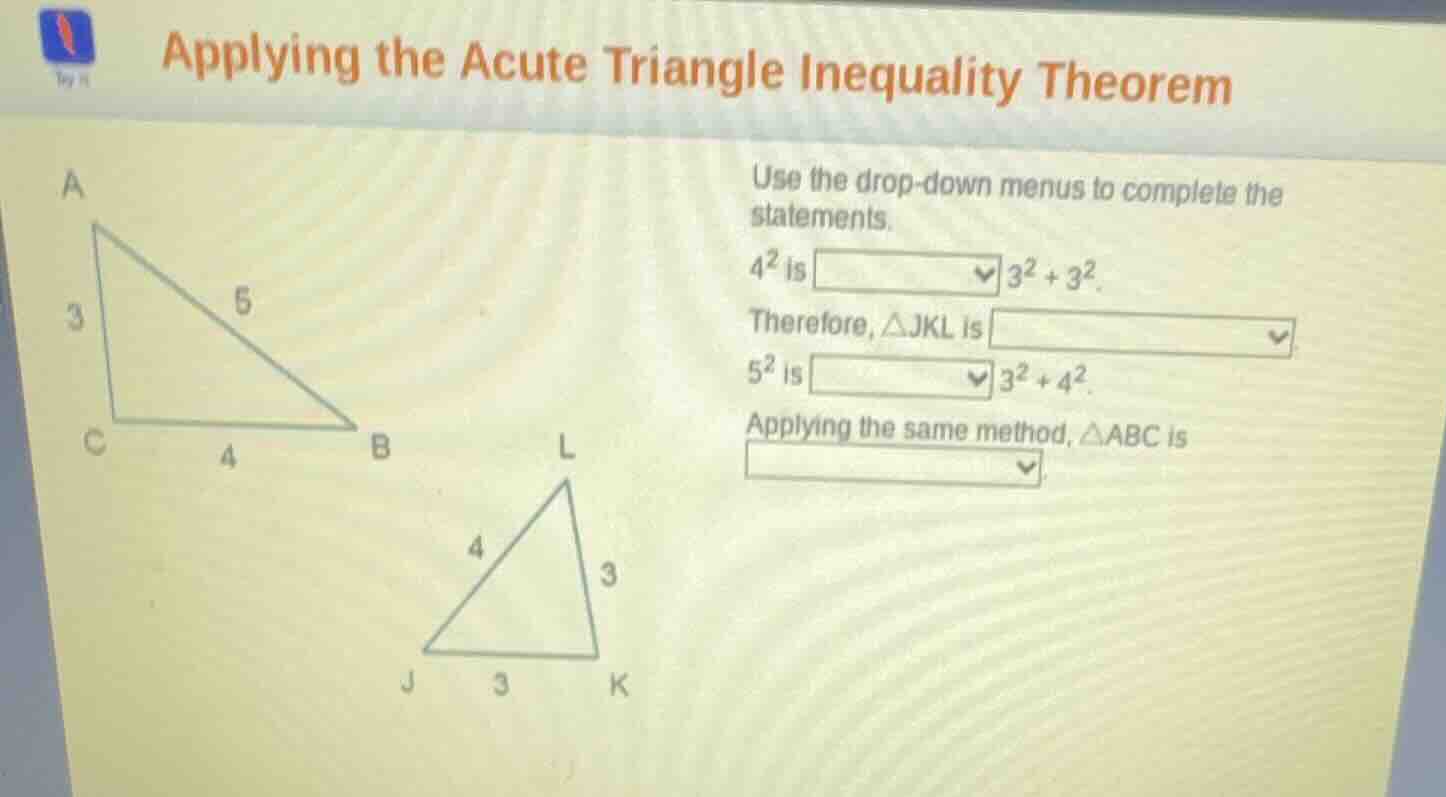
use the drop - down menus to complete the statements.
$4^2$ is $3^2 + 3^2$.
therefore, $\triangle jkl$ is.
$5^2$ is $3^2 + 4^2$.
applying the same method, $\triangle abc$ is.
(there are also two triangle figures: one with vertices a, b, c, side ac = 3, bc = 4, ab = 5; another with vertices j, k, l, side jk = 3, kl = 3, jl = 4)
Step1: Calculate each expression
$4^2=16$, $3^2+3^2=9+9=18$
Step2: Compare first pair of values
$16 < 18$, so $4^2$ is less than $3^2+3^2$. By the Acute Triangle Inequality Theorem, if the square of the longest side is less than the sum of the squares of the other two sides, the triangle is acute. So $\triangle JKL$ is acute.
Step3: Calculate next set of values
$5^2=25$, $3^2+4^2=9+16=25$
Step4: Compare second pair of values
$25 = 25$, so $5^2$ is equal to $3^2+4^2$. When the square of the longest side equals the sum of the squares of the other two sides, the triangle is right. So $\triangle ABC$ is right.

Snap & solve any problem in the app
Get step-by-step solutions on Sovi AI
Photo-based solutions with guided steps
Explore more problems and detailed explanations
$4^2$ is $\boldsymbol{less\ than}$ $3^2 + 3^2$.
Therefore, $\triangle JKL$ is $\boldsymbol{an\ acute\ triangle}$.
$5^2$ is $\boldsymbol{equal\ to}$ $3^2 + 4^2$.
Applying the same method, $\triangle ABC$ is $\boldsymbol{a\ right\ triangle}$.