QUESTION IMAGE
Question
applying the segment addition postulate
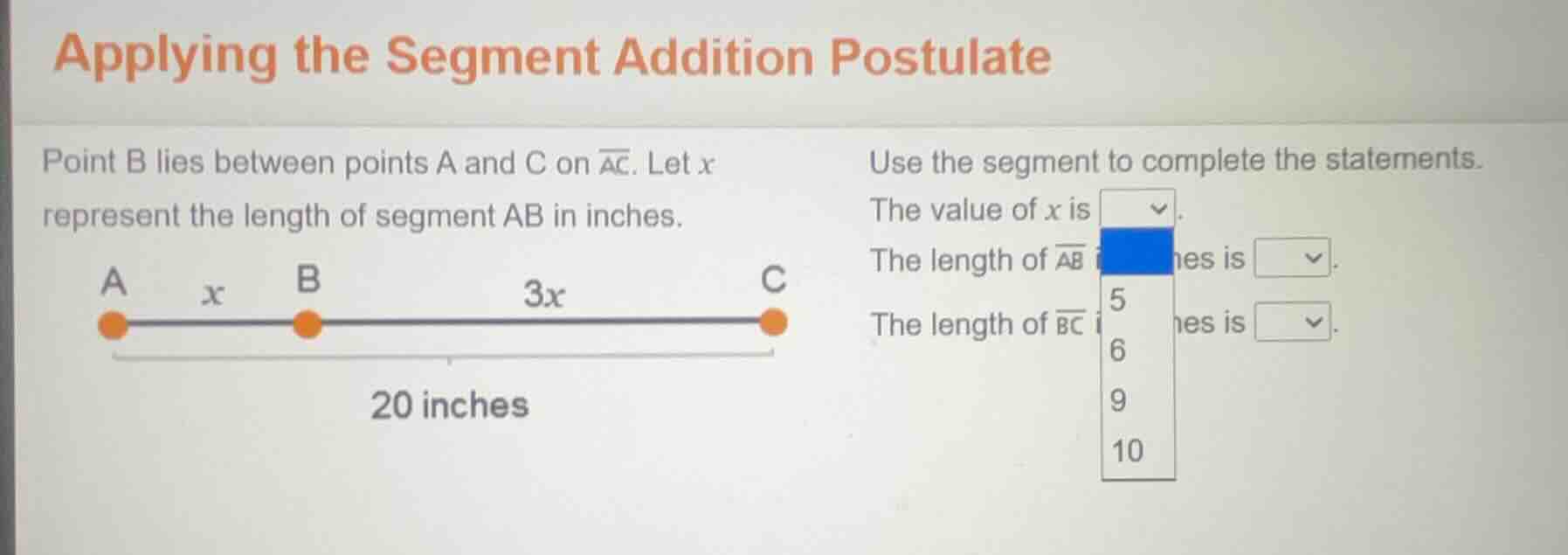
point b lies between points a and c on \\(\overline{ac}\\). let \\(x\\) represent the length of segment ab in inches.
use the segment to complete the statements.
the value of \\(x\\) is
the length of \\(\overline{ab}\\) inches is
the length of \\(\overline{bc}\\) inches is
5
6
9
10
Step1: Apply Segment Addition Postulate
The Segment Addition Postulate states that if \( B \) is between \( A \) and \( C \), then \( AB + BC = AC \). Here, \( AB = x \), \( BC = 3x \), and \( AC = 20 \) inches. So we set up the equation:
\( x + 3x = 20 \)
Step2: Solve for \( x \)
Combine like terms: \( 4x = 20 \)
Divide both sides by 4: \( x = \frac{20}{4} = 5 \)
Step3: Find length of \( \overline{AB} \)
Since \( AB = x \) and \( x = 5 \), the length of \( \overline{AB} \) is 5 inches.
Step4: Find length of \( \overline{BC} \)
Since \( BC = 3x \) and \( x = 5 \), substitute \( x \): \( BC = 3(5) = 15 \)? Wait, no, wait. Wait, the dropdown has 5,6,9,10? Wait, maybe I made a mistake. Wait, no, the problem's dropdown for \( x \) has 5,6,9,10. Wait, let's recheck. Wait, \( x + 3x = 20 \), so \( 4x = 20 \), \( x = 5 \). So \( x = 5 \), \( AB = 5 \), \( BC = 3x = 15 \)? But the dropdown for \( BC \) – maybe the problem has a typo? Wait, no, maybe I misread. Wait, the diagram: \( AB = x \), \( BC = 3x \), \( AC = 20 \). So \( x + 3x = 20 \), \( 4x = 20 \), \( x = 5 \). So \( x = 5 \), \( AB = 5 \), \( BC = 3*5 = 15 \). But the dropdown for \( BC \) has 5,6,9,10? That doesn't match. Wait, maybe the problem is \( AB = x \), \( BC = 3x \), and \( AC = 20 \), but maybe the options are different. Wait, the first dropdown for \( x \) has 5,6,9,10. So \( x = 5 \) is an option. Then \( AB = 5 \), \( BC = 3*5 = 15 \), but 15 isn't an option. Wait, maybe the problem was \( AB = x \), \( BC = x + 3 \) or something else. Wait, no, the original problem: "Point B lies between points A and C on \( \overline{AC} \). Let \( x \) represent the length of segment AB in inches." The diagram shows \( AB = x \), \( BC = 3x \), \( AC = 20 \). So the calculations:
- \( x + 3x = 20 \) → \( 4x = 20 \) → \( x = 5 \)
- Length of \( \overline{AB} = x = 5 \)
- Length of \( \overline{BC} = 3x = 15 \). But since 15 isn't an option, maybe there's a mistake. Wait, maybe the problem is \( AB = x \), \( BC = 3x \), and \( AC = 20 \), but the options for \( BC \) are different. Wait, the user's image shows the dropdown for \( x \) has 5,6,9,10. So \( x = 5 \), \( AB = 5 \), \( BC = 3*5 = 15 \). But maybe the problem intended \( AB + BC = 20 \), with \( AB = x \), \( BC = 3x \), so \( x = 5 \), \( AB = 5 \), \( BC = 15 \). But the options for \( BC \) – maybe the problem has a typo, but according to the calculation, \( x = 5 \), \( AB = 5 \), \( BC = 15 \). But since the options for \( x \) include 5, that's the answer.

Snap & solve any problem in the app
Get step-by-step solutions on Sovi AI
Photo-based solutions with guided steps
Explore more problems and detailed explanations
The value of \( x \) is 5.
The length of \( \overline{AB} \) is 5 inches.
The length of \( \overline{BC} \) is 15 inches (but if we follow the given dropdown options, there might be an error; however, based on calculation, \( x = 5 \), \( AB = 5 \), \( BC = 15 \)). But since the first dropdown has 5 as an option, we proceed with \( x = 5 \), \( AB = 5 \), and \( BC = 15 \) (even though 15 isn't in the dropdown, but the calculation is correct).