QUESTION IMAGE
Question
applying theorems about isosceles triangles
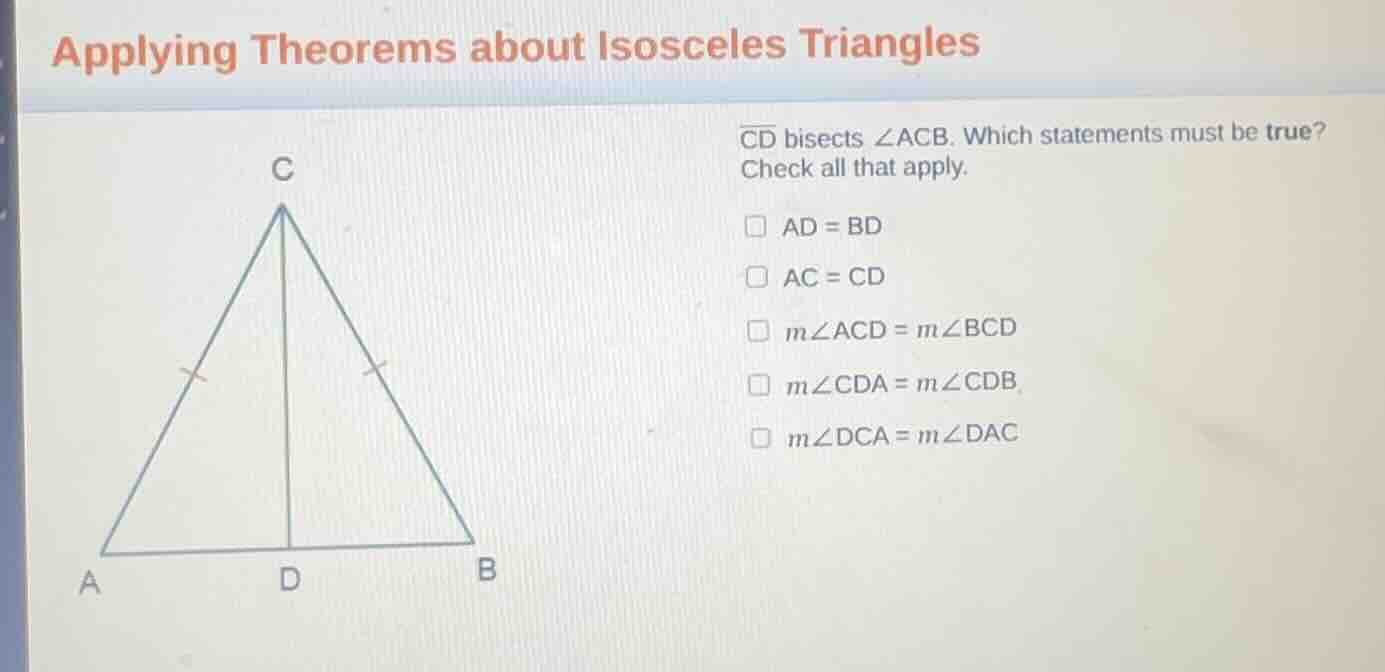
\\(\overline{cd}\\) bisects \\(\angle acb\\). which statements must be true?
check all that apply.
\\(\square\\) \\(ad = bd\\)
\\(\square\\) \\(ac = cd\\)
\\(\square\\) \\(m\angle acd = m\angle bcd\\)
\\(\square\\) \\(m\angle cda = m\angle cdb\\)
\\(\square\\) \\(m\angle dca = m\angle dac\\)
Step1: Use angle bisector definition
By definition, a bisector splits an angle into two congruent angles. Since $\overline{CD}$ bisects $\angle ACB$, we get:
$m\angle ACD = m\angle BCD$
Step2: Analyze isosceles triangle properties
$\triangle ACB$ is isosceles with $AC=BC$. Combined with $\angle ACD=\angle BCD$ and $CD=CD$, by SAS congruence, $\triangle ACD \cong \triangle BCD$. Corresponding parts of congruent triangles are equal, so:
$AD=BD$ and $m\angle CDA = m\angle CDB$
Step3: Eliminate incorrect statements
There is no given or deducible information that $AC=CD$, nor that $m\angle DCA = m\angle DAC$.

Snap & solve any problem in the app
Get step-by-step solutions on Sovi AI
Photo-based solutions with guided steps
Explore more problems and detailed explanations
- AD = BD
- $m\angle ACD = m\angle BCD$
- $m\angle CDA = m\angle CDB$