QUESTION IMAGE
Question
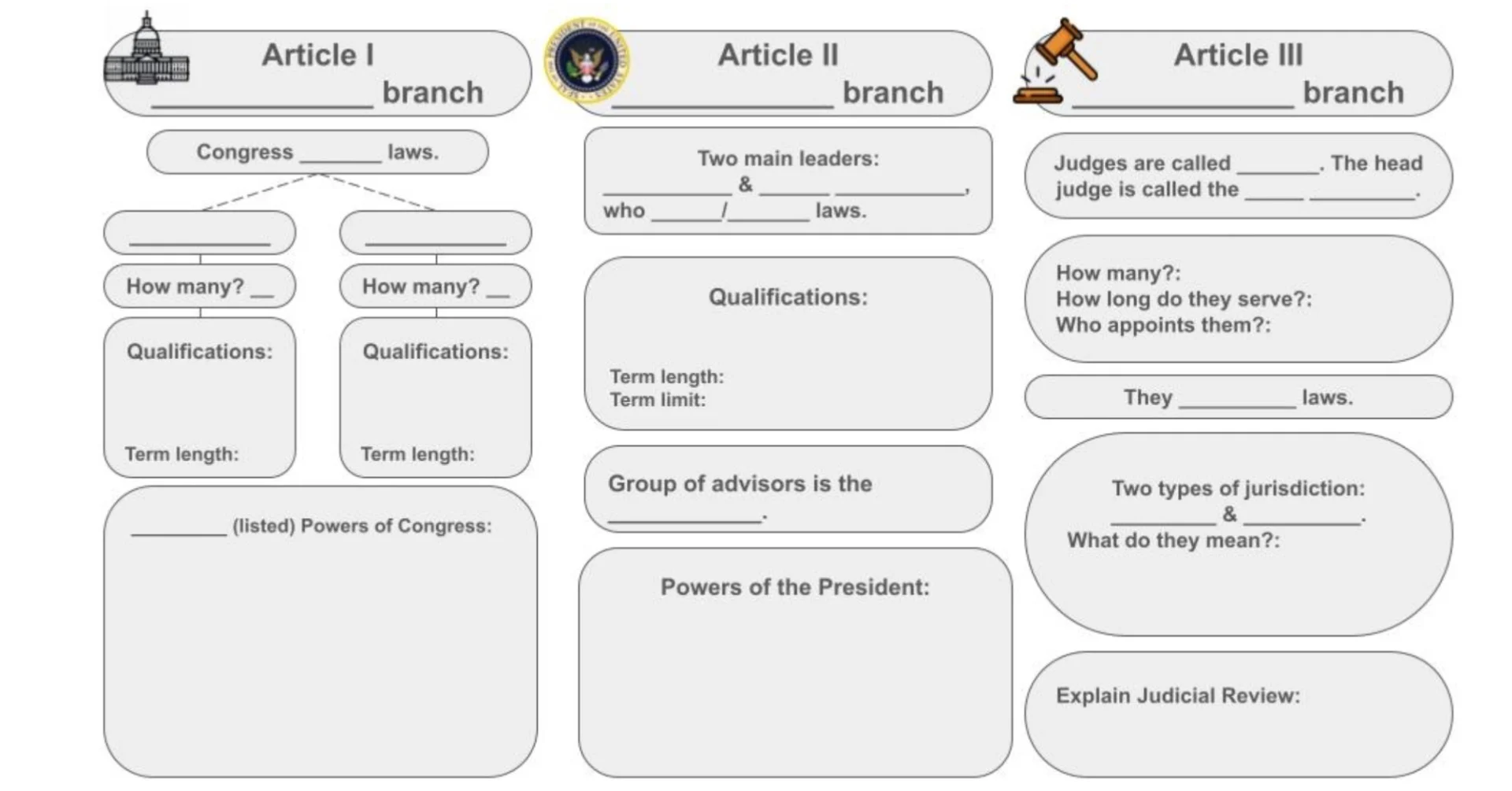
article i_____ branchcongress ___ laws.___how many? qualifications:term length:_____how many? qualifications:term length:_____ listed powers of congress:article ii___ branchtwo main leaders:___ & ___ ___,who ___/___ laws.qualifications:term length:term limit:group of advisors is the___.powers of the president:article iii___ branchjudges are called ___. the head judge is called the ___ ___.how many?:how long do they serve?:who appoints them?:they ___ laws.two types of jurisdiction:___ & _____.what do they mean?:explain judicial review:
This is a fill-in-the-blank diagram outlining the three branches of the U.S. federal government as defined by the U.S. Constitution. Each section corresponds to the core structure, roles, and powers of each branch:
- Article I (Legislative Branch): This branch makes federal laws, composed of the bicameral Congress.
- Article II (Executive Branch): This branch enforces and carries out federal laws, led by the President and Vice President.
- Article III (Judicial Branch): This branch interprets federal laws and the Constitution, composed of federal courts and judges.

Snap & solve any problem in the app
Get step-by-step solutions on Sovi AI
Photo-based solutions with guided steps
Explore more problems and detailed explanations
Article I (Legislative Branch)
- Article I: Legislative branch
- Congress makes laws.
- House of Representatives
- How many?: 435
- Qualifications: At least 25 years old; U.S. citizen for 7+ years; resident of represented state
- Term length: 2 years
- Senate
- How many?: 100
- Qualifications: At least 30 years old; U.S. citizen for 9+ years; resident of represented state
- Term length: 6 years
- Enumerated (listed) Powers of Congress:
- Levy taxes, borrow money, regulate commerce, coin money, declare war, establish post offices, raise and support armies, create federal courts inferior to the Supreme Court, approve presidential appointments/treaties
---
Article II (Executive Branch)
- Article II: Executive branch
- Two main leaders: President & Vice President, who enforce/implement laws.
- Qualifications:
- At least 35 years old; natural-born U.S. citizen; resident of U.S. for 14+ years
- Term length: 4 years
- Term limit: Maximum 2 full terms (or 10 years total if assuming office mid-term)
- Group of advisors is the Cabinet.
- Powers of the President:
- Sign/veto bills, command armed forces, appoint federal officials/judges, negotiate treaties, grant pardons, deliver State of the Union address, enforce federal laws
---
Article III (Judicial Branch)
- Article III: Judicial branch
- Judges are called Justices (Supreme Court) / Federal Judges (lower courts). The head judge is called the Chief Justice (of the United States).
- How many?: 9 (Supreme Court; lower courts have varying numbers)
- How long do they serve?: Lifetime tenure (during "good Behaviour")
- Who appoints them?: President (with Senate confirmation)
- They interpret laws.
- Two types of jurisdiction: Original & Appellate
- What do they mean?:
- Original: Court hears the case first (has authority over the case's facts)
- Appellate: Court reviews a lower court's decision for legal errors
- Explain Judicial Review: The power of federal courts to review laws and executive actions, and declare them unconstitutional if they conflict with the U.S. Constitution (established in Marbury v. Madison, 1803)