QUESTION IMAGE
Question
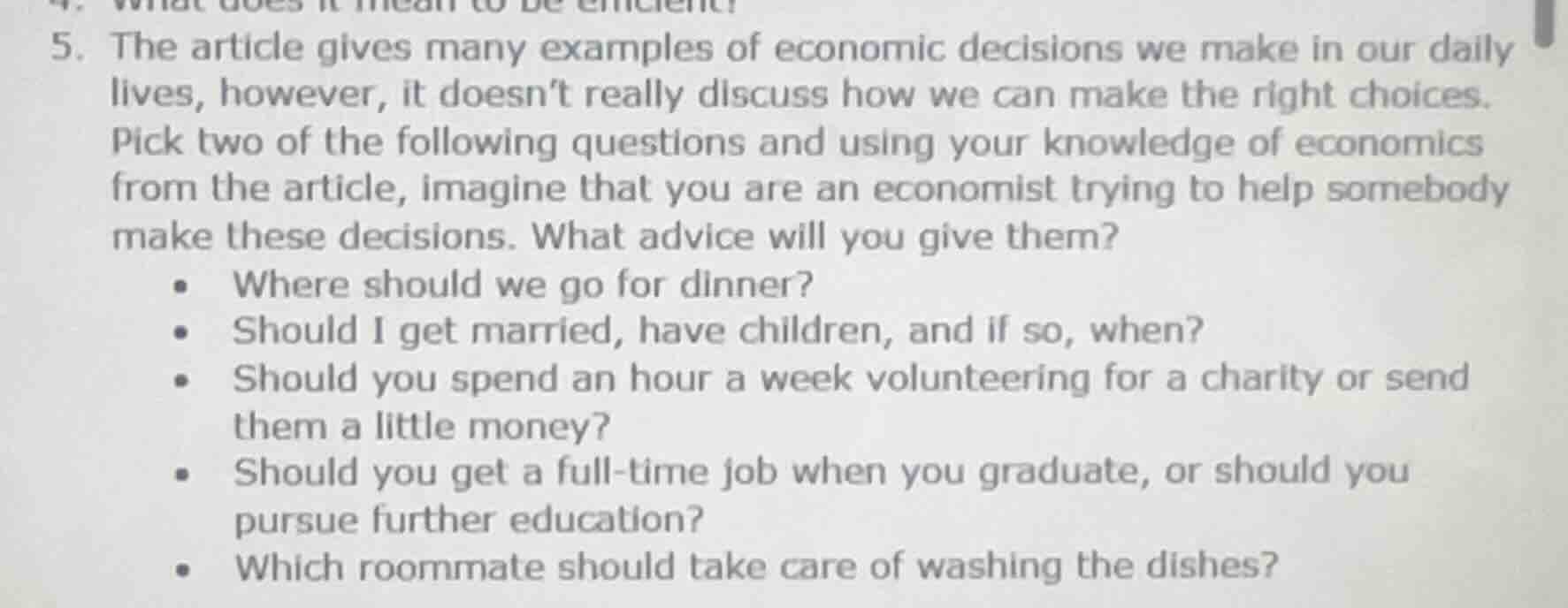
- the article gives many examples of economic decisions we make in our daily lives, however, it doesn’t really discuss how we can make the right choices. pick two of the following questions and using your knowledge of economics from the article, imagine that you are an economist trying to help somebody make these decisions. what advice will you give them? - where should we go for dinner? - should i get married, have children, and if so, when? - should you spend an hour a week volunteering for a charity or send them a little money? - should you get a full - time job when you graduate, or should you pursue further education? - which roommate should take care of washing the dishes?
For "Where should we go for dinner?"
Advise comparing the marginal cost (monetary cost, travel time, wait time) and marginal benefit (enjoyment, food quality, convenience) of each option. Choose the restaurant where the marginal benefit exceeds marginal cost by the largest amount. Also, consider opportunity cost: what you give up (like a cheaper meal's savings for another activity) by picking a more expensive spot.
For "Should you get a full-time job when you graduate, or should you pursue further education?"
Calculate the immediate financial cost of further education (tuition, lost wages from not working) against the long-term benefit (higher future salary, expanded career opportunities). Compare the net present value of lifetime earnings for both paths. If the present value of earnings with further education minus its costs is higher than the present value of immediate full-time work earnings, choose further education; otherwise, take the job.

Snap & solve any problem in the app
Get step-by-step solutions on Sovi AI
Photo-based solutions with guided steps
Explore more problems and detailed explanations
- For "Where should we go for dinner?":
Compare marginal cost (cost, time) and benefit (enjoyment, quality) of each restaurant. Choose the option where marginal benefit minus marginal cost is highest, and account for the opportunity cost of your choice (e.g., savings you give up for a pricier meal).
- For "Should you get a full-time job when you graduate, or pursue further education?":
Compare the net present value of lifetime earnings for both paths. Calculate the total cost of further education (tuition + lost wages from not working) and subtract it from the discounted value of future higher earnings. If this net value is greater than the discounted lifetime earnings of an immediate full-time job, pursue further education; otherwise, take the full-time job.