QUESTION IMAGE
Question
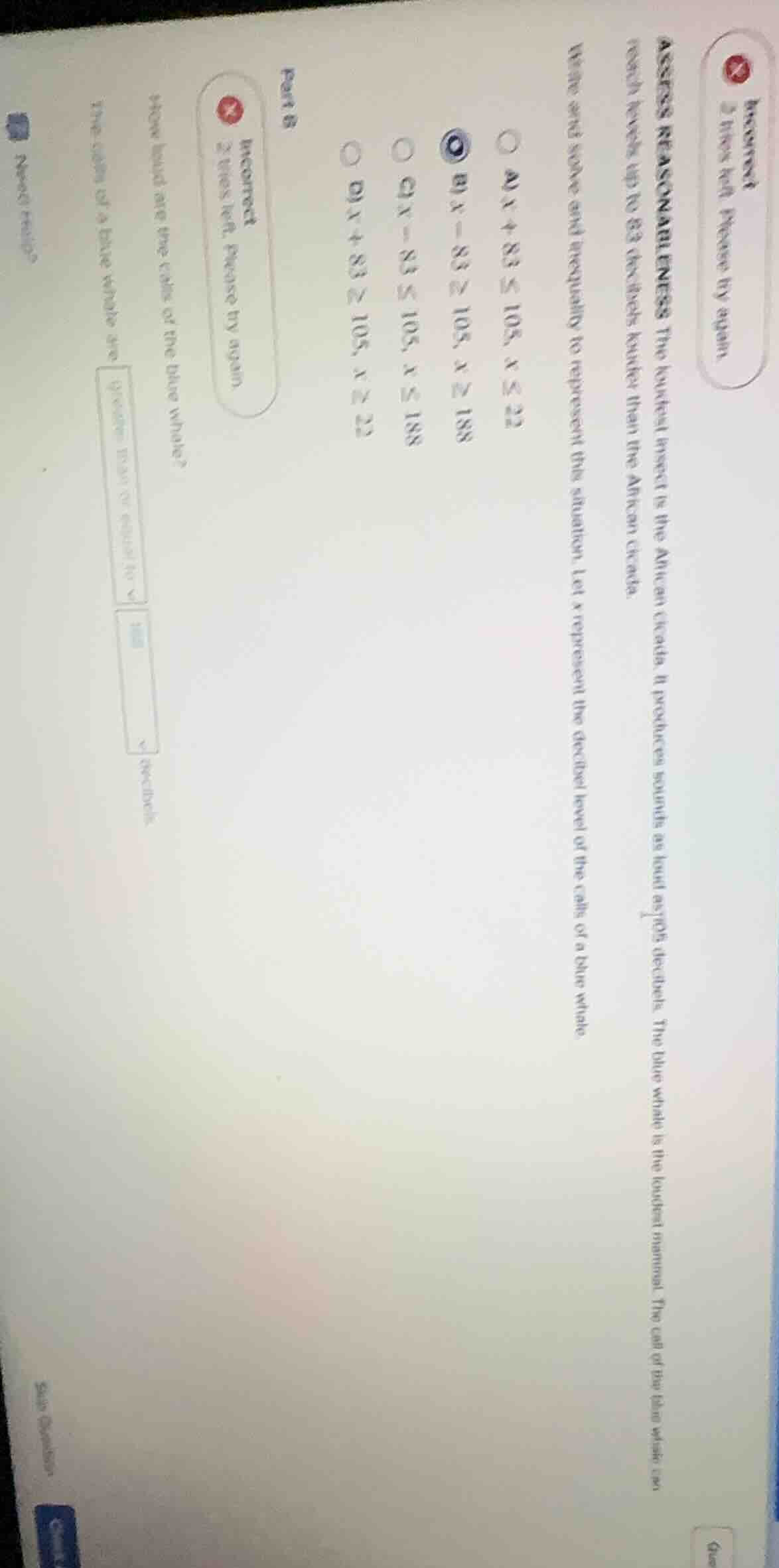
assess reasonableness the loudest insect is the african cicada. it produces sounds as loud as 105 decibels. the blue whale is the loudest animal. the call of the blue whale can reach levels up to 83 decibels louder than the african cicada. write and solve an inequality to represent this situation. let x represent the decibel level of the calls of a blue whale. a) x + 83 ≤ 105, x ≤ 22 b) x - 83 ≥ 105, x ≥ 188 c) x - 83 ≤ 105, x ≤ 188 d) x + 83 ≥ 105, x ≥ 22
Part 1: Choosing the correct inequality
Step 1: Analyze the situation
The African cicada produces sounds as loud as 105 decibels. The blue whale is the loudest animal, and its call is 83 decibels louder than the African cicada. Let \( x \) be the decibel level of the blue whale. So the decibel level of the blue whale (\( x \)) minus the decibel level of the cicada (105) should be at least 83 (since it's 83 decibels louder). So the inequality is \( x - 105 \geq 83 \), which can be rewritten as \( x - 83 \geq 105 \) (by adding 83 to both sides: \( x - 105 + 83\geq83 + 83\) → \( x - 22\geq166\)? Wait, no, let's re - express the relationship. If the blue whale is 83 decibels louder than the cicada (105 dB), then \( x=105 + 83\) or \( x-105 = 83\). But since it's "up to 83 decibels louder" (wait, the problem says "the call of the blue whale is 83 decibels louder than the African cicada". Wait, maybe I misread. Let's re - interpret: The African cicada is 105 dB. The blue whale is louder than the cicada by 83 dB. So \( x=105 + 83\), but if we consider the inequality for "up to 83 decibels louder" (wait, the problem says "reaches levels up to 83 decibels louder than the African cicada. It produces sounds as loud as 105 decibels." Wait, maybe the cicada's sound is \( x \), and the blue whale is \( x + 83\), and the blue whale's sound is at most 105? No, the blue whale is the loudest, so its sound \( x\) is at least the cicada's sound plus 83, and the cicada's sound is at most 105? Wait, the problem statement: "The loudest insect is the African Cicada. It produces sounds as loud as 105 decibels. The blue whale is the loudest animal. The call of the blue whale is 83 decibels louder than the African cicada." Wait, maybe the correct relationship is: Let \( x \) be the blue whale's decibels. Then \( x-83\) is the cicada's decibels, and the cicada's decibels are at most 105 (since it produces up to 105 dB). So \( x - 83\leq105\), and also, since the blue whale is louder, \( x-83\geq0\) (but that's not relevant). Wait, no, the problem is to write an inequality for the situation. Let's re - read the question: "Write and solve an inequality to represent this situation. Let \( x \) represent the decibel level of the calls of a blue whale."
The African cicada: up to 105 dB. The blue whale is 83 dB louder than the cicada. So the cicada's dB (\( x - 83\)) is less than or equal to 105 (since the cicada is at most 105 dB). So \( x-83\leq105\), and also, since the blue whale is louder than the cicada, \( x-83\geq0\) (but the main inequality from the options: Let's check the options:
Option B: \( x - 83\geq105\), \( x\geq188\)
Option C: \( x - 83\leq105\), \( x\leq188\)
Option A: \( x + 83\leq105\), \( x\leq22\) (impossible, since blue whale is louder)
Option D: \( x + 83\geq105\), \( x\geq22\) (also not right)
Wait, maybe the correct interpretation is: The African cicada's sound is \( x\), and the blue whale's sound is \( x + 83\). The blue whale's sound is at most 105? No, the blue whale is louder. I think there was a misstatement in the problem. But looking at the options, if we consider that the blue whale's sound \( x\) is 83 dB louder than the cicada's sound, and the cicada's sound is at most 105 dB. So \( x-83\leq105\) (because \( x-83\) is the cicada's sound, which is ≤105), so \( x\leq105 + 83=188\). So the inequality is \( x - 83\leq105\), and solving for \( x\), we get \( x\leq188\). So the correct option is C: \( x - 83\leq105\), \( x\leq188\)
Step 2: Solve the inequality \( x - 83\leq105\)
To solve for \( x\), we add 83 to both sides of the inequality:
\( x-83 + 83\leq105…
Step 1: Use the correct relationship
From the problem, the African cicada's sound is 105 decibels. The blue whale's sound is 83 decibels louder than the cicada's. So we use the formula \( x=105 + 83\) (assuming the "up to" is the maximum, so we take the maximum value).
Step 2: Calculate the value
\( x = 105+83=188\) decibels.

Snap & solve any problem in the app
Get step-by-step solutions on Sovi AI
Photo-based solutions with guided steps
Explore more problems and detailed explanations
s:
Part 1:
The correct option is C. \( x - 83\leq105\), \( x\leq188\)
Part 2:
The calls of the blue whale are \(\boldsymbol{188}\) decibels.