QUESTION IMAGE
Question
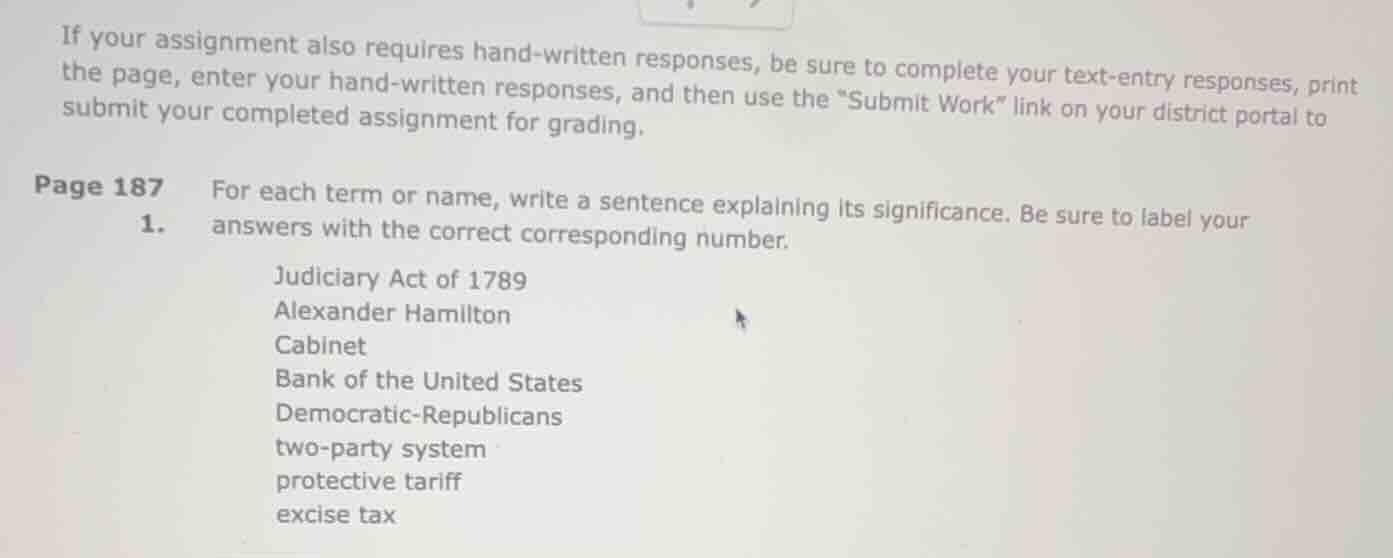
if your assignment also requires hand - written responses, be sure to complete your text - entry responses, print the page, enter your hand - written responses, and then use the \submit work\ link on your district portal to submit your completed assignment for grading.
page 187
- for each term or name, write a sentence explaining its significance. be sure to label your answers with the correct corresponding number.
judiciary act of 1789
alexander hamilton
cabinet
bank of the united states
democratic - republicans
two - party system
protective tariff
excise tax
Brief Explanations
- Judiciary Act of 1789: Established the U.S. federal court system, including the Supreme Court's structure and lower federal courts, defining the judiciary's role in the government.
- Alexander Hamilton: A Founding Father, first U.S. Treasury Secretary, who shaped early federal economic policy and advocated for a strong central government.
- Cabinet: A group of presidential advisors leading executive branch departments, formed to help the president execute federal duties and policy.
- Bank of the United States: A national bank proposed by Hamilton to manage federal funds, stabilize currency, and support the nation's economic growth in the early republic.
- Democratic-Republicans: An early U.S. political party led by Jefferson and Madison, favoring states' rights, agrarian interests, and limited federal power.
- two-party system: A political system where two major parties dominate elections and governance, shaping U.S. political competition and policy direction.
- protective tariff: A tax on imported goods designed to raise their price, protecting domestic U.S. industries from foreign competition in the 1790s.
- excise tax: A tax on the production or sale of domestic goods (like whiskey), used by Hamilton to raise federal revenue and fund national debt.

Snap & solve any problem in the app
Get step-by-step solutions on Sovi AI
Photo-based solutions with guided steps
Explore more problems and detailed explanations
- Judiciary Act of 1789: It established the structure of the U.S. federal court system, creating lower federal courts and defining the Supreme Court's jurisdiction, laying the foundation for the federal judiciary.
- Alexander Hamilton: A Founding Father and first U.S. Secretary of the Treasury, he crafted policies to strengthen the federal government, pay off national debt, and promote a centralized, industrialized economy.
- Cabinet: An advisory body for the U.S. president, made up of heads of executive departments, which provides expertise and helps implement the president's policy agenda.
- Bank of the United States: A national financial institution chartered in 1791 to manage federal funds, standardize currency, and support the young nation's economic stability and growth.
- Democratic-Republicans: An early U.S. political party founded by Thomas Jefferson and James Madison, advocating for states' rights, agrarian interests, and a limited federal government in opposition to Federalist policies.
- two-party system: A political framework where two major parties (originally Federalists and Democratic-Republicans, later Democrats and Republicans) dominate electoral politics, shaping U.S. legislative and executive outcomes.
- protective tariff: A tax imposed on imported goods to make them more expensive than domestic products, intended to shield U.S. manufacturers from foreign competition and promote domestic industry.
- excise tax: A tax levied on the production, sale, or use of specific domestic goods (most infamously whiskey in the 1790s), used by the federal government to generate revenue and pay down national debt.