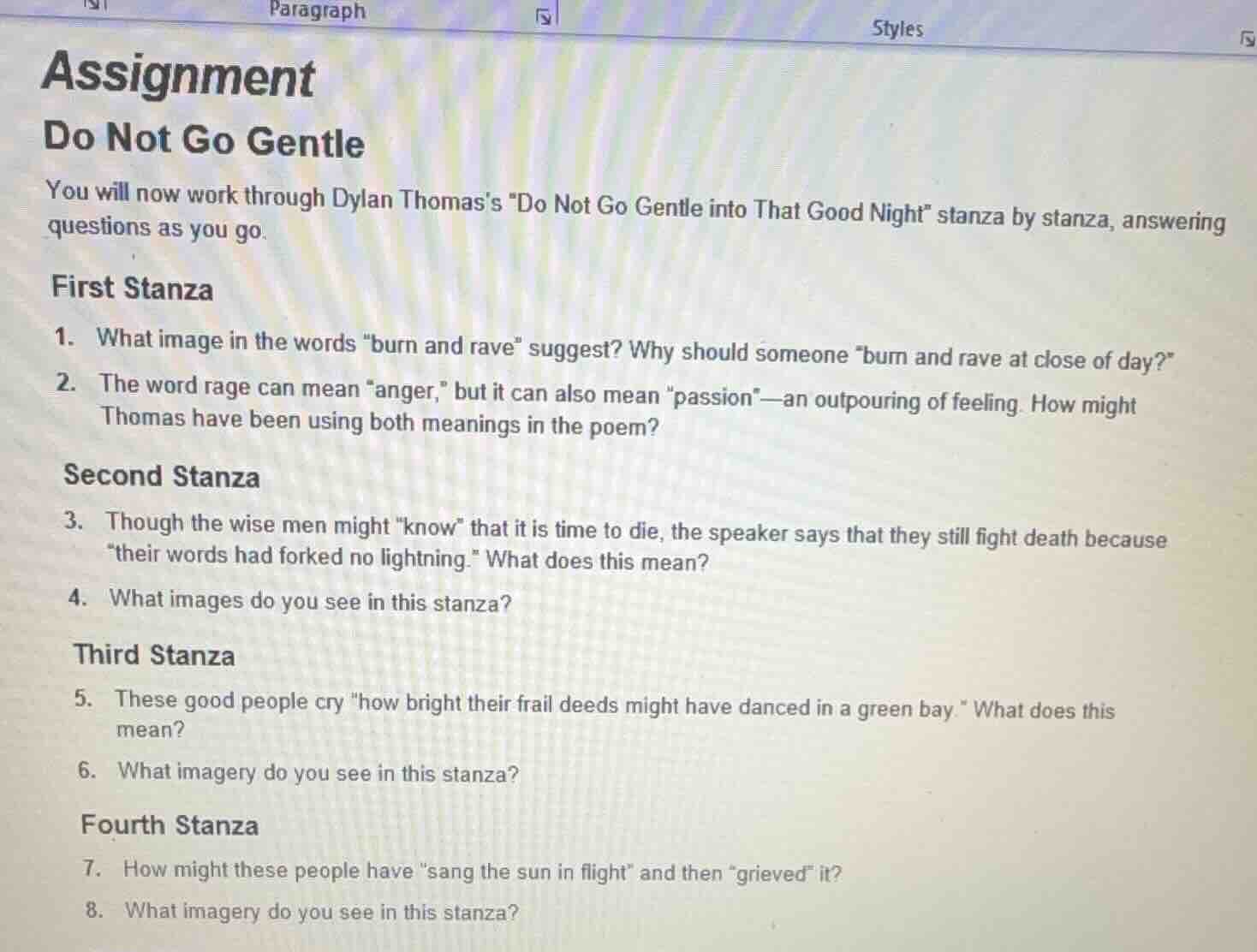
QUESTION IMAGE
Question
assignment
do not go gentle
you will now work through dylan thomass \do not go gentle into that good night\ stanza by stanza, answering questions as you go.
first stanza
- what image in the words \burn and rave\ suggest? why should someone \burn and rave at close of day?\
- the word rage can mean \anger,\ but it can also mean \passion\—an outpouring of feeling. how might thomas have been using both meanings in the poem?
second stanza
- though the wise men might \know\ that it is time to die, the speaker says that they still fight death because \their words had forked no lightning.\ what does this mean?
- what images do you see in this stanza?
third stanza
- these good people cry \how bright their frail deeds might have danced in a green bay.\ what does this mean?
- what imagery do you see in this stanza?
fourth stanza
- how might these people have \sang the sun in flight\ and then \grieved\ it?
- what imagery do you see in this stanza?
Brief Explanations
- "Burn and rave" evokes a bright, fierce flame—an image of intense, unyielding energy. People should "burn and rave at close of day" (approaching death) to resist fading quietly, fighting against the end instead of accepting it passively.
- Thomas uses "rage" as anger at the injustice of death stealing life, and as passionate, fierce will to hold on to life and make one's last moments count. Both meanings fuel the poem's call to resist death.
- Wise men fight death because their ideas, words, and life's work never made a powerful, transformative impact ("forked no lightning"—no sudden, world-changing spark). They regret unfulfilled potential and refuse to die without leaving a meaningful mark.
- The stanza uses the image of wise men with unfulfilled intellectual legacies, paired with the metaphor of "close of day" (death) as a fading, darkening end.
- These good people mourn that their small, modest acts of goodness ("frail deeds") could have been far more vibrant, impactful, and celebrated ("danced in a green bay"—a lively, thriving, hopeful space) if they had more time or opportunity.
- The stanza uses imagery of quiet, unremarkable good deeds contrasted with a bright, lively "green bay," plus the metaphor of "close of day" (death) as a fading end.
- These are adventurous, passionate people who "sang the sun in flight"—they celebrated, embraced, and lived fully during the bright, active days of their lives. They "grieved" it because they mourn the loss of that vibrant life, and rage against death taking their ability to live fully.
- The stanza uses vivid imagery of a bright, soaring sun (representing a vibrant, lived life) paired with the sorrow of grieving that lost light, plus the "close of day" (death) metaphor.

Snap & solve any problem in the app
Get step-by-step solutions on Sovi AI
Photo-based solutions with guided steps
Explore more problems and detailed explanations
- "Burn and rave" suggests a fierce, bright flame; people should resist death instead of fading quietly.
- "Rage" means anger at death's injustice and passionate will to cling to life.
- Wise men's work never made a transformative impact, so they fight death to leave a legacy.
- Images of unfulfilled wise men and fading "close of day" (death).
- Good people mourn that their small deeds could have been far more vibrant and impactful.
- Imagery of modest good deeds, a lively "green bay," and fading "close of day" (death).
- They fully embraced and celebrated their vibrant lives, then grieved the loss of that life to death.
- Imagery of a soaring, bright sun (vibrant life) and grief over its loss, plus fading "close of day" (death).