QUESTION IMAGE
Question
assignment
katherine period 2 homework
use a separate piece of paper for your journal entry.
journal
explain why all sequences
represent functions.
remember
a sequence is a pattern involving an ordered
arrangement of numbers, geometric figures, letters, or
other objects. it is a function whose domain is the set of
natural numbers.
practice
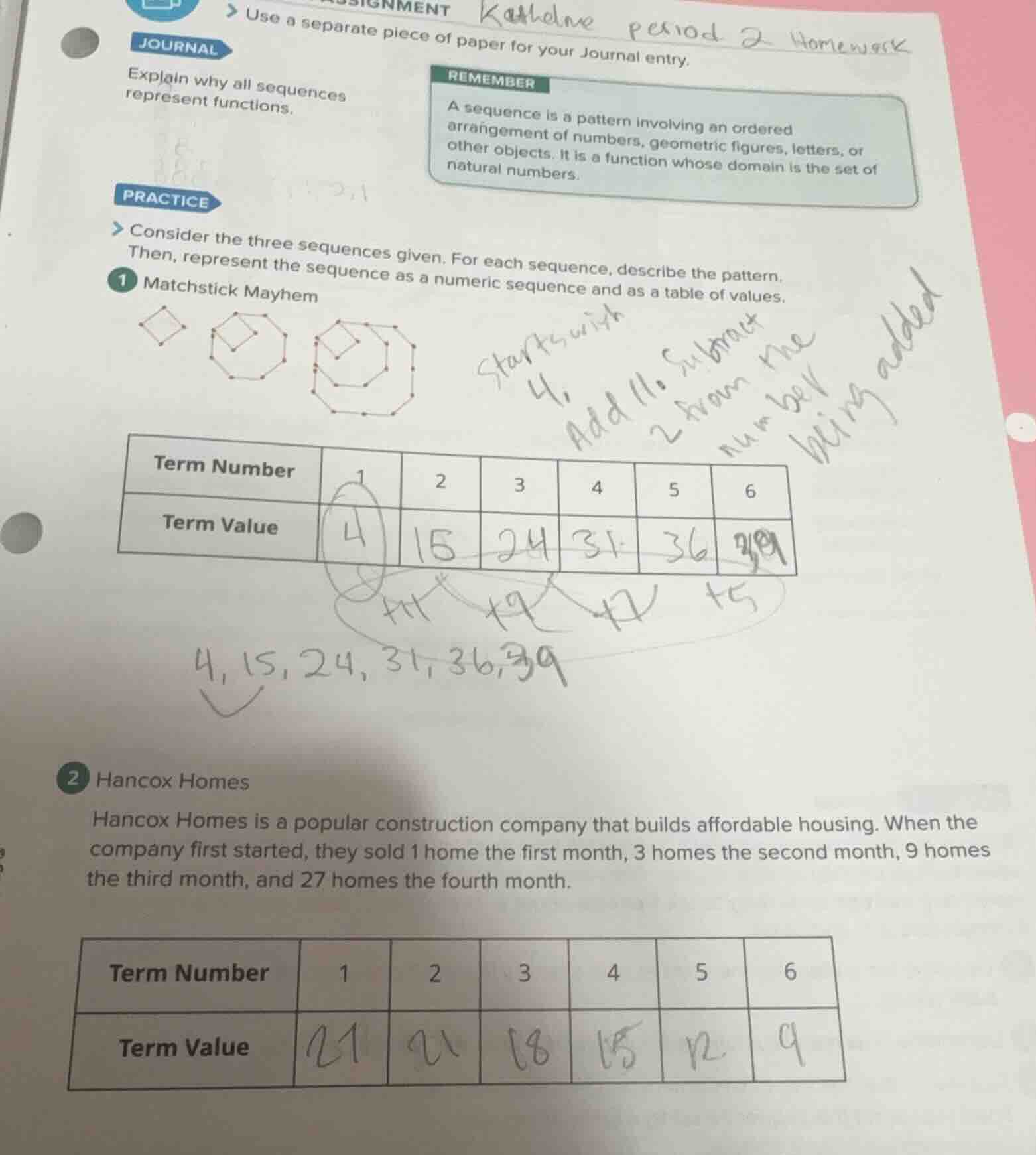
consider the three sequences given. for each sequence, describe the pattern.
then, represent the sequence as a numeric sequence and as a table of values.
1 matchstick mayhem
three geometric figures
table with term number (1,2,3,4,5,6) and term value (4,15,24,31,36,39) with handwritten notes
4,15,24,31,36,39
2 hancox homes
hancox homes is a popular construction company that builds affordable housing. when the
company first started, they sold 1 home the first month, 3 homes the second month, 9 homes
the third month, and 27 homes the fourth month.
table with term number (1,2,3,4,5,6) and term value (21, 21, 18, 15, 12, 9) with handwritten notes
Journal Question:
A sequence is defined as a function with a domain of natural numbers (positive integers: 1,2,3,...). For every natural number input (term number), there is exactly one corresponding term value in the sequence. This satisfies the core definition of a function: each input has exactly one output.
---
1. Matchstick Mayhem
Step1: Identify pattern
Start at 4. Each subsequent increment decreases by 2: $15-4=11$, $24-15=9$, $31-24=7$, $36-31=5$, $39-36=3$.
Step2: Numeric sequence
List term values in order: $4, 15, 24, 31, 36, 39$
Step3: Table of values
Map term numbers to values:
| Term Number | 1 | 2 | 3 | 4 | 5 | 6 |
|---|
---
2. Hancox Homes
Step1: Identify pattern
Each term is 3 times the prior term: $3=1\times3$, $9=3\times3$, $27=9\times3$.
Step2: Calculate terms 5 and 6
Term 5: $27\times3=81$; Term 6: $81\times3=243$
Step3: Numeric sequence
List term values in order: $1, 3, 9, 27, 81, 243$
Step4: Table of values
Map term numbers to corrected values:
| Term Number | 1 | 2 | 3 | 4 | 5 | 6 |
|---|

Snap & solve any problem in the app
Get step-by-step solutions on Sovi AI
Photo-based solutions with guided steps
Explore more problems and detailed explanations
Journal Answer:
A sequence is a function because its domain is the set of natural numbers, and each term number (input) corresponds to exactly one term value (output), satisfying the definition of a function.
1. Matchstick Mayhem
- Pattern: Starts at 4, each increment is 2 less than the previous increment (11, 9, 7, 5, 3).
- Numeric Sequence: $4, 15, 24, 31, 36, 39$
- Table of Values:
| Term Number | 1 | 2 | 3 | 4 | 5 | 6 |
|---|
2. Hancox Homes
- Pattern: Each term is 3 times the previous term (geometric sequence with common ratio 3).
- Numeric Sequence: $1, 3, 9, 27, 81, 243$
- Table of Values:
| Term Number | 1 | 2 | 3 | 4 | 5 | 6 |
|---|