QUESTION IMAGE
Question
assignment in progress for 10982n0008 83 ela grade 8
due january 18, 2028 at 11:59 pm
how do we tell right from wrong?
kohlbergs stages of moral development
anne - marie reidy • 2019
dr. lawrence kohlberg (1927 - 1987) was an american psychologist best known for his research into moral development. through his work, kohlberg created a new field in psychology in which researchers try to understand how humans make moral choices. as you read, make note of the details that support the author’s central idea: how do people tell right from wrong?
decisions, decisions
- joe and his best friend kim stop at a convenience store on their walk home from school. joe sees kim take a candy bar and slip it into her bag. then kim walks quickly out the door without paying. the store owner, who knows joe from the neighborhood, asks him, “joe, did that girl steal something from me?” joe has been taught that it’s wrong to steal or lie —
assessment questions
4.
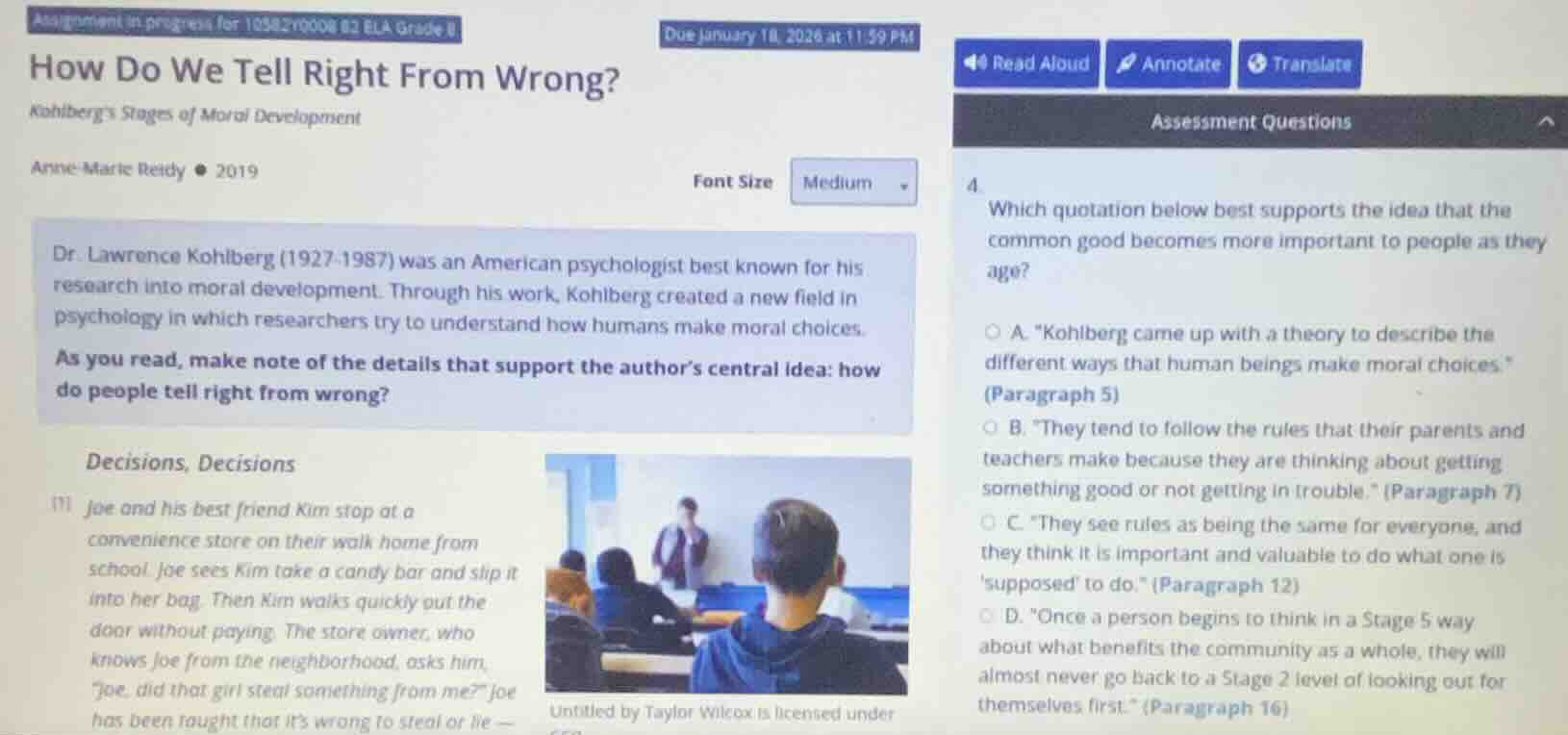
which quotation below best supports the idea that the common good becomes more important to people as they age?
a. “kohlberg came up with a theory to describe the different ways that human beings make moral choices.” (paragraph 5)
b. “they tend to follow the rules that their parents and teachers make because they are thinking about getting something good or not getting in trouble.” (paragraph 7)
c. “they see rules as being the same for everyone, and they think it is important and valuable to do what one is ‘supposed’ to do.” (paragraph 12)
d. “once a person begins to think in a stage 5 way about what benefits the community as a whole, they will almost never go back to a stage 2 level of looking out for themselves first.” (paragraph 16)
To solve this, we analyze each option:
- Option A: Describes Kohlberg's theory about moral choices, not about age and common good. Eliminate.
- Option B: Talks about following rules for personal gain (not getting in trouble), related to a lower stage, not common good with age. Eliminate.
- Option C: Focuses on following rules for everyone, but not about age and common good. Eliminate.
- Option D: Mentions that when a person (as they develop, implying age) thinks in Stage 5 (benefiting the community, common good), they don't go back to self - centered Stage 2. This shows common good becomes more important with age.

Snap & solve any problem in the app
Get step-by-step solutions on Sovi AI
Photo-based solutions with guided steps
Explore more problems and detailed explanations
D. "Once a person begins to think in a Stage 5 way about what benefits the community as a whole, they will almost never go back to a Stage 2 level of looking out for themselves first." (Paragraph 16)