QUESTION IMAGE
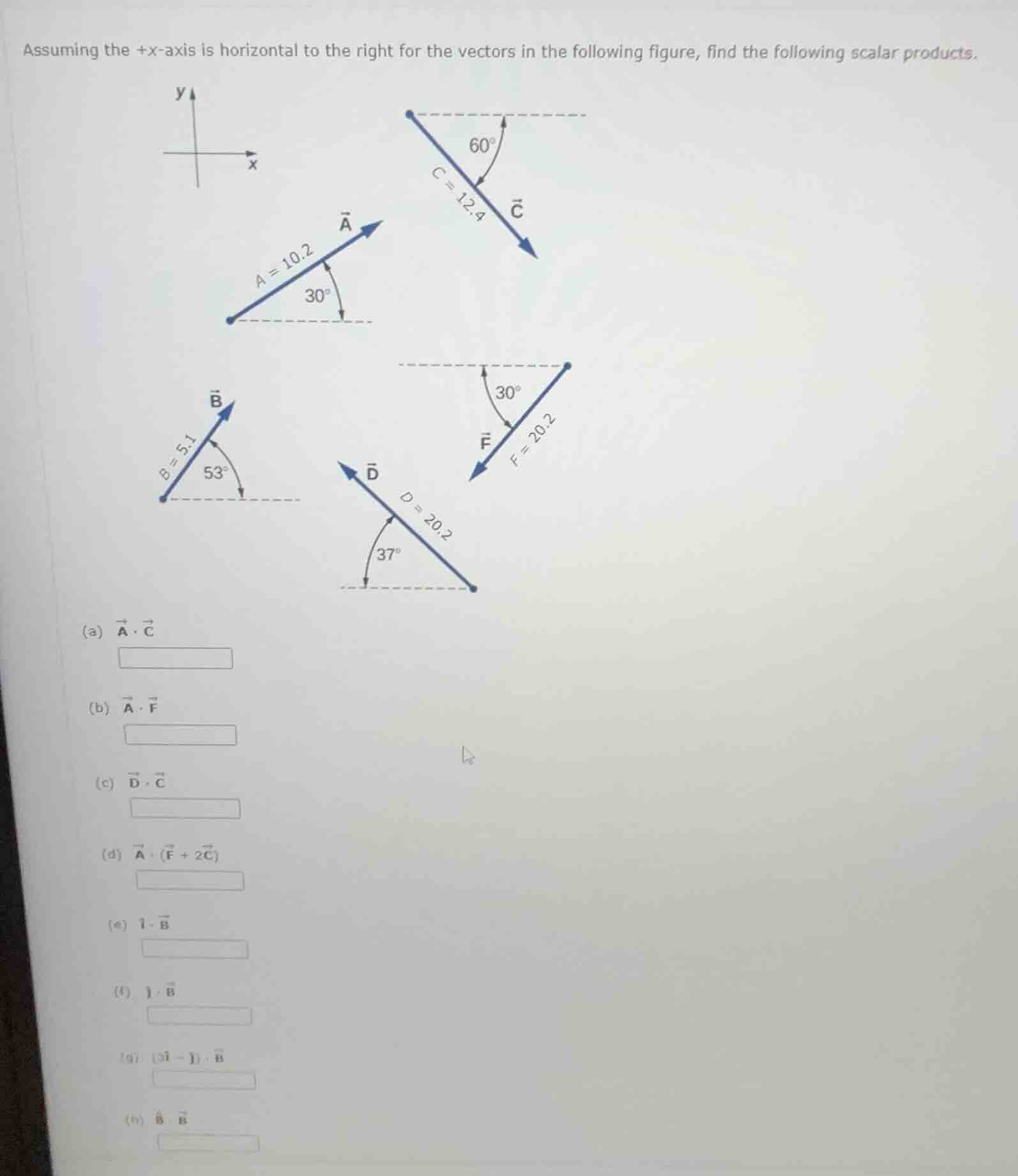
Question
assuming the +x-axis is horizontal to the right for the vectors in the following figure, find the following scalar products.
(a) \\(\vec{a} \cdot \vec{c}\\)
(b) \\(\vec{a} \cdot \vec{f}\\)
(c) \\(\vec{d} \cdot \vec{c}\\)
(d) \\(\vec{a} \cdot (\vec{f} + 2\vec{c})\\)
(e) \\(\hat{i} \cdot \vec{b}\\)
(f) \\(\hat{j} \cdot \vec{b}\\)
(g) \\((3\hat{i} - \hat{j}) \cdot \vec{b}\\)
(h) \\(\hat{b} \cdot \vec{b}\\)
The scalar (dot) product formula is $\vec{U} \cdot \vec{V} = |U||V|\cos\theta$, where $\theta$ is the angle between the two vectors when placed tail-to-tail. For unit vectors: $\hat{i} \cdot \vec{V} = |V|\cos\theta_x$ (x-component of $\vec{V}$), $\hat{j} \cdot \vec{V} = |V|\cos\theta_y$ (y-component of $\vec{V}$).
---
(a) $\vec{A} \cdot \vec{C}$
Step1: Find angle between $\vec{A},\vec{C}$
$\theta = 30^\circ + 60^\circ = 90^\circ$
Step2: Apply dot product formula
$\vec{A} \cdot \vec{C} = 10.2 \times 12.4 \times \cos(90^\circ)$
$\cos(90^\circ)=0$, so $\vec{A} \cdot \vec{C} = 10.2 \times 12.4 \times 0 = 0$
---
(b) $\vec{A} \cdot \vec{F}$
Step1: Find angle between $\vec{A},\vec{F}$
$\theta = 30^\circ + 30^\circ = 180^\circ$
Step2: Apply dot product formula
$\vec{A} \cdot \vec{F} = 10.2 \times 20.2 \times \cos(180^\circ)$
$\cos(180^\circ)=-1$, so $\vec{A} \cdot \vec{F} = 10.2 \times 20.2 \times (-1) = -206.04$
---
(c) $\vec{D} \cdot \vec{C}$
Step1: Find angle between $\vec{D},\vec{C}$
$\theta = 180^\circ - 60^\circ - 37^\circ = 83^\circ$
Step2: Apply dot product formula
$\vec{D} \cdot \vec{C} = 20.2 \times 12.4 \times \cos(83^\circ)$
$\cos(83^\circ)\approx0.1219$, so $\vec{D} \cdot \vec{C} \approx 20.2 \times 12.4 \times 0.1219 \approx 30.7$
---
(d) $\vec{A} \cdot (\vec{F} + 2\vec{C})$
Step1: Use distributive property
$\vec{A} \cdot (\vec{F} + 2\vec{C}) = \vec{A} \cdot \vec{F} + 2(\vec{A} \cdot \vec{C})$
Step2: Substitute known values
From (a): $\vec{A} \cdot \vec{C}=0$; From (b): $\vec{A} \cdot \vec{F}=-206.04$
$\vec{A} \cdot (\vec{F} + 2\vec{C}) = -206.04 + 2(0) = -206.04$
---
(e) $\hat{i} \cdot \vec{B}$
Step1: Find x-component of $\vec{B}$
$\hat{i} \cdot \vec{B} = |B|\cos(53^\circ)$
Step2: Calculate value
$\cos(53^\circ)\approx0.6$, so $\hat{i} \cdot \vec{B} \approx 5.1 \times 0.6 = 3.06$
---
(f) $\hat{j} \cdot \vec{B}$
Step1: Find y-component of $\vec{B}$
$\hat{j} \cdot \vec{B} = |B|\sin(53^\circ)$
Step2: Calculate value
$\sin(53^\circ)\approx0.8$, so $\hat{j} \cdot \vec{B} \approx 5.1 \times 0.8 = 4.08$
---
(g) $(3\hat{i} - \hat{j}) \cdot \vec{B}$
Step1: Use distributive property
$(3\hat{i} - \hat{j}) \cdot \vec{B} = 3(\hat{i} \cdot \vec{B}) - (\hat{j} \cdot \vec{B})$
Step2: Substitute known values
From (e): $\hat{i} \cdot \vec{B}=3.06$; From (f): $\hat{j} \cdot \vec{B}=4.08$
$(3\hat{i} - \hat{j}) \cdot \vec{B} = 3(3.06) - 4.08 = 9.18 - 4.08 = 5.1$
---
(h) $\vec{B} \cdot \vec{B}$
Step1: Apply dot product formula
$\vec{B} \cdot \vec{B} = |B|^2$
Step2: Calculate value
$\vec{B} \cdot \vec{B} = (5.1)^2 = 26.01$

Snap & solve any problem in the app
Get step-by-step solutions on Sovi AI
Photo-based solutions with guided steps
Explore more problems and detailed explanations
(a) $0$
(b) $-206.04$
(c) $\approx 30.7$
(d) $-206.04$
(e) $\approx 3.06$
(f) $\approx 4.08$
(g) $5.1$
(h) $26.01$