QUESTION IMAGE
Question
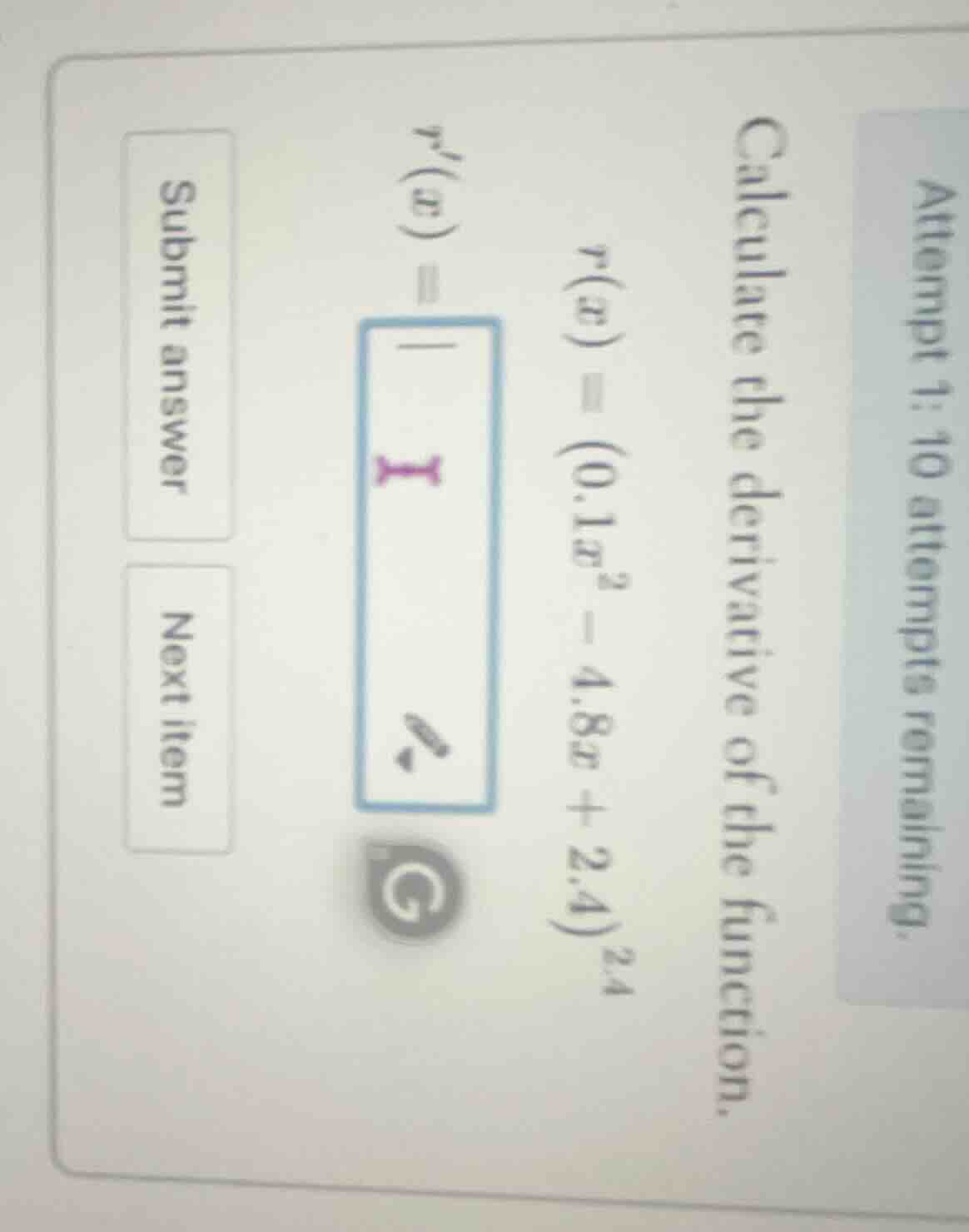
attempt 1: 10 attempts remaining. calculate the derivative of the function. r(x) = (0.1x² - 4.8x + 2.4)^2.4 r(x) = | i submit answer next item
Step1: Identify the function type
The function \( r(x) = (0.1x^2 - 4.8x + 2.4)^{2.4} \) is a composite function, so we use the chain rule. The chain rule states that if \( y = u^n \) where \( u \) is a function of \( x \), then \( y' = n \cdot u^{n - 1} \cdot u' \). Here, \( u = 0.1x^2 - 4.8x + 2.4 \) and \( n = 2.4 \).
Step2: Find the derivative of the outer function
First, differentiate the outer function with respect to \( u \). If \( y = u^{2.4} \), then \( \frac{dy}{du} = 2.4u^{2.4 - 1} = 2.4u^{1.4} \).
Step3: Find the derivative of the inner function
Next, differentiate the inner function \( u = 0.1x^2 - 4.8x + 2.4 \) with respect to \( x \). Using the power rule, \( \frac{du}{dx} = 0.1 \cdot 2x - 4.8 + 0 = 0.2x - 4.8 \).
Step4: Apply the chain rule
Now, apply the chain rule \( r'(x) = \frac{dy}{du} \cdot \frac{du}{dx} \). Substitute \( u = 0.1x^2 - 4.8x + 2.4 \), \( \frac{dy}{du} = 2.4u^{1.4} \), and \( \frac{du}{dx} = 0.2x - 4.8 \) into the chain rule formula:
\( r'(x) = 2.4(0.1x^2 - 4.8x + 2.4)^{1.4} \cdot (0.2x - 4.8) \)
We can also factor out the 0.2 from the second term: \( 0.2x - 4.8 = 0.2(x - 24) \), and 2.4 * 0.2 = 0.48, so:
\( r'(x) = 0.48(0.1x^2 - 4.8x + 2.4)^{1.4}(x - 24) \)
Or we can just leave it as \( 2.4(0.2x - 4.8)(0.1x^2 - 4.8x + 2.4)^{1.4} \). Let's simplify the coefficients: 2.4 0.2 = 0.48 and 2.4 (-4.8) = -11.52, but maybe it's better to present it as:
First, calculate 2.4(0.2x - 4.8): 2.40.2x = 0.48x and 2.4*(-4.8) = -11.52. So:
\( r'(x) = (0.48x - 11.52)(0.1x^2 - 4.8x + 2.4)^{1.4} \)
We can also factor out 0.48 from the first term: 0.48(x - 24), so:
\( r'(x) = 0.48(x - 24)(0.1x^2 - 4.8x + 2.4)^{1.4} \)
Alternatively, we can write the derivative as:
\( r'(x) = 2.4(0.1x^2 - 4.8x + 2.4)^{1.4}(0.2x - 4.8) \)
Let's check the arithmetic again. The derivative of \( 0.1x^2 \) is \( 0.2x \), derivative of -4.8x is -4.8, derivative of 2.4 is 0. So \( u' = 0.2x - 4.8 \). Then multiplying by 2.4: 2.4(0.2x - 4.8) = 0.48x - 11.52. So the derivative is \( (0.48x - 11.52)(0.1x^2 - 4.8x + 2.4)^{1.4} \). We can also factor 0.48 from the first factor: 0.48(x - 24), since -11.52 / 0.48 = -24? Wait, no: 0.48x - 11.52 = 0.48(x - 24) because 0.4824 = 11.52. Yes, that's correct. So:
\( r'(x) = 0.48(x - 24)(0.1x^2 - 4.8x + 2.4)^{1.4} \)
Or we can write it as \( 2.4(0.2x - 4.8)(0.1x^2 - 4.8x + 2.4)^{1.4} \). Either form is correct, but let's compute the numerical coefficients properly.
First, 2.4 0.2x = 0.48x, 2.4 (-4.8) = -11.52. So:
\( r'(x) = (0.48x - 11.52)(0.1x^2 - 4.8x + 2.4)^{1.4} \)
We can also factor out 0.48:
\( r'(x) = 0.48(x - 24)(0.1x^2 - 4.8x + 2.4)^{1.4} \)
Yes, because 0.48x / 0.48 = x and -11.52 / 0.48 = -24, so that's correct.

Snap & solve any problem in the app
Get step-by-step solutions on Sovi AI
Photo-based solutions with guided steps
Explore more problems and detailed explanations
\( r'(x) = 2.4(0.2x - 4.8)(0.1x^2 - 4.8x + 2.4)^{1.4} \) (or equivalent simplified forms like \( 0.48(x - 24)(0.1x^2 - 4.8x + 2.4)^{1.4} \))