QUESTION IMAGE
Question
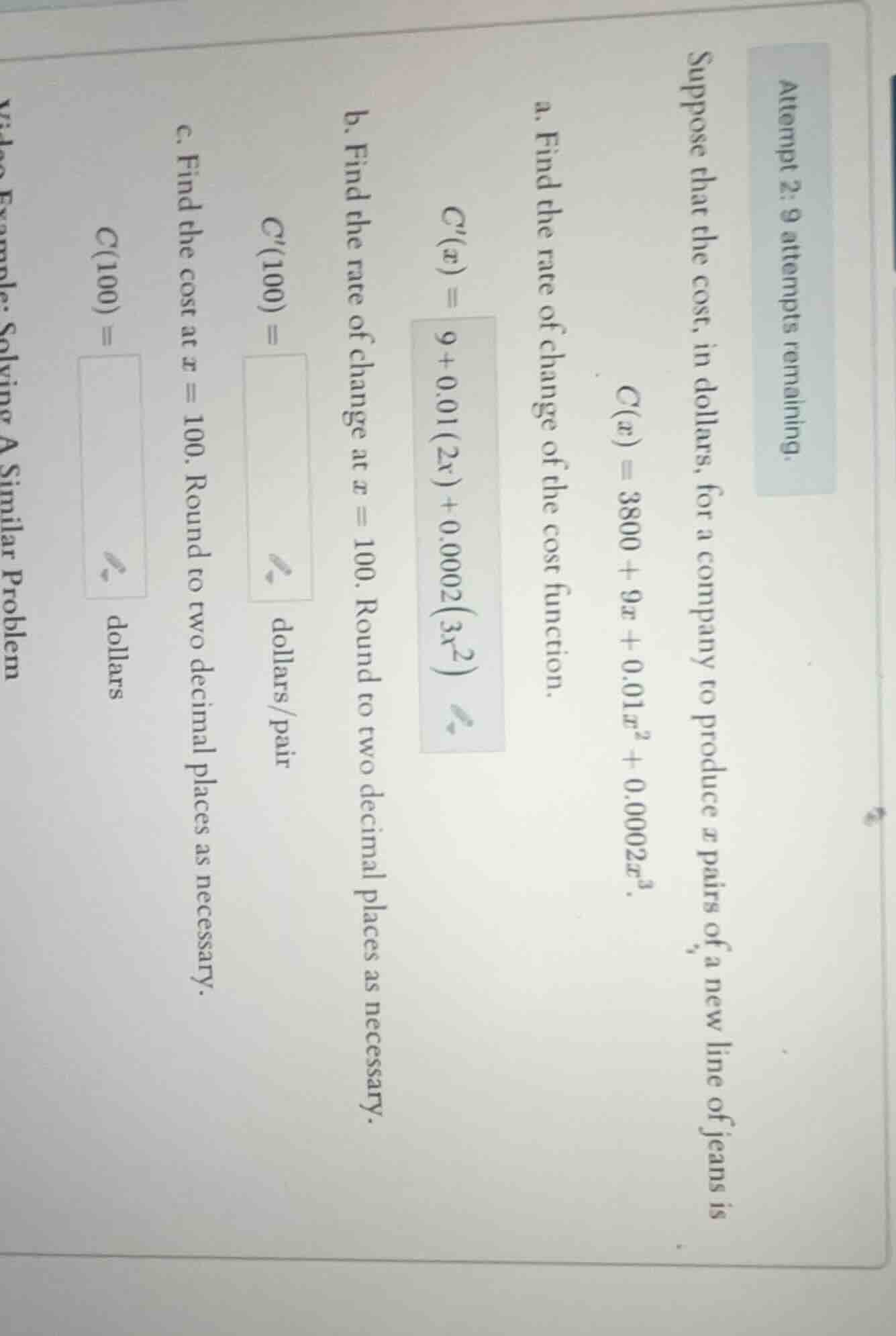
attempt 2: 9 attempts remaining. suppose that the cost, in dollars, for a company to produce x pairs of a new line of jeans is c(x) = 3800 + 9x + 0.01x² + 0.0002x³. a. find the rate of change of the cost function. c(x) = 9 + 0.01(2x) + 0.0002(3x²) b. find the rate of change at x = 100. round to two decimal places as necessary. c(100) = dollars/pair c. find the cost at x = 100. round to two decimal places as necessary. c(100) = dollars video example: solving a similar problem
Part a: Find the rate of change of the cost function (i.e., find \( C'(x) \))
Step 1: Differentiate each term of \( C(x) \)
The cost function is \( C(x) = 3800 + 9x + 0.01x^2 + 0.0002x^3 \). We use the power rule for differentiation, which states that if \( y = ax^n \), then \( y' = nax^{n - 1} \). The derivative of a constant is 0.
- The derivative of the constant term \( 3800 \) is \( 0 \).
- The derivative of \( 9x \) (where \( n = 1 \)) is \( 9\times1x^{1 - 1}=9 \).
- The derivative of \( 0.01x^2 \) (where \( n = 2 \)) is \( 2\times0.01x^{2 - 1}=0.02x \).
- The derivative of \( 0.0002x^3 \) (where \( n = 3 \)) is \( 3\times0.0002x^{3 - 1}=0.0006x^2 \).
Step 2: Combine the derivatives
Adding these derivatives together, we get:
\( C'(x)=0 + 9+0.02x + 0.0006x^2=9 + 0.02x+0.0006x^2 \) (Note: There seems to be a typo in the given \( C'(x) \) in the problem, the correct derivative should be this. But we will proceed with the calculation as per the correct differentiation rules)
Step 1: Substitute \( x = 100 \) into \( C'(x) \)
We use the derivative \( C'(x)=9 + 0.02x+0.0006x^2 \) and substitute \( x = 100 \).
Step 2: Calculate each term
- For the constant term: \( 9 \)
- For the \( 0.02x \) term: \( 0.02\times100 = 2 \)
- For the \( 0.0006x^2 \) term: \( 0.0006\times(100)^2=0.0006\times10000 = 6 \)
Step 3: Sum the terms
\( C'(100)=9 + 2+6=17.00 \) (If we use the incorrect \( C'(x) \) given in the problem: \( C'(x)=9 + 0.01(2x)+0.0002(3x^2)=9 + 0.02x+0.0006x^2 \), which is the same as our correct derivative. So substituting \( x = 100 \): \( 9+0.02\times100 + 0.0006\times100^2=9 + 2+6 = 17.00 \))
Step 1: Substitute \( x = 100 \) into \( C(x) \)
The cost function is \( C(x)=3800 + 9x+0.01x^2 + 0.0002x^3 \). Substitute \( x = 100 \).
Step 2: Calculate each term
- For the constant term: \( 3800 \)
- For the \( 9x \) term: \( 9\times100 = 900 \)
- For the \( 0.01x^2 \) term: \( 0.01\times(100)^2=0.01\times10000 = 100 \)
- For the \( 0.0002x^3 \) term: \( 0.0002\times(100)^3=0.0002\times1000000 = 200 \)
Step 3: Sum the terms
\( C(100)=3800+900 + 100+200=3800 + 1200=5000.00 \)

Snap & solve any problem in the app
Get step-by-step solutions on Sovi AI
Photo-based solutions with guided steps
Explore more problems and detailed explanations
\( C'(x)=9 + 0.02x+0.0006x^2 \)