QUESTION IMAGE
Question
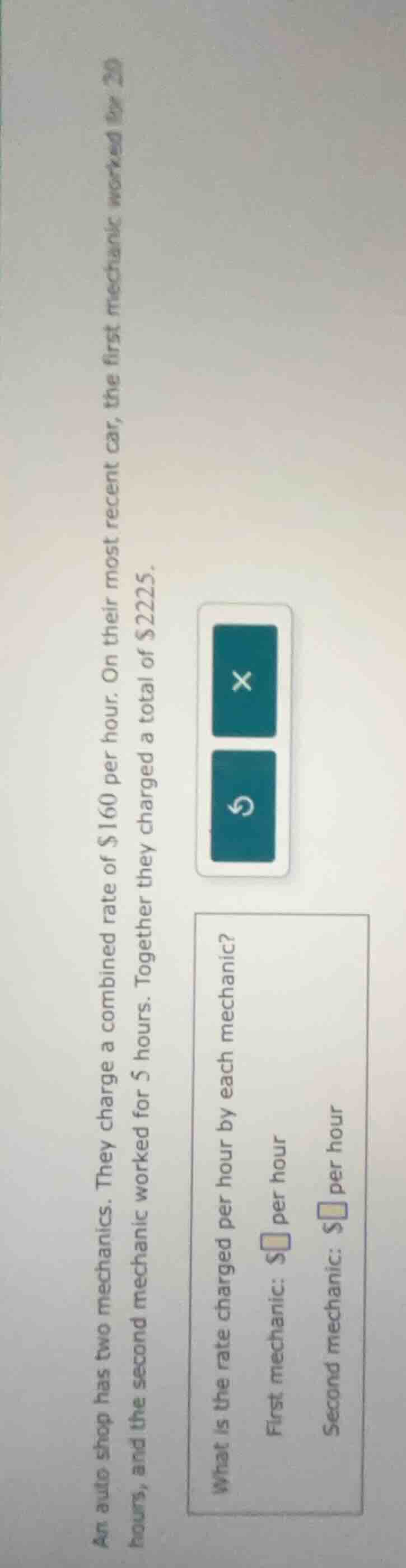
an auto shop has two mechanics. they charge a combined rate of $160 per hour. on their most recent car, the first mechanic worked for 20 hours, and the second mechanic worked for 5 hours. together they charged a total of $2225. what is the rate charged per hour by each mechanic? first mechanic: $\square$ per hour second mechanic: $\square$ per hour
Step1: Find total hours worked
First mechanic worked 20 hours, second worked 5 hours. Total hours: \(20 + 5 = 25\) hours.
Step2: Find combined rate per hour
Total charge is $2225 for 25 hours. Combined rate: LXI0? Wait, no, wait. Wait, the problem says "combined rate of $160 per hour"? Wait, no, re - read. Wait, maybe I misread. Wait, the problem: "They charge a combined rate of $160 per hour." Wait, no, maybe the original problem: Let's re - parse.
Wait, correct parsing: Two mechanics. Let first mechanic's rate be \(r_1\), second be \(r_2\). Combined rate \(r_1 + r_2=160\) (per hour). First worked 20 hours, second 5 hours. Total charge: \(20r_1+5r_2 = 2225\).
Now, from \(r_1 + r_2=160\), we get \(r_2 = 160 - r_1\). Substitute into total charge equation:
\(20r_1+5(160 - r_1)=2225\)
Step3: Solve for \(r_1\)
Expand: \(20r_1+800 - 5r_1=2225\)
Simplify: \(15r_1+800 = 2225\)
Subtract 800: \(15r_1=2225 - 800=1425\)
Divide by 15: \(r_1=\frac{1425}{15}=95\)? Wait, no, that can't be. Wait, maybe the combined rate is not 160. Wait, the original text: "They charge a combined rate of $160 per hour." Wait, maybe I misread the hours. Wait, "the first mechanic worked 20 hours, and the second mechanic worked for 5 hours. Together they charged a total of $2225."
Wait, let's start over. Let \(r_1\) be first mechanic's rate (per hour), \(r_2\) be second's.
Total charge = (first's hours \(r_1\)) + (second's hours \(r_2\)) = \(20r_1+5r_2 = 2225\)
We need another equation. Wait, maybe the "combined rate of $160 per hour" is \(r_1 + r_2=160\).
So we have a system:
- \(r_1 + r_2=160\)
- \(20r_1+5r_2 = 2225\)
From equation 1: \(r_2 = 160 - r_1\). Substitute into equation 2:
\(20r_1+5(160 - r_1)=2225\)
\(20r_1 + 800-5r_1=2225\)
\(15r_1=2225 - 800 = 1425\)
\(r_1=\frac{1425}{15}=95\). Then \(r_2=160 - 95 = 65\). Wait, but that seems low. Wait, maybe the combined rate is not 160. Wait, maybe the problem was miswritten. Wait, the user's image: "An auto shop has two mechanics. They charge a combined rate of $160 per hour. On their most recent car, the first mechanic worked 20 hours, and the second mechanic worked for 5 hours. Together they charged a total of $2225. What is the rate charged per hour by each mechanic? First mechanic: $[] per hour. Second mechanic: $[] per hour."
Wait, let's check the calculation again. \(20r_1+5r_2 = 2225\), and \(r_1 + r_2=160\) => \(r_2 = 160 - r_1\).
Substitute: \(20r_1+5(160 - r_1)=20r_1 + 800-5r_1=15r_1 + 800 = 2225\)
\(15r_1=2225 - 800 = 1425\)
\(r_1 = 1425/15 = 95\). Then \(r_2=160 - 95 = 65\). Let's verify: \(20*95 + 5*65=1900+325 = 2225\). Yes, that works.
Wait, but the user's initial problem may have a typo, but according to the numbers, first mechanic: $95, second: $65. But wait, the user's image shows "combined rate of $160 per hour" – maybe that's a mistake, but according to the total charge and hours, this is the solution.
Wait, maybe I misread the combined rate. Wait, maybe the combined rate is not 160. Wait, the problem says "They charge a combined rate of $160 per hour" – maybe that's the sum of their hourly rates. So the calculation is correct.

Snap & solve any problem in the app
Get step-by-step solutions on Sovi AI
Photo-based solutions with guided steps
Explore more problems and detailed explanations
First mechanic: $95 per hour. Second mechanic: $65 per hour.