QUESTION IMAGE
Question
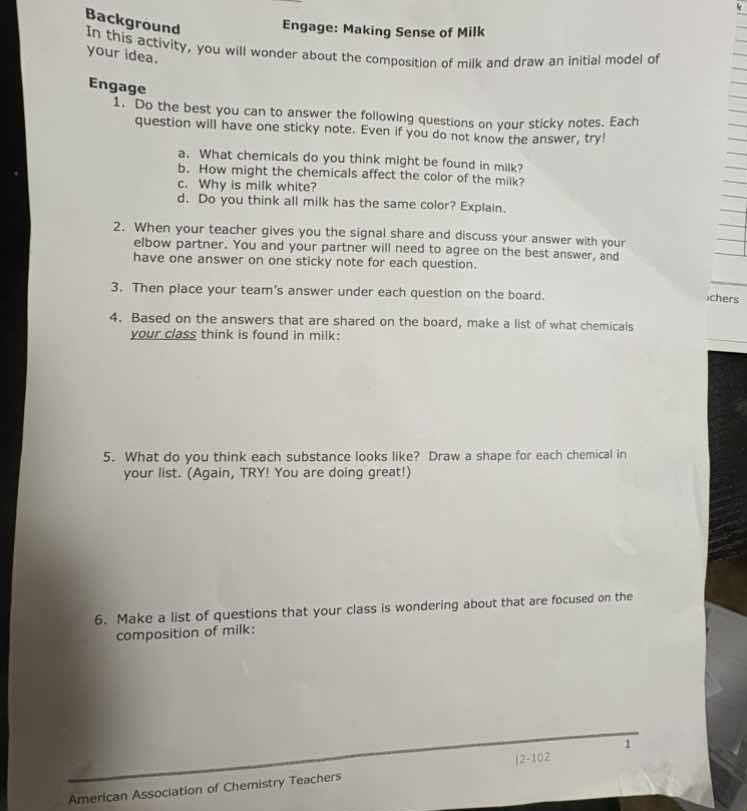
background engage: making sense of milk in this activity, you will wonder about the composition of milk and draw an initial model of your idea. engage 1. do the best you can to answer the following questions on your sticky notes. each question will have one sticky note. even if you do not know the answer, try! a. what chemicals do you think might be found in milk? b. how might the chemicals affect the color of the milk? c. why is milk white? d. do you think all milk has the same color? explain. 2. when your teacher gives you the signal share and discuss your answer with your elbow partner. you and your partner will need to agree on the best answer, and have one answer on one sticky note for each question. 3. then place your team’s answer under each question on the board. 4. based on the answers that are shared on the board, make a list of what chemicals your class think is found in milk: 5. what do you think each substance looks like? draw a shape for each chemical in your list. (again, try! you are doing great!) 6. make a list of questions that your class is wondering about that are focused on the composition of milk: american association of chemistry teachers |2-102 1
This is an introductory chemistry activity to explore milk's composition. Below are evidence-based answers for the core questions, plus guidance for the collaborative tasks:
- For question 1a: Milk contains water, lactose (sugar), fats, proteins (casein, whey), minerals (calcium, phosphorus), and vitamins (vitamin D, B12).
1b: White color comes from casein proteins and fat globules scattering light evenly across visible wavelengths.
1c: The light-scattering effect of suspended particles (proteins, fats) makes milk white; these particles do not absorb specific visible light wavelengths, so all light is scattered back as white.
1d: Most cow's milk is off-white/white, but milk from other animals (e.g., goat's milk is whiter, camel's milk is creamy white) or processed milk (e.g., skim milk is paler, chocolate milk is brown) can differ due to varying fat/protein content or added substances.
- For collaborative tasks (steps 2-6): Work with peers to share ideas, compile a class list of suspected chemicals, draw simple shapes (e.g., circles for fat globules, chains for proteins), and brainstorm questions like "How can we test for lactose in milk?" or "Why does skim milk look paler than whole milk?".

Snap & solve any problem in the app
Get step-by-step solutions on Sovi AI
Photo-based solutions with guided steps
Explore more problems and detailed explanations
- a. Water, lactose, fats, casein, calcium, vitamins
b. Scattered light from proteins/fat globules
c. Particles scatter all visible light wavelengths
d. No; varies by animal/processing (e.g., skim milk is paler, goat milk is whiter)
- (Collaborative task: Discuss with a partner to agree on shared answers)
- (Collaborative task: Post team answers on the board)
- (Collaborative task: Compile class-wide list of suspected milk chemicals)
- (Collaborative task: Draw simple shapes, e.g., circles for fat globules, linked ovals for protein chains)
- (Collaborative task: Example class questions: "How do we test for milk proteins?", "Why does sour milk change color?", "What makes organic milk different in composition?")