QUESTION IMAGE
Question
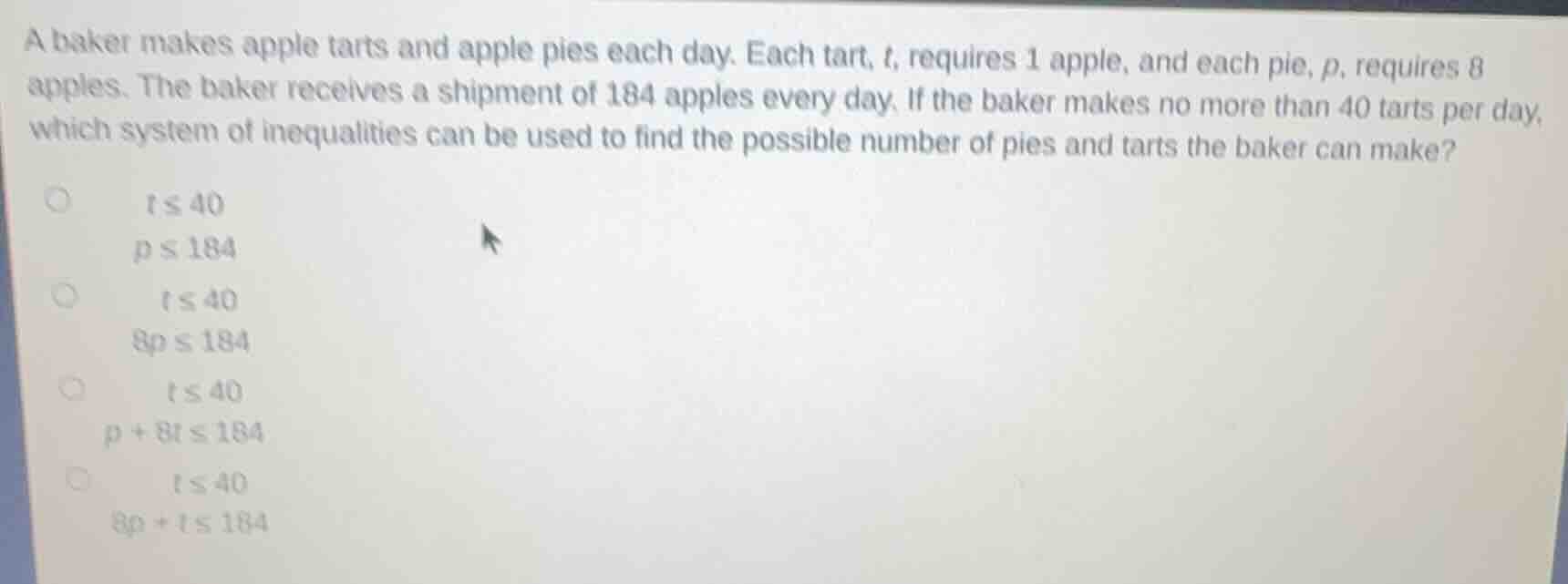
a baker makes apple tarts and apple pies each day. each tart, t, requires 1 apple, and each pie, p, requires 8 apples. the baker receives a shipment of 184 apples every day. if the baker makes no more than 40 tarts per day, which system of inequalities can be used to find the possible number of pies and tarts the baker can make?
t ≤ 40
p ≤ 184
t ≤ 40
8p ≤ 184
t ≤ 40
p + 8t ≤ 184
t ≤ 40
8p + t ≤ 184
Step1: Analyze tart inequality
The baker makes no more than 40 tarts, so \( t \leq 40 \).
Step2: Analyze apple usage inequality
Each tart (\( t \)) needs 1 apple, each pie (\( p \)) needs 8 apples. Total apples used (\( t + 8p \)) must be ≤ 184 (since 184 apples are received daily). So \( t + 8p \leq 184 \)? Wait, no—wait, tart uses 1 apple, so tarts use \( t\times1 = t \) apples, pies use \( p\times8 = 8p \) apples. So total apples: \( t + 8p \leq 184 \)? Wait, no, wait the last option is \( 8p + t \leq 184 \), which is same as \( t + 8p \leq 184 \). Wait, let's recheck:
Wait, each tart (t) needs 1 apple: so apples for tarts: \( t \times 1 = t \). Each pie (p) needs 8 apples: apples for pies: \( p \times 8 = 8p \). Total apples used: \( t + 8p \). This must be ≤ 184 (since they can't use more than 184 apples). And t ≤ 40. So the system is \( t \leq 40 \) and \( t + 8p \leq 184 \)? Wait, no, the last option is \( 8p + t \leq 184 \), which is the same as \( t + 8p \leq 184 \). Wait, let's check the options:
Option 1: \( t \leq 40 \), \( p \leq 184 \) – wrong, because p is number of pies, not apples.
Option 2: \( t \leq 40 \), \( 8p \leq 184 \) – wrong, because this ignores the apples used by tarts.
Option 3: \( t \leq 40 \), \( p + 8t \leq 184 \) – wrong, because pies use 8 apples each, tarts use 1, so it should be \( t + 8p \), not \( p + 8t \).
Option 4: \( t \leq 40 \), \( 8p + t \leq 184 \) – this is correct. Because tarts use t apples (1 per tart), pies use 8p apples (8 per pie), total ≤ 184. And t ≤ 40.
Wait, maybe I mixed up p and t in the third option. Let's re-express:
Let me re-express each option:
- \( t \leq 40 \); \( p \leq 184 \): p is number of pies, not apples, so wrong.
- \( t \leq 40 \); \( 8p \leq 184 \): this only considers pies' apples, ignores tarts' apples, so wrong.
- \( t \leq 40 \); \( p + 8t \leq 184 \): this would mean pies use p apples (1 per pie) and tarts use 8t apples (8 per tart), which is wrong (tarts use 1 per tart, pies 8 per pie). So this is reversed.
- \( t \leq 40 \); \( 8p + t \leq 184 \): tarts use t apples (1 per tart), pies use 8p apples (8 per pie), total ≤ 184. Correct.
So the correct system is \( t \leq 40 \) and \( 8p + t \leq 184 \), which is the last option.

Snap & solve any problem in the app
Get step-by-step solutions on Sovi AI
Photo-based solutions with guided steps
Explore more problems and detailed explanations
The correct system of inequalities is the last option: \( t \leq 40 \) and \( 8p + t \leq 184 \), so the answer is the option with \( t \leq 40 \) and \( 8p + t \leq 184 \) (the fourth option in the list, assuming the options are ordered as shown: the last radio button option).