QUESTION IMAGE
Question
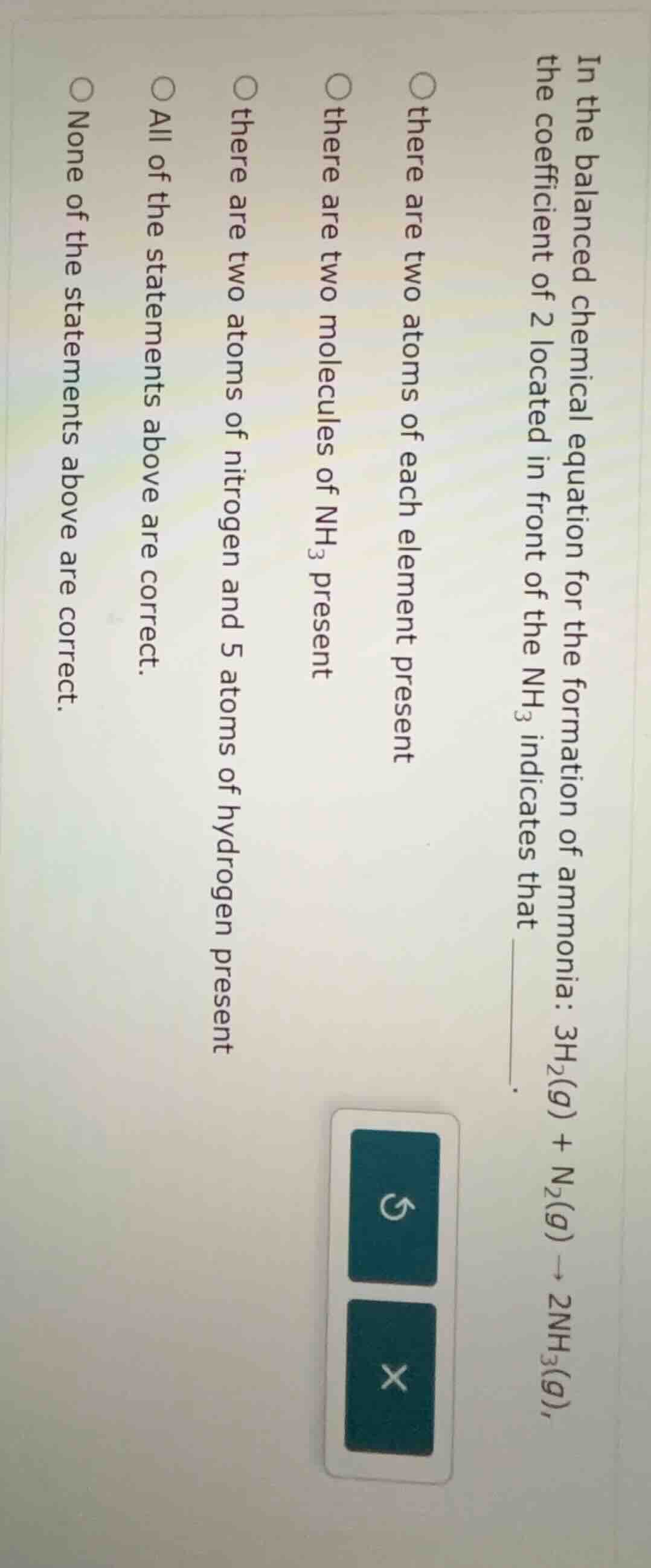
in the balanced chemical equation for the formation of ammonia: 3h₂(g) + n₂(g) → 2nh₃(g), the coefficient of 2 located in front of the nh₃ indicates that ______. there are two atoms of each element present there are two molecules of nh₃ present there are two atoms of nitrogen and 5 atoms of hydrogen present all of the statements above are correct. none of the statements above are correct.
Brief Explanations
- Analyze the first option: The coefficient 2 in front of \(NH_3\) means 2 molecules of \(NH_3\). In each \(NH_3\) molecule, there is 1 N atom and 3 H atoms. So for 2 \(NH_3\) molecules, N atoms: \(2\times1 = 2\), H atoms: \(2\times3=6\). The reactants have \(3H_2\) (6 H atoms) and \(N_2\) (2 N atoms). So the number of each element's atoms is conserved (2 N, 6 H), but the option says "two atoms of each element" which is wrong (H has 6 atoms).
- Analyze the second option: The coefficient 2 in front of \(NH_3\) does mean there are 2 molecules of \(NH_3\) present. This is correct.
- Analyze the third option: For 2 \(NH_3\) molecules, N atoms: \(2\times1 = 2\), H atoms: \(2\times3 = 6\), not 5. So this is wrong.
- Since the second option is correct, "All of the statements..." is wrong. "None of the statements..." is also wrong. So the correct option is the one saying "there are two molecules of \(NH_3\) present".

Snap & solve any problem in the app
Get step-by-step solutions on Sovi AI
Photo-based solutions with guided steps
Explore more problems and detailed explanations
the option "there are two molecules of \(NH_3\) present" (the second option in the list)