QUESTION IMAGE
Question
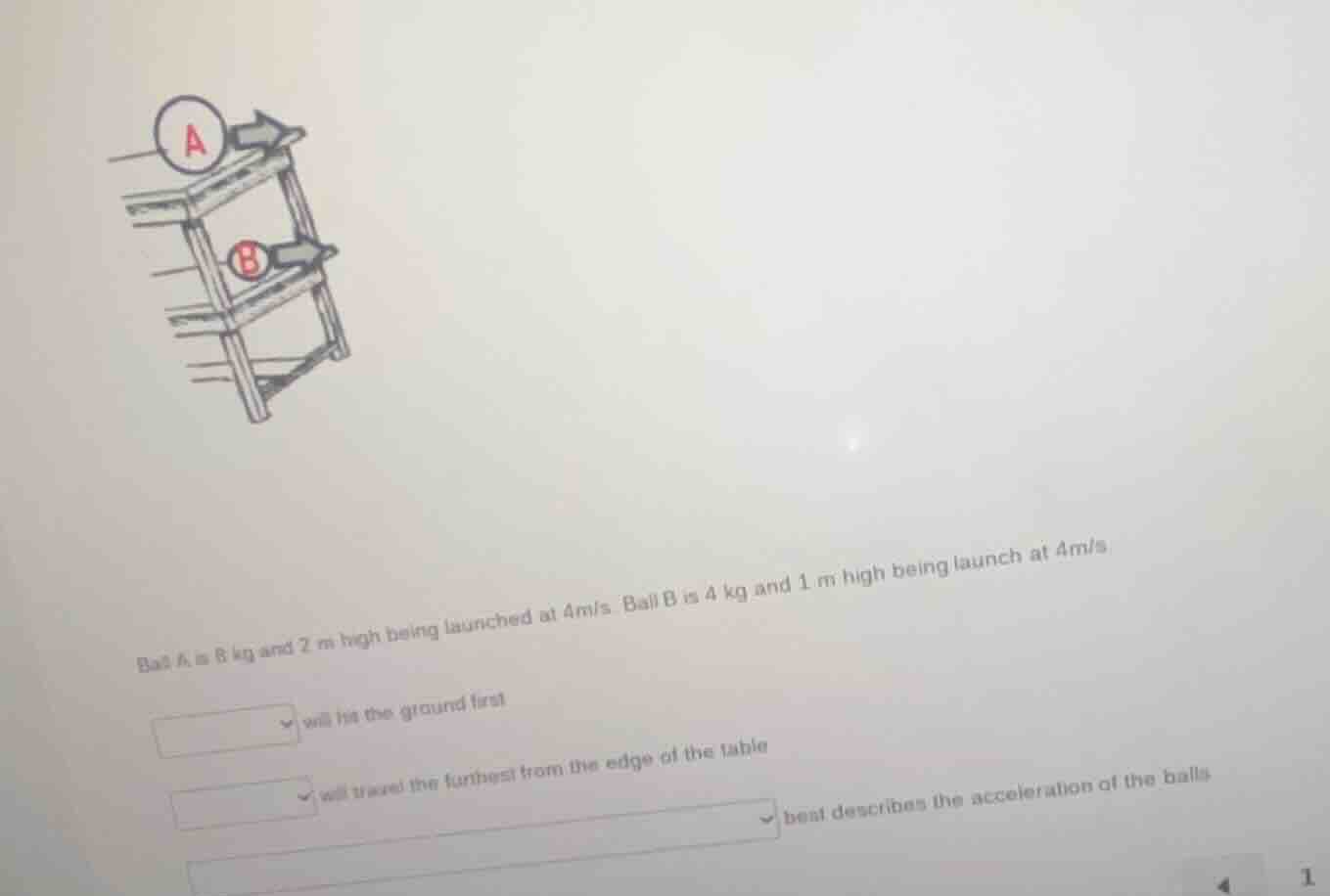
ball a is 8 kg and 2 m high being launched at 4m/s. ball b is 4 kg and 1 m high being launch at 4m/s
will hit the ground first
will travel the furthest from the edge of the table
best describes the acceleration of the balls
Step1: Analyze time to hit ground
For projectile motion, vertical motion determines fall time. Use $h = \frac{1}{2}gt^2$, so $t = \sqrt{\frac{2h}{g}}$.
- Ball A: $t_A = \sqrt{\frac{2\times2}{9.8}} \approx 0.64\ \text{s}$
- Ball B: $t_B = \sqrt{\frac{2\times1}{9.8}} \approx 0.45\ \text{s}$
Step2: Analyze horizontal distance
Horizontal distance $d = v_0 t$, where $v_0=4\ \text{m/s}$ for both.
- Ball A: $d_A = 4\times0.64 \approx 2.56\ \text{m}$
- Ball B: $d_B = 4\times0.45 \approx 1.80\ \text{m}$
Step3: Analyze acceleration
Both balls experience only gravitational acceleration $g=9.8\ \text{m/s}^2$ downward; horizontal acceleration is 0. Mass does not affect acceleration in free fall.

Snap & solve any problem in the app
Get step-by-step solutions on Sovi AI
Photo-based solutions with guided steps
Explore more problems and detailed explanations
- Ball B will hit the ground first
- Ball A will travel the furthest from the edge of the table
- Both balls have a downward acceleration of $9.8\ \text{m/s}^2$ (no horizontal acceleration) best describes the acceleration of the balls