QUESTION IMAGE
Question
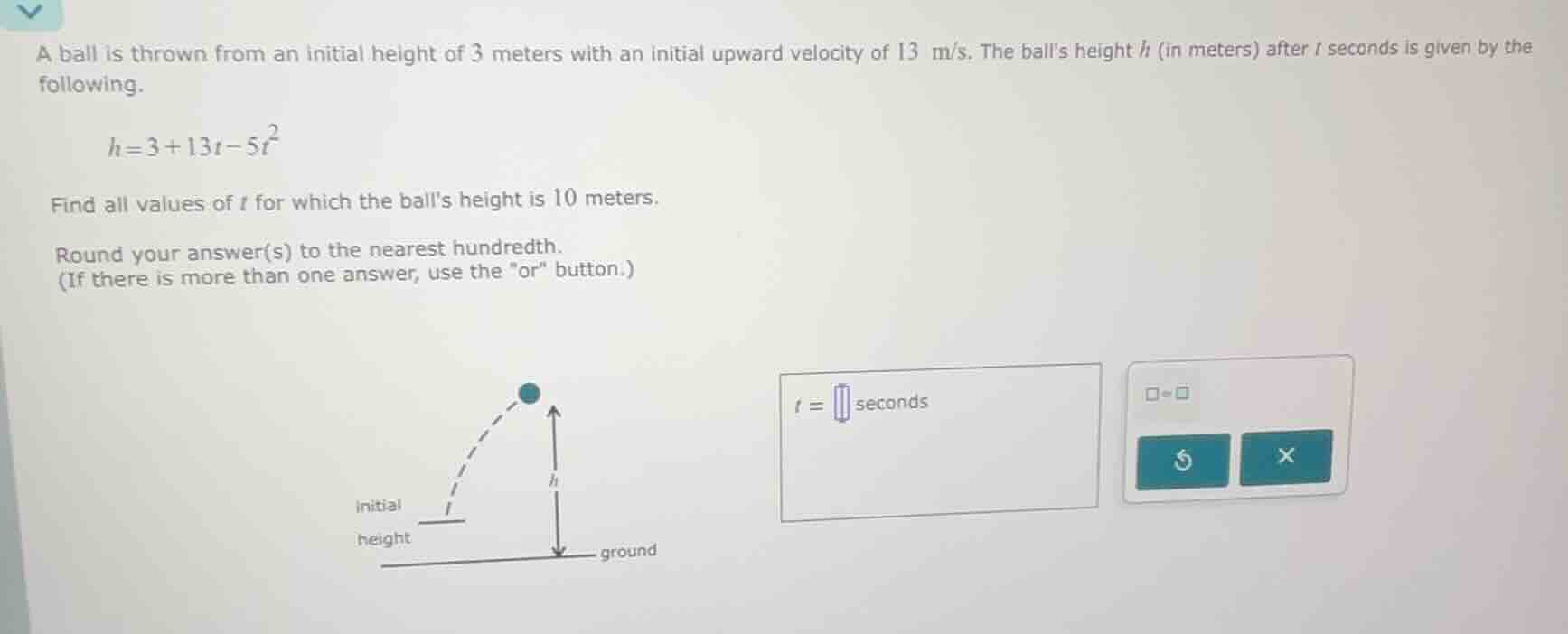
a ball is thrown from an initial height of 3 meters with an initial upward velocity of 13 m/s. the balls height h (in meters) after t seconds is given by the following.
h = 3 + 13t - 5t²
find all values of t for which the balls height is 10 meters.
round your answer(s) to the nearest hundredth.
(if there is more than one answer, use the \or\ button.)
Step1: Set up the equation
We know that \( h = 10 \), so substitute \( h \) into the given formula \( h = 3 + 13t - 5t^2 \). We get the equation:
\[
10 = 3 + 13t - 5t^2
\]
Step2: Rearrange the equation to standard quadratic form
Subtract 10 from both sides to set the equation to zero:
\[
0 = 3 + 13t - 5t^2 - 10
\]
Simplify the right - hand side:
\[
5t^2 - 13t + 7 = 0
\]
The quadratic formula for a quadratic equation \( ax^2+bx + c = 0 \) is \( t=\frac{-b\pm\sqrt{b^2 - 4ac}}{2a} \). For the equation \( 5t^2-13t + 7 = 0 \), we have \( a = 5 \), \( b=- 13 \), and \( c = 7 \).
Step3: Calculate the discriminant
First, calculate the discriminant \( D=b^2 - 4ac \). Substitute \( a = 5 \), \( b=-13 \), and \( c = 7 \) into the discriminant formula:
\[
D=(-13)^2-4\times5\times7=169 - 140 = 29
\]
Step4: Solve for t using the quadratic formula
Now, substitute \( a = 5 \), \( b=-13 \), and \( D = 29 \) into the quadratic formula:
\[
t=\frac{-(-13)\pm\sqrt{29}}{2\times5}=\frac{13\pm\sqrt{29}}{10}
\]
We know that \( \sqrt{29}\approx5.385 \).
For the plus sign:
\[
t_1=\frac{13 + 5.385}{10}=\frac{18.385}{10}=1.8385\approx1.84
\]
For the minus sign:
\[
t_2=\frac{13 - 5.385}{10}=\frac{7.615}{10}=0.7615\approx0.76
\]

Snap & solve any problem in the app
Get step-by-step solutions on Sovi AI
Photo-based solutions with guided steps
Explore more problems and detailed explanations
\( t = 0.76 \) or \( t = 1.84 \)