QUESTION IMAGE
Question
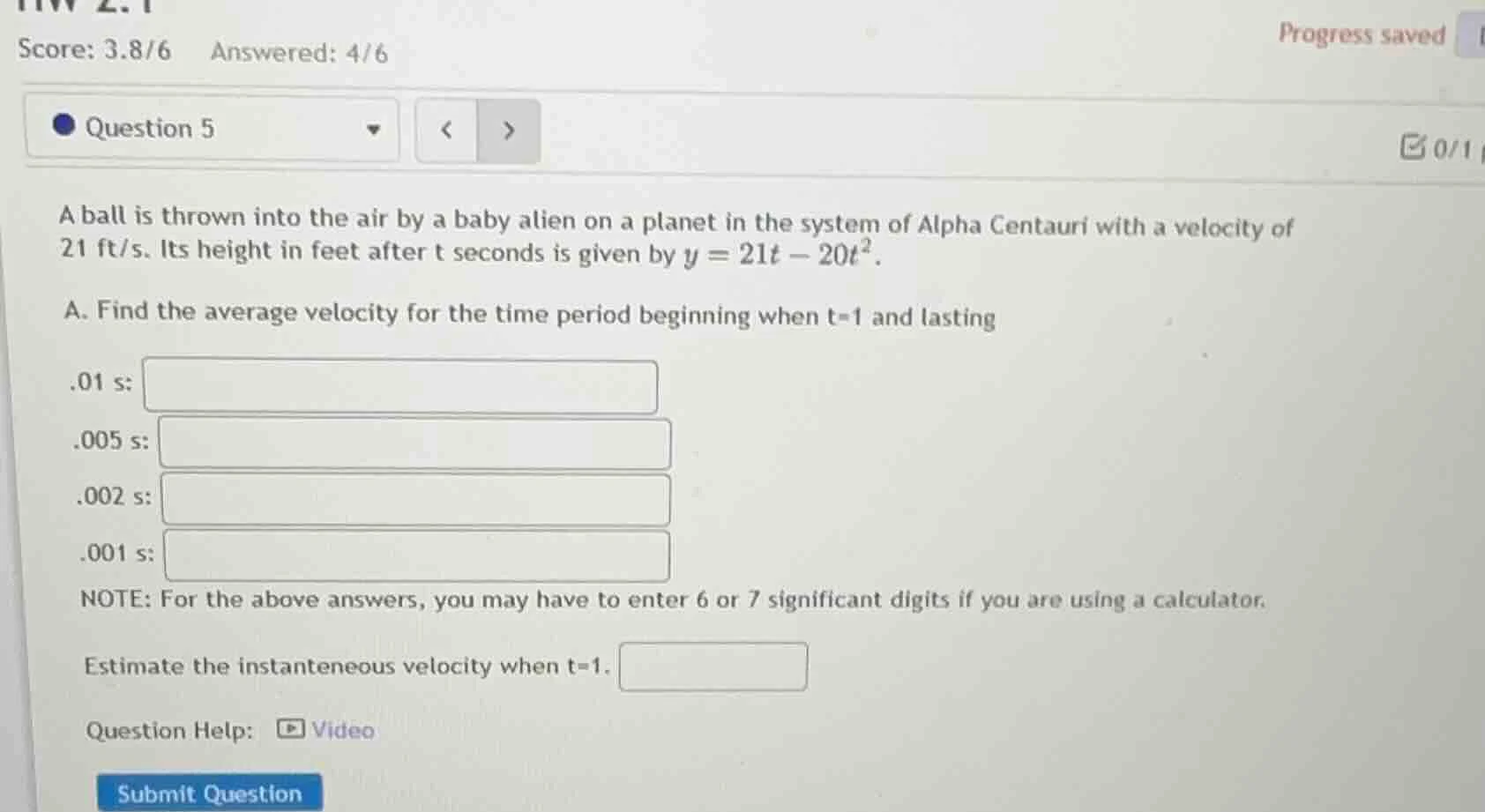
a ball is thrown into the air by a baby alien on a planet in the system of alpha centauri with a velocity of 21 ft/s. its height in feet after t seconds is given by $y = 21t - 20t^2$. a. find the average velocity for the time period beginning when t=1 and lasting.01 s:.005 s:.002 s:.001 s: note: for the above answers, you may have to enter 6 or 7 significant digits if you are using a calculator. estimate the instantaneous velocity when t=1.
Part A: Average Velocity Calculations
The formula for average velocity over the time interval \([t, t + h]\) is \(\frac{y(t + h) - y(t)}{h}\), where \(y(t)=21t - 20t^{2}\) and \(t = 1\).
For \(h = 0.01\):
Step 1: Find \(y(1 + 0.01)\)
First, calculate \(t + h=1 + 0.01 = 1.01\). Then substitute into \(y(t)\):
\(y(1.01)=21(1.01)-20(1.01)^{2}\)
\(=21.21-20(1.0201)\)
\(=21.21 - 20.402\)
\(=0.808\)
Step 2: Find \(y(1)\)
Substitute \(t = 1\) into \(y(t)\):
\(y(1)=21(1)-20(1)^{2}=21 - 20 = 1\)
Step 3: Calculate average velocity
Using the average velocity formula \(\frac{y(1.01)-y(1)}{0.01}\):
\(\frac{0.808 - 1}{0.01}=\frac{-0.192}{0.01}=-19.2\)
For \(h = 0.005\):
Step 1: Find \(y(1 + 0.005)\)
\(t + h = 1+0.005 = 1.005\)
\(y(1.005)=21(1.005)-20(1.005)^{2}\)
\(=21.105-20(1.010025)\)
\(=21.105 - 20.2005\)
\(=0.9045\)
Step 2: Calculate average velocity
\(\frac{y(1.005)-y(1)}{0.005}=\frac{0.9045 - 1}{0.005}=\frac{-0.0955}{0.005}=-19.1\)
For \(h = 0.002\):
Step 1: Find \(y(1 + 0.002)\)
\(t + h=1 + 0.002 = 1.002\)
\(y(1.002)=21(1.002)-20(1.002)^{2}\)
\(=21.042-20(1.004004)\)
\(=21.042 - 20.08008\)
\(=0.96192\)
Step 2: Calculate average velocity
\(\frac{y(1.002)-y(1)}{0.002}=\frac{0.96192 - 1}{0.002}=\frac{-0.03808}{0.002}=-19.04\)
For \(h = 0.001\):
Step 1: Find \(y(1 + 0.001)\)
\(t + h=1 + 0.001 = 1.001\)
\(y(1.001)=21(1.001)-20(1.001)^{2}\)
\(=21.021-20(1.002001)\)
\(=21.021 - 20.04002\)
\(=0.98098\)
Step 2: Calculate average velocity
\(\frac{y(1.001)-y(1)}{0.001}=\frac{0.98098 - 1}{0.001}=\frac{-0.01902}{0.001}=-19.02\)
Part B: Estimate Instantaneous Velocity
As \(h\) approaches \(0\), the average velocity approaches the instantaneous velocity. Looking at the average velocities for \(h = 0.01, 0.005, 0.002, 0.001\) (which are \(-19.2, -19.1, -19.04, -19.02\)), we can see that as \(h\) gets smaller, the average velocity approaches \(-19\). We can also use the derivative (since instantaneous velocity is the derivative of position with respect to time). The derivative of \(y(t)=21t - 20t^{2}\) is \(y^\prime(t)=21 - 40t\). Substituting \(t = 1\): \(y^\prime(1)=21 - 40(1)=-19\).

Snap & solve any problem in the app
Get step-by-step solutions on Sovi AI
Photo-based solutions with guided steps
Explore more problems and detailed explanations
s:
- For \(h = 0.01\) s: \(\boldsymbol{-19.2}\)
- For \(h = 0.005\) s: \(\boldsymbol{-19.1}\)
- For \(h = 0.002\) s: \(\boldsymbol{-19.04}\)
- For \(h = 0.001\) s: \(\boldsymbol{-19.02}\)
- Instantaneous velocity at \(t = 1\): \(\boldsymbol{-19}\)