QUESTION IMAGE
Question
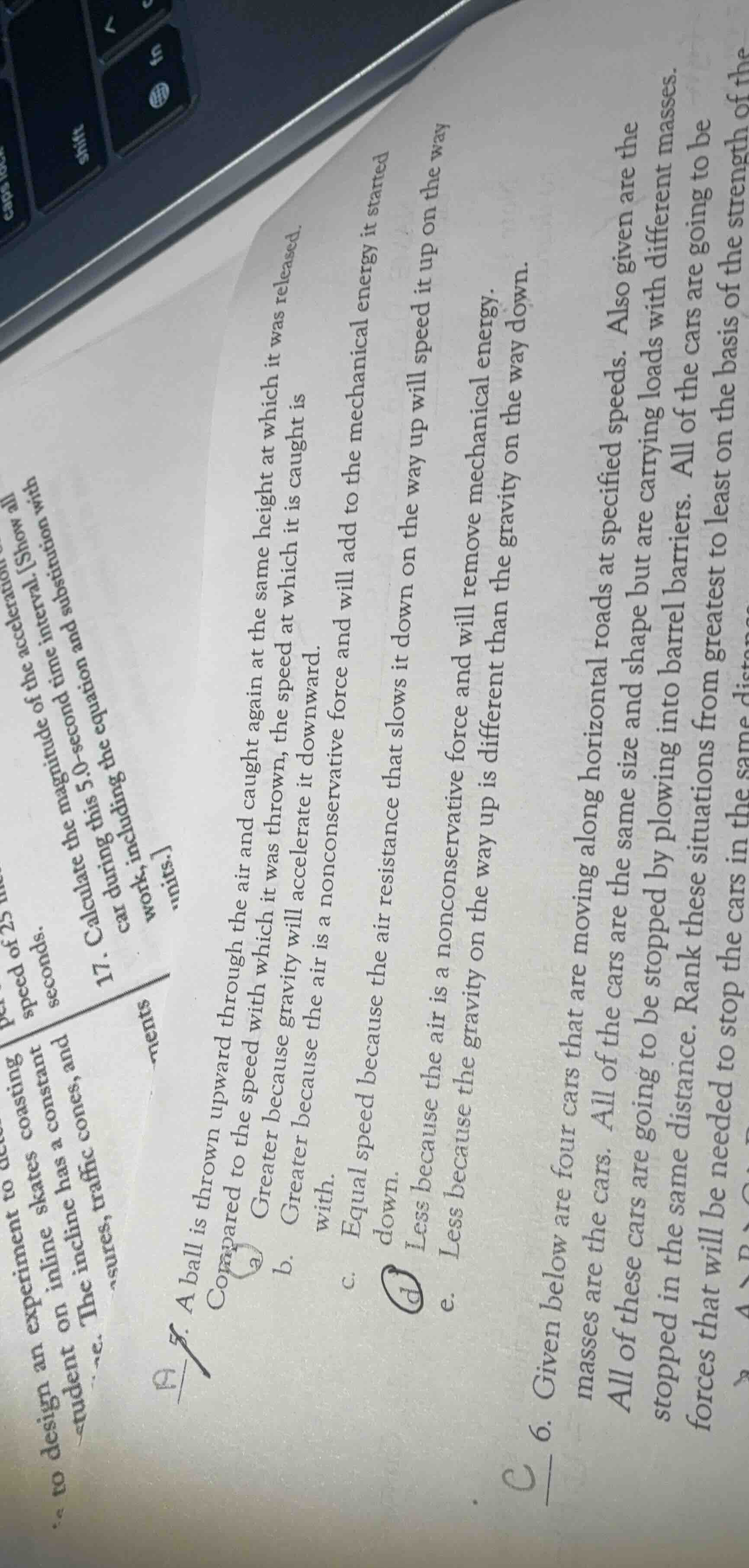
- a ball is thrown upward through the air and caught again at the same height at which it was released. compared to the speed with which it was thrown, the speed at which it is caught is
a. greater because gravity will accelerate it downward.
b. greater because the air is a nonconservative force and will add to the mechanical energy it started with.
c. equal speed because the air resistance that slows it down on the way up will speed it up on the way down.
d. less because the air is a nonconservative force and will remove mechanical energy.
e. less because the gravity on the way up is different than the gravity on the way down.
- given below are four cars that are moving along horizontal roads at specified speeds. also given are the masses of the cars. all of the cars are the same size and shape but are carrying loads with different masses. also these cars are going to be stopped in the same distance. rank these situations from greatest to least on the basis of the strength of the forces that will be needed to stop the cars in the same distance.
For the ball - throwing question (question 7):
When a ball is thrown upward and then caught at the same height, air resistance acts as a non - conservative force. On the way up, air resistance opposes the motion (acts downward), and on the way down, it also opposes the motion (acts upward). The work done by air resistance is negative in both cases, which means mechanical energy is lost. At the same height, the gravitational potential energy is the same. But because mechanical energy (kinetic + potential) is less on the way down (due to energy loss from air resistance), and potential energy is the same, the kinetic energy (and thus speed) on the way down is less than the initial speed on the way up. Option d states "Less because the air resistance that slows it down on the way up will speed it up on the way down" is incorrect. Option e: "Less because the air is a nonconservative force and will remove mechanical energy. The gravity on the way up is different than the gravity on the way down" is wrong as gravity is constant (acceleration due to gravity is approximately constant near the Earth's surface). Option a: "Greater because gravity will accelerate it downward" - gravity does accelerate it downward, but air resistance causes energy loss, so speed is less. Option b: "Greater because the air is a nonconservative force and will add to the mechanical energy it started with" - non - conservative forces like air resistance remove mechanical energy, not add. Option c: "Equal speed because the air resistance slows it down on the way down" - air resistance affects both ways and causes energy loss, so speed is not equal. The correct reasoning is that air resistance is a non - conservative force, it removes mechanical energy, so at the same height, the speed on the way down is less than the initial speed on the way up. The best option that aligns with the fact that air resistance causes energy loss (so speed is less) is the one that recognizes air resistance as a non - conservative force removing energy. But among the options, the correct idea is that the speed on the way down is less due to air resistance (a non - conservative force) removing mechanical energy. So the correct option should be the one that says the speed is less because of air resistance (non - conservative force) removing energy. If we assume the intended correct option is the one that accounts for air resistance causing energy loss, and among the options, the one that is correct is the one where the speed is less due to non - conservative force (air resistance) removing energy.

Snap & solve any problem in the app
Get step-by-step solutions on Sovi AI
Photo-based solutions with guided steps
Explore more problems and detailed explanations
(Assuming the options are labeled as in the text, the correct option is the one that states the speed is less because air resistance (a non - conservative force) removes mechanical energy. If we take the labeled options, and based on the analysis, the correct option is the one that has the reasoning about air resistance causing energy loss leading to lower speed. For example, if the options are as per the text, and the correct option is the one that says the speed is less due to air resistance removing mechanical energy, but from the labeled options, the correct answer is the option that is consistent with energy loss from air resistance leading to lower speed on the way down. If we consider the options, the correct option is the one that is about air resistance causing energy loss, so the answer is the option (probably the one with the correct reasoning about non - conservative force and energy loss, but from the text, if we have to pick, the correct option is the one that says the speed is less because of air resistance (non - conservative force) removing mechanical energy. If we assume the options are a - e, and the correct one is the one that has the correct reasoning, the answer is the option that is consistent with energy loss from air resistance, so the correct option is the one that is about less speed due to air resistance (non - conservative force) removing energy.
For the car - stopping question (question 6):
To rank the forces needed to stop the cars, we use the work - energy theorem. The work done by the stopping force \( W = F\times d\) (where \( F\) is the force and \( d\) is the stopping distance). The work done by the stopping force should be equal to the change in kinetic energy of the car. The kinetic energy of a car is \( KE=\frac{1}{2}mv^{2}\). Since all cars stop (final kinetic energy is 0), the work done by the stopping force \( W = 0-\frac{1}{2}mv^{2}=-\frac{1}{2}mv^{2}\). The magnitude of the work is \( |W|=\frac{1}{2}mv^{2}\). And since \( |W| = F\times d\) and \( d\) (stopping distance) is the same for all cars, \( F=\frac{mv^{2}}{2d}\). So the force \( F\) is proportional to \( mv^{2}\) (since \( d\) is constant). So to rank the forces from greatest to least, we need to rank the cars based on \( mv^{2}\) (mass times speed squared). The car with the largest \( mv^{2}\) will require the greatest force, and the one with the smallest \( mv^{2}\) will require the least force.
For the acceleration question (question 17):
To calculate the magnitude of acceleration, we need to know the motion of the car. If it's a motion with constant acceleration, we can use the kinematic equations. For example, if we know the initial velocity \( v_0\), final velocity \( v\), and time \( t\), we can use \( a=\frac{v - v_0}{t}\). If the car is moving with a certain displacement \( x\), initial velocity \( v_0\), and time \( t\), we can use \( x=v_0t+\frac{1}{2}at^{2}\) and solve for \( a\). But since the details of the car's motion (like initial velocity, final velocity, displacement) are not fully visible, we can't calculate the exact value, but the general method is to use kinematic equations based on the given motion parameters (like time interval, initial and final velocity, displacement) to find the acceleration.