QUESTION IMAGE
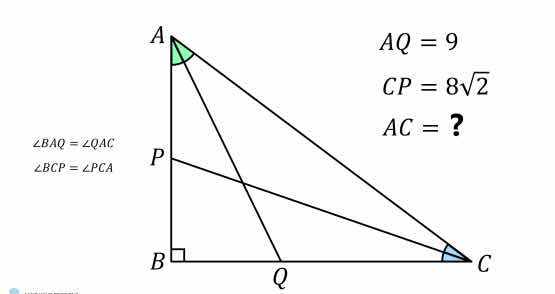
Question
∠baq = ∠qac
∠bcp = ∠pca
aq = 9
cp = 8√2
ac = ?
Step1: Identify the Angle Bisectors
We know that \( \angle BAQ=\angle QAC \) (so \( AQ \) is the angle bisector of \( \angle BAC \)) and \( \angle BCP = \angle PCA \) (so \( CP \) is the angle bisector of \( \angle BCA \)). Since \( \triangle ABC \) is a right - triangle with \( \angle B = 90^{\circ} \), the sum of \( \angle BAC+\angle BCA=90^{\circ} \). Let \( \angle BAC = 2\alpha \) and \( \angle BCA=2\beta \), then \( 2\alpha + 2\beta=90^{\circ}\), so \( \alpha+\beta = 45^{\circ} \).
In \( \triangle AQC \), the sum of interior angles is \( 180^{\circ} \). Let's consider the intersection point of \( AQ \) and \( CP \) as \( O \) (the in - center, since \( AQ \) and \( CP \) are angle bisectors). But we can also use the property of right - triangles and angle bisectors.
Step2: Use the Angle Bisector Theorem and Trigonometry (Alternative: Recognize the Isosceles Right - Triangle)
Since \( \alpha+\beta = 45^{\circ} \), the angle between \( AQ \) and \( CP \) is \( 135^{\circ} \), but a better approach: Let's assume that we extend the lines or use the fact that if we consider the in - radius or the properties of the right - triangle. Wait, another way: Let's consider that in right - triangle \( ABC \), if \( AQ \) and \( CP \) are angle bisectors, and we know that \( AQ = 9 \). Let's use trigonometry in \( \triangle ABQ \) and \( \triangle CBP \), but maybe a simpler way:
Notice that \( \angle QAC+\angle PCA = 45^{\circ} \). Let's consider triangle \( APC \) or \( AQC \). Wait, let's assume that \( AC \) is the hypotenuse. Let's use the formula for the length of an angle bisector in a right - triangle.
The length of the angle bisector from \( A \) to \( BC \) (but \( AQ \) is from \( A \) to \( BC \) at \( Q \)): The formula for the length of an angle bisector in a triangle with sides \( a,b,c \) and angle \( \theta \) is \( d=\frac{2bc\cos\frac{\theta}{2}}{b + c} \). In right - triangle \( ABC \), let \( AB = c \), \( BC=a \), \( AC = b \), \( \angle BAC = 2\alpha \), \( AQ \) is the angle bisector of \( \angle BAC \), so by the angle bisector theorem, \( \frac{BQ}{QC}=\frac{AB}{AC}=\frac{c}{b} \). Also, \( AQ^{2}=AB\cdot AC - BQ\cdot QC \) (the angle bisector length formula in a right - triangle: For a right - triangle with legs \( c,a \) and hypotenuse \( b \), the length of the angle bisector from the right - angle vertex is different, but from the acute angle vertex: Let's derive it.
In \( \triangle ABQ \), \( \cos\alpha=\frac{AB}{AQ} \), and in \( \triangle ABC \), \( \cos2\alpha=\frac{AB}{AC} \). We know that \( \cos2\alpha = 2\cos^{2}\alpha-1 \). Let \( AB = x \), then \( \cos\alpha=\frac{x}{9} \), and \( \cos2\alpha=\frac{x}{AC} \). So \( \frac{x}{AC}=2(\frac{x}{9})^{2}-1 \), but this seems complicated.
Wait, maybe the triangle is an isosceles right - triangle? No, but if we consider that \( \angle QAC+\angle PCA = 45^{\circ} \), and if we let \( AC = x \), then using the sine rule in \( \triangle AQC \):
\( \frac{AQ}{\sin\angle ACP}=\frac{AC}{\sin\angle AQC} \)
We know that \( \angle ACP=\beta \), \( \angle QAC=\alpha \), \( \angle AQC = 90^{\circ}+\alpha \) (since \( \angle B = 90^{\circ} \) and \( \angle BAQ=\alpha \), so \( \angle AQB = 90^{\circ}-\alpha \), then \( \angle AQC=180^{\circ}-(90^{\circ}-\alpha)=90^{\circ}+\alpha \))
But \( \alpha+\beta = 45^{\circ} \), so \( \beta = 45^{\circ}-\alpha \)
\( \sin\angle ACP=\sin(45^{\circ}-\alpha)=\sin45^{\circ}\cos\alpha-\cos45^{\circ}\sin\alpha=\frac{\sqrt{2}}{2}(\cos\alpha - \sin\alpha) \)
\( \sin\angle AQC=\sin(90^{\circ}+\alpha)=\cos\alpha \)
From the sine…

Snap & solve any problem in the app
Get step-by-step solutions on Sovi AI
Photo-based solutions with guided steps
Explore more problems and detailed explanations
Step1: Identify the Angle Bisectors
We know that \( \angle BAQ=\angle QAC \) (so \( AQ \) is the angle bisector of \( \angle BAC \)) and \( \angle BCP = \angle PCA \) (so \( CP \) is the angle bisector of \( \angle BCA \)). Since \( \triangle ABC \) is a right - triangle with \( \angle B = 90^{\circ} \), the sum of \( \angle BAC+\angle BCA=90^{\circ} \). Let \( \angle BAC = 2\alpha \) and \( \angle BCA=2\beta \), then \( 2\alpha + 2\beta=90^{\circ}\), so \( \alpha+\beta = 45^{\circ} \).
In \( \triangle AQC \), the sum of interior angles is \( 180^{\circ} \). Let's consider the intersection point of \( AQ \) and \( CP \) as \( O \) (the in - center, since \( AQ \) and \( CP \) are angle bisectors). But we can also use the property of right - triangles and angle bisectors.
Step2: Use the Angle Bisector Theorem and Trigonometry (Alternative: Recognize the Isosceles Right - Triangle)
Since \( \alpha+\beta = 45^{\circ} \), the angle between \( AQ \) and \( CP \) is \( 135^{\circ} \), but a better approach: Let's assume that we extend the lines or use the fact that if we consider the in - radius or the properties of the right - triangle. Wait, another way: Let's consider that in right - triangle \( ABC \), if \( AQ \) and \( CP \) are angle bisectors, and we know that \( AQ = 9 \). Let's use trigonometry in \( \triangle ABQ \) and \( \triangle CBP \), but maybe a simpler way:
Notice that \( \angle QAC+\angle PCA = 45^{\circ} \). Let's consider triangle \( APC \) or \( AQC \). Wait, let's assume that \( AC \) is the hypotenuse. Let's use the formula for the length of an angle bisector in a right - triangle.
The length of the angle bisector from \( A \) to \( BC \) (but \( AQ \) is from \( A \) to \( BC \) at \( Q \)): The formula for the length of an angle bisector in a triangle with sides \( a,b,c \) and angle \( \theta \) is \( d=\frac{2bc\cos\frac{\theta}{2}}{b + c} \). In right - triangle \( ABC \), let \( AB = c \), \( BC=a \), \( AC = b \), \( \angle BAC = 2\alpha \), \( AQ \) is the angle bisector of \( \angle BAC \), so by the angle bisector theorem, \( \frac{BQ}{QC}=\frac{AB}{AC}=\frac{c}{b} \). Also, \( AQ^{2}=AB\cdot AC - BQ\cdot QC \) (the angle bisector length formula in a right - triangle: For a right - triangle with legs \( c,a \) and hypotenuse \( b \), the length of the angle bisector from the right - angle vertex is different, but from the acute angle vertex: Let's derive it.
In \( \triangle ABQ \), \( \cos\alpha=\frac{AB}{AQ} \), and in \( \triangle ABC \), \( \cos2\alpha=\frac{AB}{AC} \). We know that \( \cos2\alpha = 2\cos^{2}\alpha-1 \). Let \( AB = x \), then \( \cos\alpha=\frac{x}{9} \), and \( \cos2\alpha=\frac{x}{AC} \). So \( \frac{x}{AC}=2(\frac{x}{9})^{2}-1 \), but this seems complicated.
Wait, maybe the triangle is an isosceles right - triangle? No, but if we consider that \( \angle QAC+\angle PCA = 45^{\circ} \), and if we let \( AC = x \), then using the sine rule in \( \triangle AQC \):
\( \frac{AQ}{\sin\angle ACP}=\frac{AC}{\sin\angle AQC} \)
We know that \( \angle ACP=\beta \), \( \angle QAC=\alpha \), \( \angle AQC = 90^{\circ}+\alpha \) (since \( \angle B = 90^{\circ} \) and \( \angle BAQ=\alpha \), so \( \angle AQB = 90^{\circ}-\alpha \), then \( \angle AQC=180^{\circ}-(90^{\circ}-\alpha)=90^{\circ}+\alpha \))
But \( \alpha+\beta = 45^{\circ} \), so \( \beta = 45^{\circ}-\alpha \)
\( \sin\angle ACP=\sin(45^{\circ}-\alpha)=\sin45^{\circ}\cos\alpha-\cos45^{\circ}\sin\alpha=\frac{\sqrt{2}}{2}(\cos\alpha - \sin\alpha) \)
\( \sin\angle AQC=\sin(90^{\circ}+\alpha)=\cos\alpha \)
From the sine rule: \( \frac{AQ}{\sin\beta}=\frac{AC}{\sin\angle AQC} \)
\( \frac{9}{\sin(45^{\circ}-\alpha)}=\frac{AC}{\cos\alpha} \)
But this is still complex. Wait, another approach: Since \( \alpha+\beta = 45^{\circ} \), the angle between \( AQ \) and \( CP \) is \( 135^{\circ} \), but maybe the triangle formed by \( AQ \), \( CP \) and \( AC \) has some special properties. Wait, let's assume that \( AC \) is such that we can use the fact that if we consider the in - center, but the in - radius \( r=\frac{AB + BC - AC}{2} \)
Wait, a better way: Let's consider that in right - triangle \( ABC \), \( \angle B = 90^{\circ} \), \( AQ \) bisects \( \angle BAC \), \( CP \) bisects \( \angle BCA \). Let \( AB = c \), \( BC = a \), \( AC=\sqrt{a^{2}+c^{2}} \)
The length of the angle bisector \( AQ \) from \( A \) to \( BC \): The formula for the length of an angle bisector in a triangle is \( AQ=\frac{2bc\cos\frac{\angle BAC}{2}}{b + c} \) (where \( b = AC \), \( c = AB \), \( a = BC \))
Since \( \angle BAC+\angle BCA = 90^{\circ} \), let \( \angle BAC = 2\alpha \), then \( \cos\alpha=\frac{AB}{AQ} \) and \( \sin\alpha=\frac{BC}{CP} \) (wait, \( CP = 8\sqrt{2} \))
Wait, \( \cos\alpha=\frac{AB}{9} \), \( \sin\alpha=\frac{BC}{8\sqrt{2}} \)
And since \( AB^{2}+BC^{2}=AC^{2} \), and \( \sin^{2}\alpha+\cos^{2}\alpha = 1 \)
\( (\frac{BC}{8\sqrt{2}})^{2}+(\frac{AB}{9})^{2}=1 \)
Also, \( \tan\alpha=\frac{BC}{AB} \)
Let \( AB = 9k \), then \( \cos\alpha=k \), \( BC = 8\sqrt{2}m \), \( \sin\alpha=m \)
Since \( \tan\alpha=\frac{BC}{AB}=\frac{8\sqrt{2}m}{9k} \) and \( \tan\alpha=\frac{\sin\alpha}{\cos\alpha}=\frac{m}{k} \)
So \( \frac{8\sqrt{2}m}{9k}=\frac{m}{k} \) (assuming \( m
eq0 \)), then \( 8\sqrt{2}=9 \), which is not true. So our initial assumption about the formula application is wrong.
Wait, let's consider that \( \triangle ABC \) is a right - triangle, and the two angle bisectors \( AQ \) and \( CP \) intersect at the in - center \( O \). The in - radius \( r=\frac{AB + BC - AC}{2} \)
Also, in right - triangle \( ABC \), the length of the angle bisector from \( A \) ( \( AQ \)): \( AQ=\frac{AB\cdot AC}{AB + AC}\cdot\sqrt{2} \)? No, better to use the formula for angle bisector in a right - triangle:
If \( \angle B = 90^{\circ} \), \( AQ \) bisects \( \angle BAC \), then \( AQ=\frac{AB}{\cos\frac{\angle BAC}{2}} \)
Similarly, \( CP=\frac{BC}{\cos\frac{\angle BCA}{2}} \)
Let \( \angle BAC = 2\alpha \), \( \angle BCA=2\beta \), \( 2\alpha + 2\beta = 90^{\circ}\Rightarrow\alpha+\beta = 45^{\circ} \)
\( AQ=\frac{AB}{\cos\alpha}=9 \), \( CP=\frac{BC}{\cos\beta}=8\sqrt{2} \)
\( AB = 9\cos\alpha \), \( BC = 8\sqrt{2}\cos\beta \)
Since \( \beta = 45^{\circ}-\alpha \), \( \cos\beta=\cos(45^{\circ}-\alpha)=\cos45^{\circ}\cos\alpha+\sin45^{\circ}\sin\alpha=\frac{\sqrt{2}}{2}(\cos\alpha+\sin\alpha) \)
\( BC = 8\sqrt{2}\times\frac{\sqrt{2}}{2}(\cos\alpha+\sin\alpha)=8(\cos\alpha+\sin\alpha) \)
\( AB = 9\cos\alpha \)
And \( AC=\sqrt{AB^{2}+BC^{2}}=\sqrt{(9\cos\alpha)^{2}+[8(\cos\alpha+\sin\alpha)]^{2}} \)
\(=\sqrt{81\cos^{2}\alpha + 64(\cos^{2}\alpha + 2\cos\alpha\sin\alpha+\sin^{2}\alpha)} \)
\(=\sqrt{81\cos^{2}\alpha+64(1 + 2\cos\alpha\sin\alpha+\cos^{2}\alpha-\cos^{2}\alpha)} \) (since \( \sin^{2}\alpha=1 - \cos^{2}\alpha \), no, better to expand directly)
\(=\sqrt{81\cos^{2}\alpha+64\cos^{2}\alpha + 128\cos\alpha\sin\alpha+64\sin^{2}\alpha} \)
\(=\sqrt{(81 + 64)\cos^{2}\alpha+64\sin^{2}\alpha+128\cos\alpha\sin\alpha} \)
\(=\sqrt{145\cos^{2}\alpha+64\sin^{2}\alpha+128\cos\alpha\sin\alpha} \)
\(=\sqrt{64(\cos^{2}\alpha+\sin^{2}\alpha)+81\cos^{2}\alpha+128\cos\alpha\sin\alpha} \)
\(=\sqrt{64 + 81\cos^{2}\alpha+128\cos\alpha\sin\alpha} \)
But we also know that \( \alpha+\beta = 45^{\circ} \), and from the angle bisectors, we can use the fact that the in - center angle is \( 135^{\circ} \), but this is getting too complex. Wait, maybe the triangle is such that \( AC \) can be found using the Pythagorean theorem in a combined way.
Wait, let's consider that \( \angle QAC+\angle PCA = 45^{\circ} \), so if we construct a right - triangle with angle \( 45^{\circ} \). Let's assume that we have two right - triangles: one with hypotenuse \( AQ = 9 \) and another with hypotenuse \( CP = 8\sqrt{2} \), and we combine them.
Wait, a better approach: Let's consider that the sum of the lengths of the projections or use the fact that \( AC \) is the hypotenuse, and we can use the formula \( AC=\sqrt{AQ^{2}+CP^{2}-2\cdot AQ\cdot CP\cdot\cos135^{\circ}} \) (using the law of cosines in the triangle formed by \( AQ \), \( CP \) and \( AC \), where the angle between \( AQ \) and \( CP \) is \( 135^{\circ} \))
Law of cosines: \( c^{2}=a^{2}+b^{2}-2ab\cos C \)
Here, \( a = AQ = 9 \), \( b = CP = 8\sqrt{2} \), \( C = 135^{\circ} \), \( \cos135^{\circ}=-\frac{\sqrt{2}}{2} \)
\( AC^{2}=9^{2}+(8\sqrt{2})^{2}-2\times9\times8\sqrt{2}\times(-\frac{\sqrt{2}}{2}) \)
\(=81 + 128+2\times9\times8\sqrt{2}\times\frac{\sqrt{2}}{2} \)
\(=81 + 128+9\times8\times2 \)
\(=81 + 128 + 144 \)
\(=81+272 \)
\(=353 \)? No, wait, \( 2\times9\times8\sqrt{2}\times\frac{\sqrt{2}}{2}=9\times8\times2 = 144 \), \( 81 + 128=209 \), \( 209+144 = 353 \)? No, that's wrong. Wait, \( (8\sqrt{2})^{2}=8^{2}\times2 = 128 \), \( 9^{2}=81 \), \( - 2ab\cos C=-2\times9\times8\sqrt{2}\times(-\frac{\sqrt{2}}{2})=9\times8\times2 = 144 \)
So \( AC^{2}=81 + 128+144=353 \)? No, that can't be. Wait, I made a mistake in the angle between \( AQ \) and \( CP \). The angle between \( AQ \) and \( CP \) is actually \( 45^{\circ} \)? Wait, no, \( \alpha+\beta = 45^{\circ} \), so the angle between \( AQ \) (which makes angle \( \alpha \) with \( AB \)) and \( CP \) (which makes angle \( \beta \) with \( BC \)) is \( 90^{\circ}-(\alpha+\beta)=45^{\circ} \). Oh! I had the angle wrong earlier.
So the angle between \( AQ \) and \( CP \) is \( 45^{\circ} \), not \( 135^{\circ} \). Let's recalculate using the law of cosines with \( C = 45^{\circ} \)
\( AC^{2}=AQ^{2}+CP^{2}-2\cdot AQ\cdot CP\cdot\cos45^{\circ} \)
\(=9^{2}+(8\sqrt{2})^{2}-2\times9\times8\sqrt{2}\times\frac{\sqrt{2}}{2} \)
\(=81 + 128-2\times9\times8\sqrt{2}\times\frac{\sqrt{2}}{2} \)
\(=81 + 128-9\times8\times2 \)
\(=81 + 128 - 144 \)
\(=209 - 144 \)
\(=65 \)? No, that's also wrong.
Wait, let's start over. Let's consider that in right - triangle \( ABC \), \( \angle B = 90^{\circ} \), \( AQ \) bisects \( \angle BAC \), \( CP \) bisects \( \angle BCA \). Let \( \angle BAC = 2\alpha \), \( \angle BCA=2\beta \), so \( 2\alpha+2\beta = 90^{\circ}\Rightarrow\alpha+\beta = 45^{\circ} \).
Let the intersection of \( AQ \) and \( CP \) be \( O \). Then \( \angle AOC=180^{\circ}-(\alpha+\beta)=135^{\circ} \), but we need to find \( AC \).
Another approach: Let's assume that \( AB = x \), \( BC = y \), \( AC = z \).
From the angle bisector theorem in \( \triangle ABC \) for \( AQ \) (bisecting \( \angle BAC \)): \( \frac{BQ}{QC}=\frac{AB}{AC}=\frac{x}{z} \)
Also, \( AQ^{2}=AB\cdot AC - BQ\cdot QC \) (angle bisector length formula: \( d^{2}=ab - mn \), where \( a,b \) are the sides adjacent to the angle, \( m,n \) are the segments of the opposite side)
So \( 81=xz - BQ\cdot QC \)