QUESTION IMAGE
Question
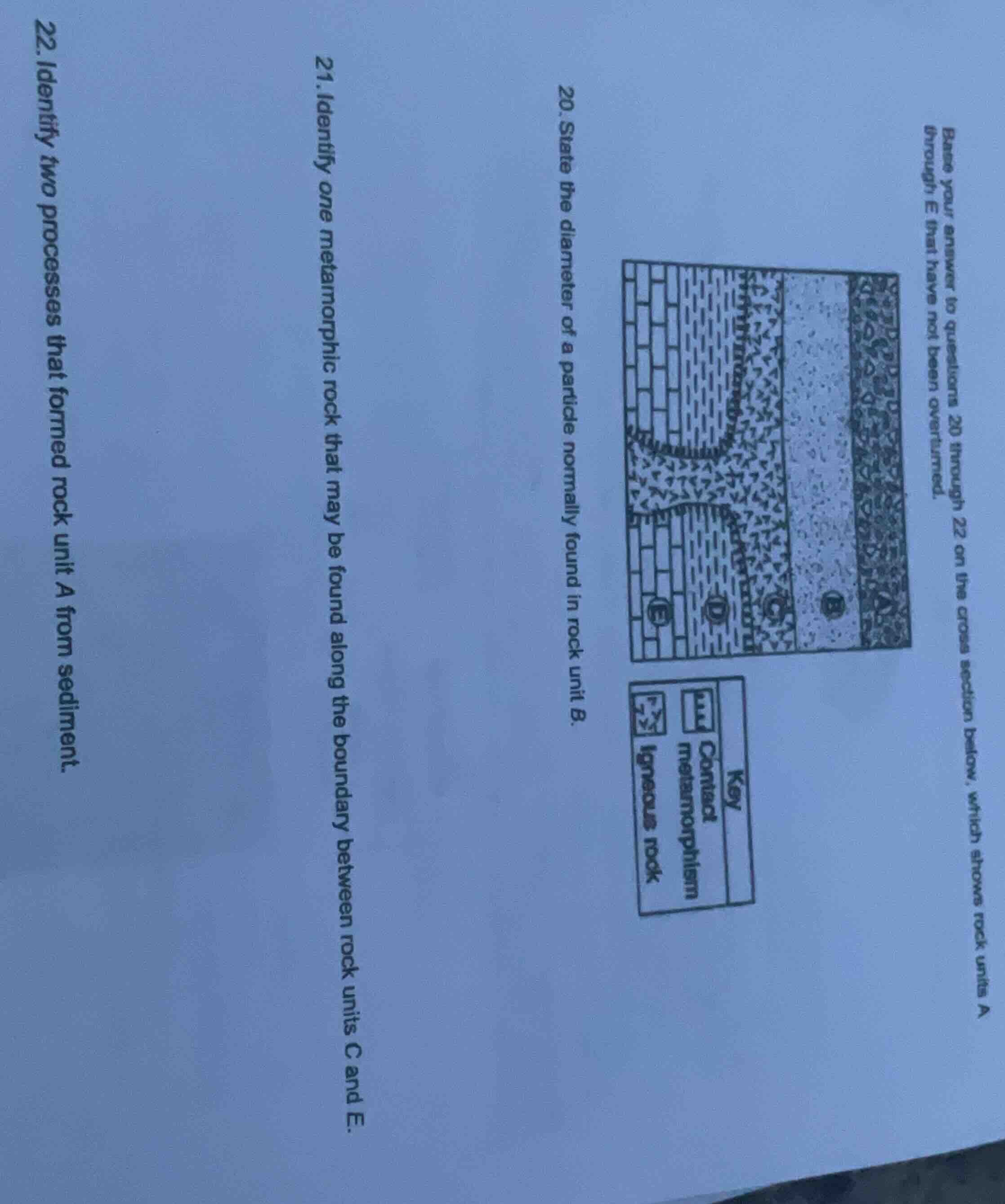
base your answer to questions 20 through 22 on the cross section below, which shows rock units a through e that have not been overturned.
- state the diameter of a particle normally found in rock unit b.
- identify one metamorphic rock that may be found along the boundary between rock units c and e.
- identify two processes that formed rock unit a from sediment.
Brief Explanations
- Rock unit B is a fine-grained sedimentary rock (like shale or siltstone), so its typical particle diameter is very small, in the range of clay or fine silt sizes.
- Along the contact between igneous rock C and sedimentary rock E, contact metamorphism forms a common metamorphic rock.
- Rock unit A is a clastic sedimentary rock, formed from sediments through compaction (pressing grains together) and cementation (binding grains with minerals).

Snap & solve any problem in the app
Get step-by-step solutions on Sovi AI
Photo-based solutions with guided steps
Explore more problems and detailed explanations
- The diameter of a particle in rock unit B is typically between 0.0004 cm and 0.006 cm (or less than 0.006 cm, consistent with fine silt/clay-sized particles).
- Hornfels (a common contact metamorphic rock formed in this setting)
- 1. Compaction
- Cementation