QUESTION IMAGE
Question
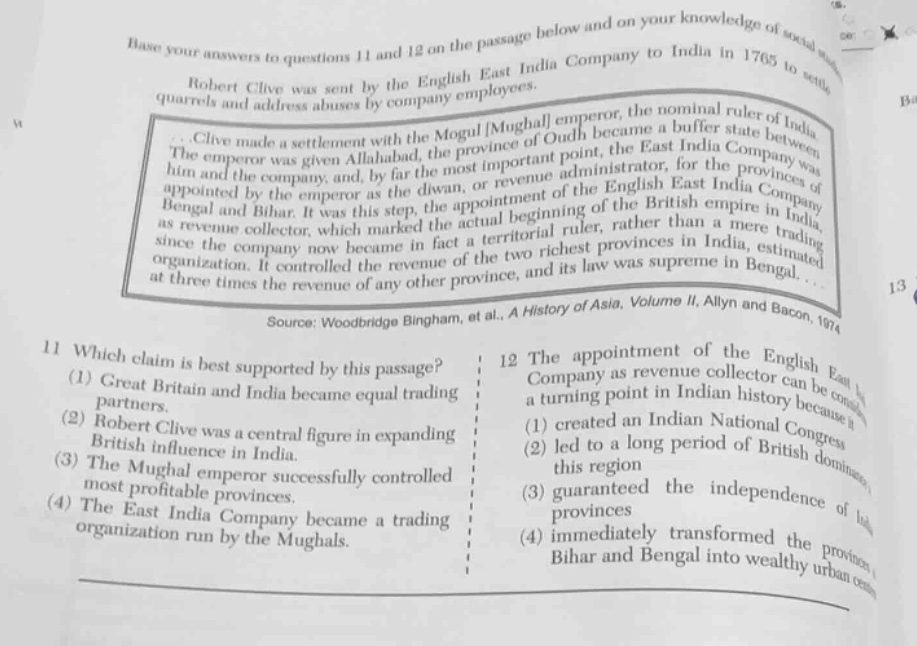
base your answers to questions 11 and 12 on the passage below and on your knowledge of social
robert clive was sent by the english east india company to india in 1765 to settle
quarrels and address abuses by company employees.
... clive made a settlement with the mogul mughal emperor, the nominal ruler of india
the emperor was given allahabad, the province of oudh became a buffer state between
him and the company, and, by far the most important point, the east india company was
appointed by the emperor as the diwan, or revenue administrator, for the provinces of
bengal and bihar. it was this step, the appointment of the english east india company
as revenue collector, which marked the actual beginning of british empire in india,
since the company now became in fact a territorial ruler, rather than a mere trading
organization. it controlled the revenue of the two richest provinces in india, estimated
at three times the revenue of any other province, and its law was supreme in bengal. ...
source: woodbridge bingham, et al., a history of asia, volume ii, allyn and bacon, 1974
11 which claim is best supported by this passage?
(1) great britain and india became equal trading
partners.
(2) robert clive was a central figure in expanding
british influence in india.
(3) the mughal emperor successfully controlled
most profitable provinces.
(4) the east india company became a trading
organization run by the mughals.
12 the appointment of the english east
company as revenue collector can be conside
a turning point in indian history because it
(1) created an indian national congress
(2) led to a long period of british dominatio
this region
(3) guaranteed the independence of
provinces
(4) immediately transformed the province
bihar and bengal into wealthy urban cente
Question 11
- Analyze Option (1): The passage shows the East India Company became a territorial ruler, not equal trading partners with India. Eliminate (1).
- Analyze Option (2): The passage states Clive's actions (like the appointment as diwan) marked the start of British empire in India, so he was central in expanding British influence. This matches.
- Analyze Option (3): The emperor gave control to the East India Company, so he did not control the profitable provinces. Eliminate (3).
- Analyze Option (4): The company became a territorial ruler, not a trading organization run by Mughals. Eliminate (4).
- Analyze Option (1): Indian National Congress was formed later, not related to this appointment. Eliminate (1).
- Analyze Option (2): The appointment made the company a territorial ruler, starting British dominance in India. This is a turning point.
- Analyze Option (3): The appointment led to British control, not Indian independence. Eliminate (3).
- Analyze Option (4): The passage says it controlled revenue, not that it immediately transformed them into urban centers. Eliminate (4).

Snap & solve any problem in the app
Get step-by-step solutions on Sovi AI
Photo-based solutions with guided steps
Explore more problems and detailed explanations
(2) Robert Clive was a central figure in expanding British influence in India.