QUESTION IMAGE
Question
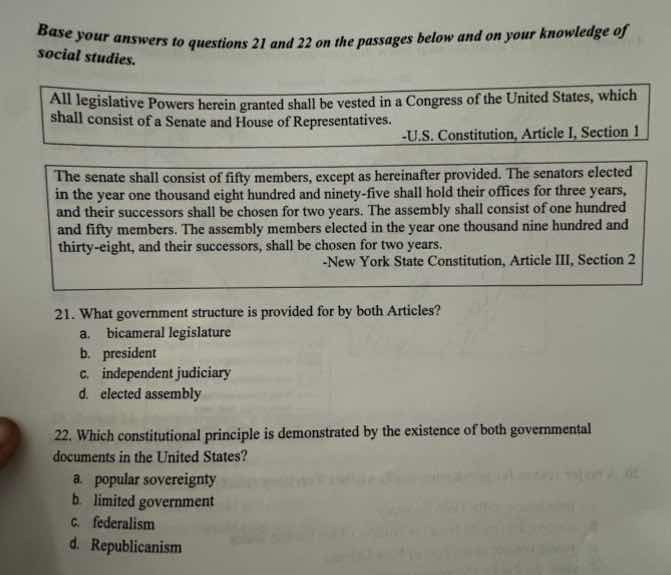
base your answers to questions 21 and 22 on the passages below and on your knowledge of social studies.
all legislative powers herein granted shall be vested in a congress of the united states, which shall consist of a senate and house of representatives.
-u.s. constitution, article i, section 1
the senate shall consist of fifty members, except as hereinafter provided. the senators elected in the year one thousand eight hundred and ninety - five shall hold their offices for three years, and their successors shall be chosen for two years. the assembly shall consist of one hundred and fifty members. the assembly members elected in the year one thousand nine hundred and thirty - eight, and their successors, shall be chosen for two years.
-new york state constitution, article iii, section 2
- what government structure is provided for by both articles?
a. bicameral legislature
b. president
c. independent judiciary
d elected assembly
- which constitutional principle is demonstrated by the existence of both governmental documents in the united states?
a. popular sovereignty
b. limited government
c. federalism
d. republicanism
Question 21
- Analyze Option a: The U.S. Constitution Article I, Section 1 has a Congress with Senate and House (bicameral). New York State Constitution Article III, Section 2 has Senate and Assembly (bicameral). So bicameral legislature matches.
- Option b: Neither article focuses on president.
- Option c: Neither article is about judiciary.
- Option d: "Elected assembly" is too vague; the key is bicameral structure, not just elected bodies.
- Option c (federalism): Federalism is the division of power between national and state governments. Both U.S. (national) and New York State (state) have constitutions, showing power division between levels, which is federalism.
- Option a (popular sovereignty): Focuses on people's rule, not shown here.
- Option b (limited government): Focuses on government power limits, not the dual constitutions.
- Option d (Republicanism): Focuses on representative government, not the dual - level governance shown.

Snap & solve any problem in the app
Get step-by-step solutions on Sovi AI
Photo-based solutions with guided steps
Explore more problems and detailed explanations
a. bicameral legislature