QUESTION IMAGE
Question
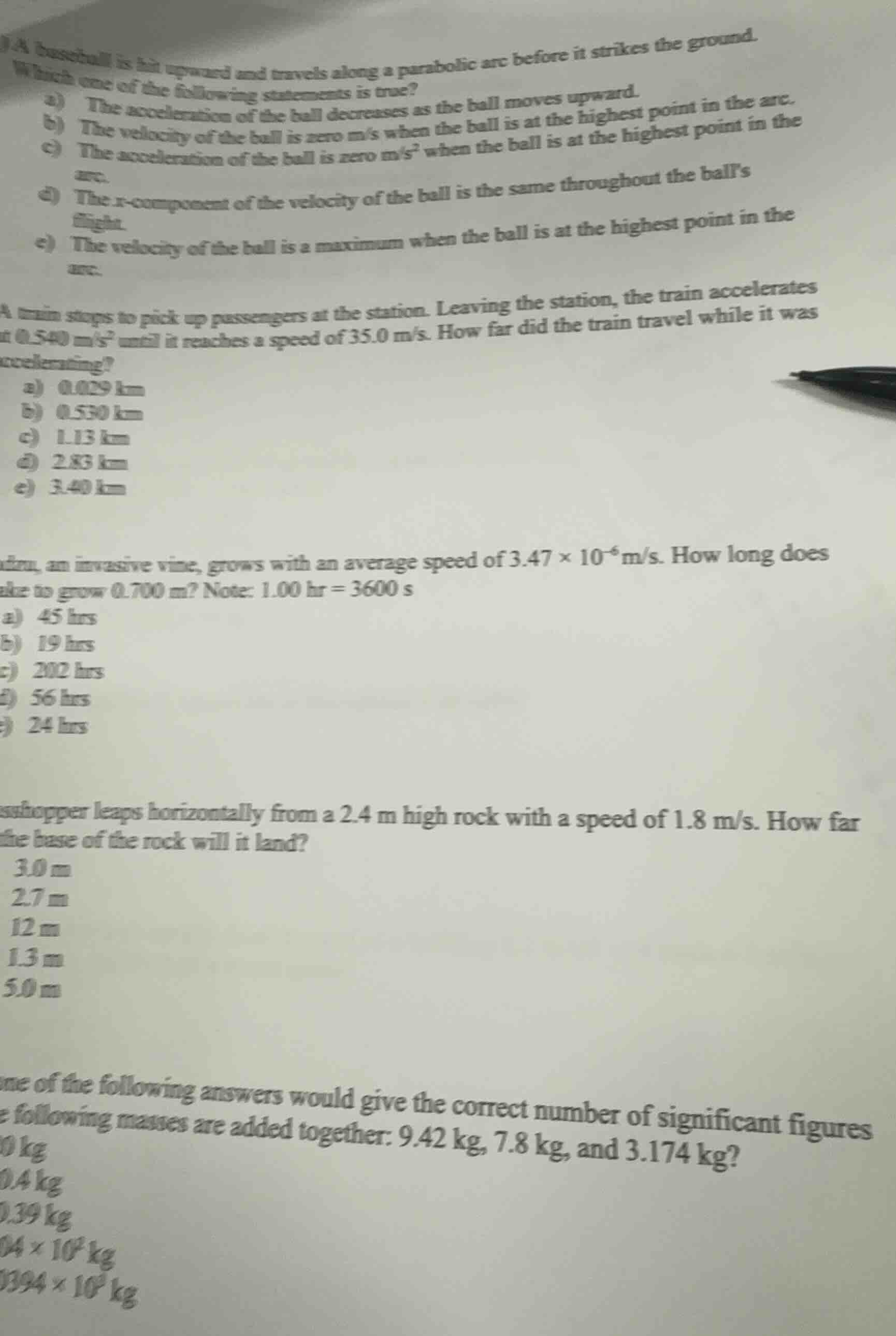
- a baseball is hit upward and travels along a parabolic arc before it strikes the ground. which one of the following statements is true?a) the acceleration of the ball decreases as the ball moves upward.b) the velocity of the ball is zero m/s when the ball is at the highest point in the arc.c) the acceleration of the ball is zero m/s² when the ball is at the highest point in the arc.d) the x-component of the velocity of the ball is the same throughout the balls flight.e) the velocity of the ball is a maximum when the ball is at the highest point in the arc.2. a train stops to pick up passengers at the station. leaving the station, the train accelerates at 0.540 m/s² until it reaches a speed of 35.0 m/s. how far did the train travel while it was accelerating?a) 0.029 kmb) 0.530 kmc) 1.13 kmd) 2.83 kme) 3.40 km3. kudzu, an invasive vine, grows with an average speed of $3.47 \times 10^{-6}$ m/s. how long does it take to grow 0.700 m? note: 1.00 hr = 3600 sa) 45 hrsb) 19 hrsc) 202 hrsd) 56 hrse) 24 hrs4. a grasshopper leaps horizontally from a 2.4 m high rock with a speed of 1.8 m/s. how far from the base of the rock will it land?3.0 m2.7 m12 m1.3 m5.0 m5. which one of the following answers would give the correct number of significant figures when the following masses are added together: 9.42 kg, 7.8 kg, and 3.174 kg?20 kg20.4 kg20.39 kg2.04 × 10² kg2.0394 × 10² kg
1. Baseball Projectile Motion Question
- a) Acceleration is constant (gravity, ~9.8 m/s² downward) during flight, so it does not decrease.
- b) At the highest point, only vertical velocity is zero; horizontal velocity remains, so total velocity is not zero.
- c) Acceleration from gravity acts throughout the flight, so it is never zero.
- d) If air resistance is ignored, there is no horizontal acceleration, so the x-component of velocity is constant.
- e) Velocity is maximum at launch/impact, not at the highest point (where vertical velocity is zero, reducing total velocity).
Step1: List known variables
Initial velocity $v_0 = 0\ \text{m/s}$, final velocity $v = 35.0\ \text{m/s}$, acceleration $a = 0.540\ \text{m/s}^2$
Step2: Use kinematic equation
We use $v^2 = v_0^2 + 2ax$ to solve for distance $x$.
Rearrange to $x = \frac{v^2 - v_0^2}{2a}$
Step3: Substitute values
$x = \frac{(35.0)^2 - 0^2}{2\times0.540} = \frac{1225}{1.08} \approx 1134.26\ \text{m} = 1.13\ \text{km}$
Step1: List known variables
Speed $v = 3.47\times10^{-6}\ \text{m/s}$, distance $d = 0.700\ \text{m}$
Step2: Solve for time in seconds
Use $t = \frac{d}{v}$
$t = \frac{0.700}{3.47\times10^{-6}} \approx 201729.11\ \text{s}$
Step3: Convert seconds to hours
Use $1\ \text{hr}=3600\ \text{s}$, so $t = \frac{201729.11}{3600} \approx 56.04\ \text{hrs} \approx 56\ \text{hrs}$

Snap & solve any problem in the app
Get step-by-step solutions on Sovi AI
Photo-based solutions with guided steps
Explore more problems and detailed explanations
d) The x-component of the velocity of the ball is the same throughout the ball's flight.
---