QUESTION IMAGE
Question
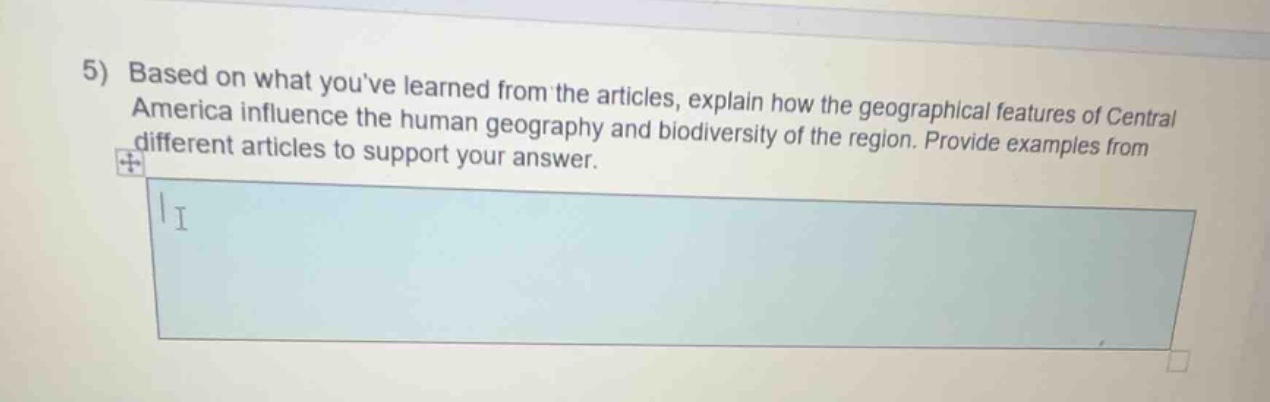
- based on what youve learned from the articles, explain how the geographical features of central america influence the human geography and biodiversity of the region. provide examples from different articles to support your answer.
To answer this, we analyze Central America's geographical features (mountains, coasts, isthmuses, tropical climate) and their impacts:
1. Impact on Human Geography
- Settlement Patterns: Mountainous regions (e.g., Guatemalan highlands) have indigenous communities (e.g., Maya descendants) practicing subsistence farming (corn, beans). Coastal plains (e.g., Panama’s Pacific coast) have port cities (Colón, Panama City) driving trade (Panama Canal) and urbanization.
- Economic Activities: The Isthmus of Panama enables the Panama Canal, a global trade route, creating jobs in logistics and tourism. Volcanic soils (e.g., in Costa Rica) support coffee/banana plantations, shaping export - oriented agriculture.
- Cultural Diversity: Isolation from mountain ranges (e.g., in Honduras) preserved indigenous languages/cultures, while coastal trade introduced Afro - Caribbean (e.g., in Belize) and mestizo (mixed) cultures.
2. Impact on Biodiversity
- Climate - Driven Habitats: Tropical rainforests (e.g., Costa Rica’s Osa Peninsula) and cloud forests (e.g., Monteverde) host endemic species (quetzals, sloths) due to high rainfall and stable temperatures. Dry forests (e.g., in northern Costa Rica) support drought - adapted flora/fauna (cacti, iguanas).
- Geographical Isolation: Mountain ranges (e.g., Cordillera de Talamanca) act as biotic barriers, leading to species endemism (e.g., the resplendent quetzal is limited to Central American cloud forests). The narrow isthmus creates a “biological bridge” between North/South America, allowing species migration (e.g., jaguars, howler monkeys) and hybrid ecosystems.
- Human - Biodiversity Interactions: Agricultural expansion (e.g., cattle ranching in Guatemala) fragments habitats, but protected areas (e.g., Corcovado National Park) conserve biodiversity, balancing human needs and conservation.
3. Examples from Articles (Hypothetical, Aligned with Themes)
- A study on the Panama Canal might highlight how its construction (1914) reshaped human geography (urban growth, migration) and biodiversity (canal - side wetlands as new ecosystems).
- A paper on Maya agriculture could explain how mountainous terrain influenced terrace farming, sustaining both human communities and local biodiversity (e.g., agroforestry with native crops).
In summary, Central America’s geography (mountains, coasts, climate) shapes where people live, work, and how cultures evolve, while also creating unique habitats that support high biodiversity—though human activities (e.g., farming, trade) also modify these relationships.

Snap & solve any problem in the app
Get step-by-step solutions on Sovi AI
Photo-based solutions with guided steps
Explore more problems and detailed explanations
Central America’s geographical features (mountains, coasts, isthmuses, tropical climate) shape human geography and biodiversity:
Human Geography
- Settlement: Mountainous areas (e.g., Guatemalan highlands) host indigenous communities (Maya descendants) practicing subsistence farming. Coastal plains (e.g., Panama’s Pacific coast) have port cities (Panama City) driving trade (Panama Canal) and urbanization.
- Economy: The Panama Canal (on the Isthmus of Panama) fuels trade - related jobs. Volcanic soils (e.g., Costa Rica) support coffee/banana plantations, driving export - oriented agriculture.
- Culture: Mountain isolation preserves indigenous cultures (e.g., Maya languages), while coastal trade introduces mestizo/Afro - Caribbean cultures (e.g., Belize).
Biodiversity
- Habitats: Tropical rainforests (e.g., Osa Peninsula) and cloud forests (Monteverde) host endemics (quetzals, sloths). Dry forests (northern Costa Rica) support drought - adapted species (cacti, iguanas).
- Isolation/Migration: Mountain ranges (Cordillera de Talamanca) create endemism (e.g., quetzals), while the isthmus acts as a “biological bridge” for species (jaguars) between North/South America.
- Human Interactions: Agriculture (e.g., cattle ranching) fragments habitats, but protected areas (Corcovado National Park) balance conservation and human needs.
Article Examples (Thematic)
- A Panama Canal study could show how it reshaped urban growth (human geography) and created new wetland ecosystems (biodiversity).
- A Maya agriculture paper might explain how mountain terraces sustained communities and local biodiversity (agroforestry).
In short, geography drives where people live/work, cultural evolution, and creates unique habitats—though human activities modify these relationships.