QUESTION IMAGE
Question
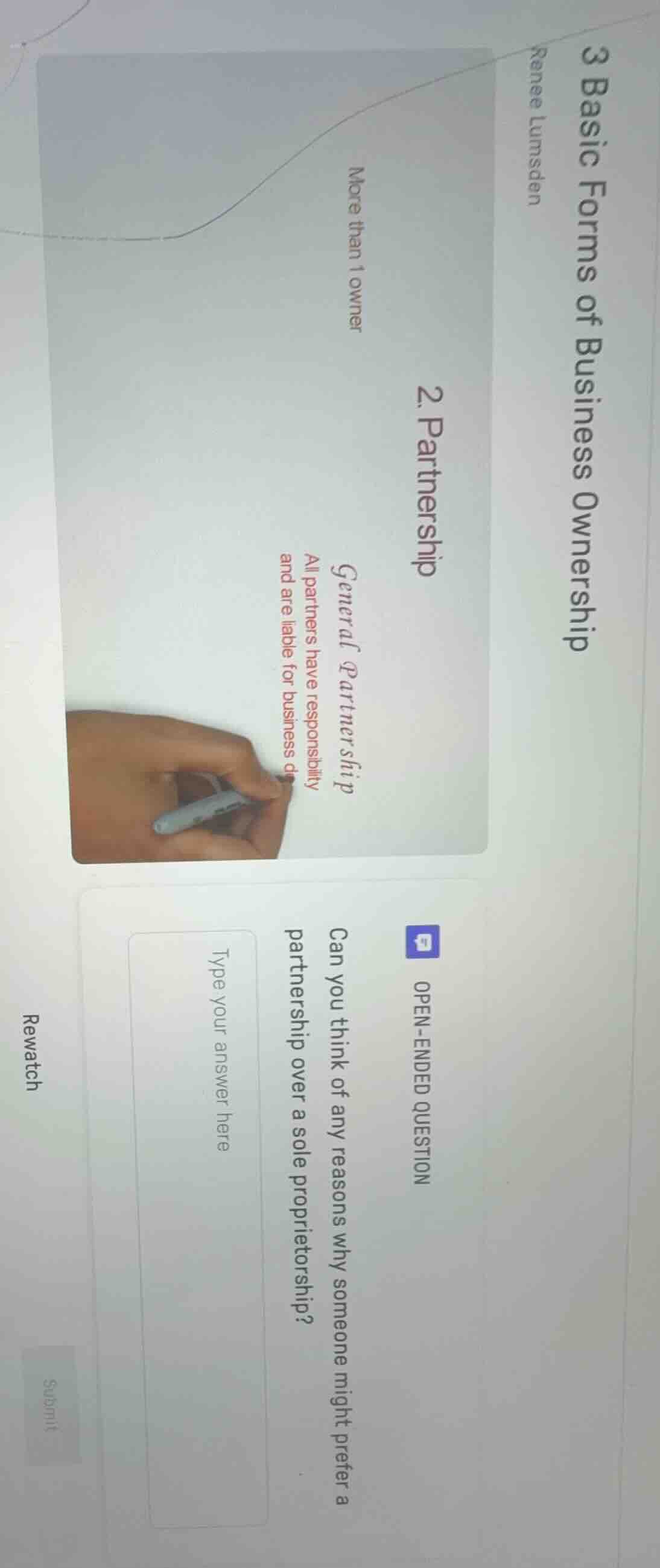
3 basic forms of business ownership
renee lumsden
more than 1 owner
- partnership
general partnership
all partners have responsibility
and are liable for business d
open - ended question
can you think of any reasons why someone might prefer a
partnership over a sole proprietorship?
type your answer here
rewatch
submit
A partnership can be preferred over a sole proprietorship for several reasons. Firstly, in a partnership, there are multiple owners, so the financial burden of starting and running the business is shared among partners. For example, if a business needs a large initial investment, each partner can contribute a portion, reducing the individual financial strain compared to a sole proprietor who has to fund everything alone. Secondly, skill and expertise diversity is a key factor. Different partners bring different skills, knowledge, and experiences. For instance, one partner might be good at marketing, another at operations, and this combined expertise can lead to better decision - making and business growth, which a sole proprietor may lack as they have to handle all aspects alone. Thirdly, risk sharing is important. Since all partners are liable (in a general partnership) or some have limited liability (in a limited partnership), the risk of business losses or legal issues is spread out. A sole proprietor bears all the risk alone, which can be a huge burden, especially in case of debts or lawsuits. Also, workload distribution is a benefit. Partners can divide tasks based on their strengths, leading to increased efficiency and reduced stress for each individual, unlike a sole proprietor who has to manage all business operations single - handedly.

Snap & solve any problem in the app
Get step-by-step solutions on Sovi AI
Photo-based solutions with guided steps
Explore more problems and detailed explanations
Some reasons someone might prefer a partnership over a sole proprietorship include:
- Shared Financial Burden: Multiple partners can contribute to startup costs and ongoing expenses, reducing individual financial strain.
- Diverse Skills/Expertise: Partners bring different skills (e.g., marketing, finance, operations) to enhance business decision - making and growth.
- Risk Sharing: Business risks (losses, legal issues) are spread among partners, unlike the sole proprietor who bears all risk.
- Workload Distribution: Tasks can be divided among partners based on strengths, increasing efficiency and reducing individual workload.