QUESTION IMAGE
Question
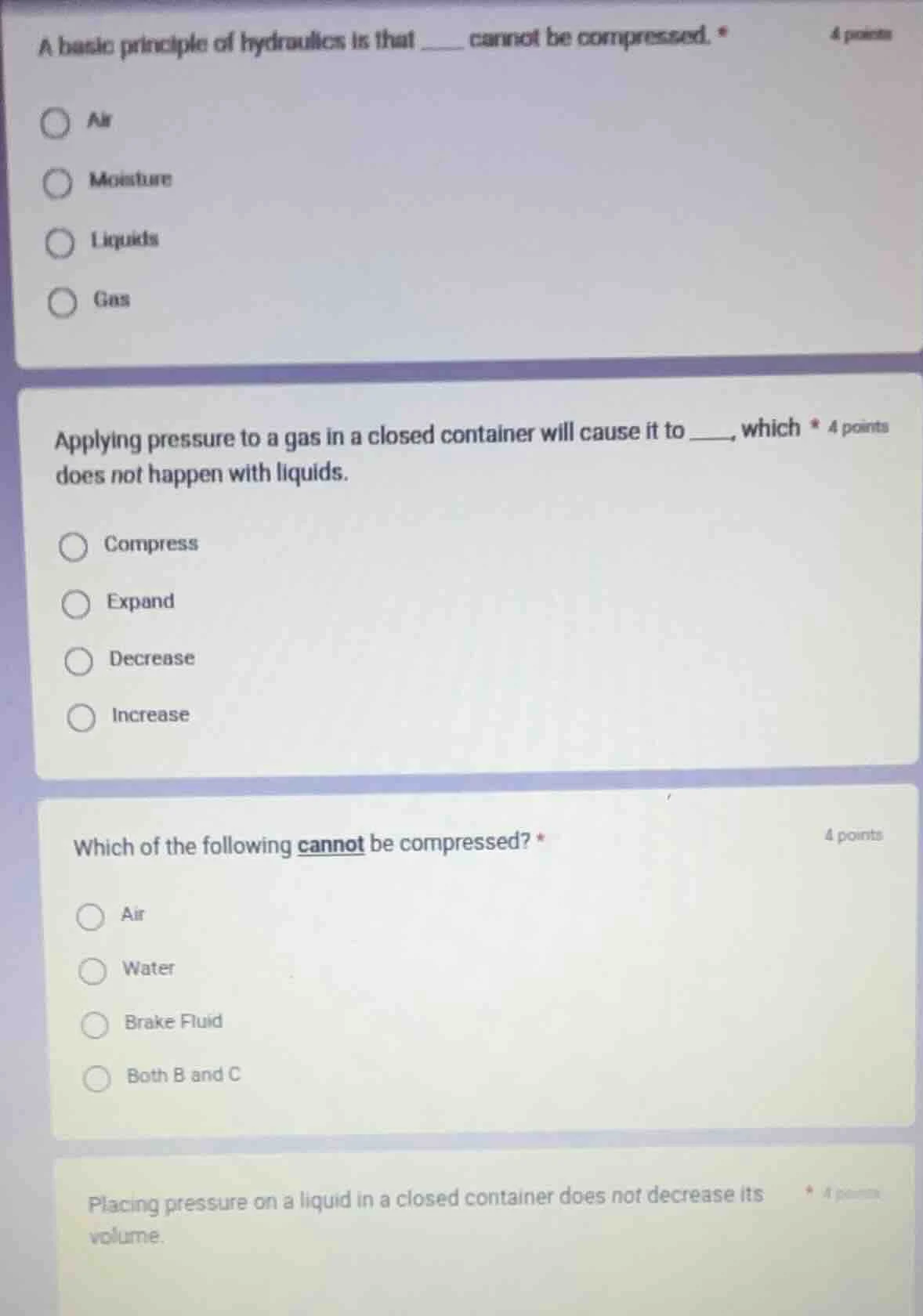
a basic principle of hydraulics is that ____ cannot be compressed.
options: air, moisture, liquids, gas
applying pressure to a gas in a closed container will cause it to ____, which does not happen with liquids.
options: compress, expand, decrease, increase
which of the following cannot be compressed?
options: air, water, brake fluid, both b and c
placing pressure on a liquid in a closed container does not decrease its volume.
First Question
In hydraulics, a key principle is that liquids are nearly incompressible. Air and gas are compressible, and moisture is not the correct term here for the incompressible substance in hydraulics. So the correct option is Liquids.
Gases are compressible, so applying pressure to a gas in a closed container causes it to compress. Liquids do not compress under pressure in the same way. Expand is the opposite of what pressure does to a gas (pressure would compress, not expand if we consider the context of the question's contrast with liquids), decrease and increase are not the specific terms for the action of pressure on gas here. So the correct option is Compress.
Water and brake fluid are both liquids, and liquids are incompressible. Air is a gas and is compressible. So both Water (option B) and Brake Fluid (option C) cannot be compressed, so the correct option is Both B and C.

Snap & solve any problem in the app
Get step-by-step solutions on Sovi AI
Photo-based solutions with guided steps
Explore more problems and detailed explanations
C. Liquids