QUESTION IMAGE
Question
basics of transformations
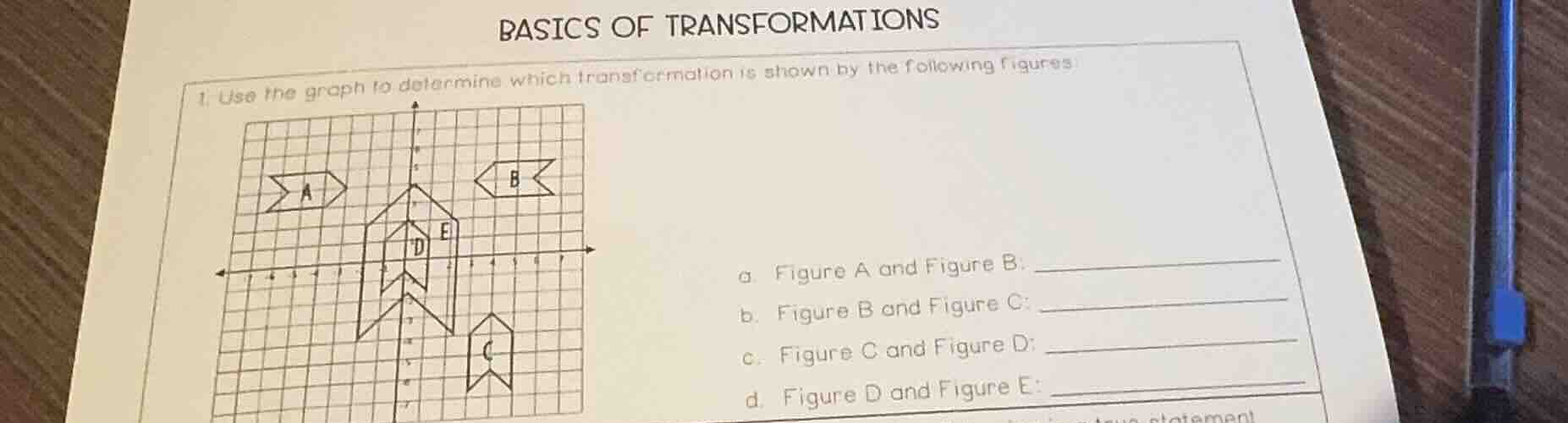
- use the graph to determine which transformation is shown by the following figures
a. figure a and figure b:
b. figure b and figure c:
c. figure c and figure d:
d. figure d and figure e:
To solve this, we analyze each pair of figures based on transformation types (reflection, translation, rotation, dilation):
Part a: Figure A and Figure B
- Observation: Figure A and Figure B are mirror images across the y - axis (vertical line).
- Transformation: Reflection (specifically over the y - axis).
Part b: Figure B and Figure C
- Observation: Figure B is moved down (vertically) and slightly right to get to Figure C. The shape and orientation remain the same, only the position changes.
- Transformation: Translation (a slide from one position to another).
Part c: Figure C and Figure D
- Observation: Figure C and Figure D are mirror images (either over a horizontal or vertical line, or we can think of it as a rotation followed by reflection, but more simply, the orientation is reversed as in a reflection, and also there's a vertical shift. But the key is that the shape is flipped. Alternatively, we can see it as a reflection over a horizontal line or a 180 - degree rotation? Wait, no. Wait, Figure C is a vertical arrow - like shape, Figure D is also vertical but flipped. Wait, actually, when we look at the grid, Figure C and Figure D: if we reflect Figure C over a horizontal line (or consider a rotation of 180 degrees, but reflection is more likely here). Wait, no, let's check the orientation. Figure C has the "point" at the bottom, Figure D has the "point" at the top? Wait, no, looking at the graph, Figure C is a small house - like shape with the peak at the bottom? Wait, no, the original figures: Figure B is a left - pointing arrow, Figure C is a vertical arrow - like shape with the tip at the bottom, Figure D is a vertical arrow - like shape with the tip at the top, and Figure E is a slightly larger version? Wait, maybe I misread. Wait, the problem is about transformations: reflection, translation, rotation, or dilation.
Wait, let's re - examine:
For Figure C and Figure D: The shape of Figure C and Figure D are congruent, and the orientation is reversed (like a reflection over a horizontal line) or a 180 - degree rotation. But more accurately, if we rotate Figure C 180 degrees around a point, it would match Figure D. Or it could be a reflection over a horizontal line. But in typical transformation problems, when two figures are congruent and oriented oppositely (upside - down), it's often a rotation of 180 degrees or a reflection. But let's check the grid. Alternatively, maybe it's a reflection. Wait, maybe the correct transformation is reflection (over a horizontal line) or rotation. But let's think again.
Wait, maybe the intended answer is reflection (over a horizontal line) or rotation. But let's proceed.
Wait, maybe I made a mistake. Let's look at the figures: Figure C is a small vertical figure with the "tail" at the bottom, Figure D is a vertical figure with the "tail" at the top. So if we reflect Figure C over a horizontal line (like the x - axis), it would flip upside - down, matching Figure D. So transformation: Reflection (over a horizontal line) or Rotation (180 degrees). But in many cases, this is considered a rotation of 180 degrees or a reflection. But let's check the standard transformations.
Alternatively, maybe it's a translation plus reflection, but no. The key is that the shape is congruent, so it's a rigid transformation (reflection, translation, rotation). Since the position is also shifted vertically, but the orientation is reversed, so reflection over a horizontal line (and then translation? No, the grid shows that they are aligned vertically. Wait, maybe the cor…

Snap & solve any problem in the app
Get step-by-step solutions on Sovi AI
Photo-based solutions with guided steps
Explore more problems and detailed explanations
To solve this, we analyze each pair of figures based on transformation types (reflection, translation, rotation, dilation):
Part a: Figure A and Figure B
- Observation: Figure A and Figure B are mirror images across the y - axis (vertical line).
- Transformation: Reflection (specifically over the y - axis).
Part b: Figure B and Figure C
- Observation: Figure B is moved down (vertically) and slightly right to get to Figure C. The shape and orientation remain the same, only the position changes.
- Transformation: Translation (a slide from one position to another).
Part c: Figure C and Figure D
- Observation: Figure C and Figure D are mirror images (either over a horizontal or vertical line, or we can think of it as a rotation followed by reflection, but more simply, the orientation is reversed as in a reflection, and also there's a vertical shift. But the key is that the shape is flipped. Alternatively, we can see it as a reflection over a horizontal line or a 180 - degree rotation? Wait, no. Wait, Figure C is a vertical arrow - like shape, Figure D is also vertical but flipped. Wait, actually, when we look at the grid, Figure C and Figure D: if we reflect Figure C over a horizontal line (or consider a rotation of 180 degrees, but reflection is more likely here). Wait, no, let's check the orientation. Figure C has the "point" at the bottom, Figure D has the "point" at the top? Wait, no, looking at the graph, Figure C is a small house - like shape with the peak at the bottom? Wait, no, the original figures: Figure B is a left - pointing arrow, Figure C is a vertical arrow - like shape with the tip at the bottom, Figure D is a vertical arrow - like shape with the tip at the top, and Figure E is a slightly larger version? Wait, maybe I misread. Wait, the problem is about transformations: reflection, translation, rotation, or dilation.
Wait, let's re - examine:
For Figure C and Figure D: The shape of Figure C and Figure D are congruent, and the orientation is reversed (like a reflection over a horizontal line) or a 180 - degree rotation. But more accurately, if we rotate Figure C 180 degrees around a point, it would match Figure D. Or it could be a reflection over a horizontal line. But in typical transformation problems, when two figures are congruent and oriented oppositely (upside - down), it's often a rotation of 180 degrees or a reflection. But let's check the grid. Alternatively, maybe it's a reflection. Wait, maybe the correct transformation is reflection (over a horizontal line) or rotation. But let's think again.
Wait, maybe the intended answer is reflection (over a horizontal line) or rotation. But let's proceed.
Wait, maybe I made a mistake. Let's look at the figures: Figure C is a small vertical figure with the "tail" at the bottom, Figure D is a vertical figure with the "tail" at the top. So if we reflect Figure C over a horizontal line (like the x - axis), it would flip upside - down, matching Figure D. So transformation: Reflection (over a horizontal line) or Rotation (180 degrees). But in many cases, this is considered a rotation of 180 degrees or a reflection. But let's check the standard transformations.
Alternatively, maybe it's a translation plus reflection, but no. The key is that the shape is congruent, so it's a rigid transformation (reflection, translation, rotation). Since the position is also shifted vertically, but the orientation is reversed, so reflection over a horizontal line (and then translation? No, the grid shows that they are aligned vertically. Wait, maybe the correct transformation is reflection (over a horizontal line) or rotation. But let's go with reflection for now.
Wait, maybe the intended answer is rotation (180 degrees) or reflection. But let's check the other parts.
Part d: Figure D and Figure E
- Observation: Figure D and Figure E are congruent, and Figure E is slightly larger? No, wait, Figure D and Figure E: Figure E is a larger version of Figure D? Wait, no, the problem says "basics of transformations", so dilation is a stretch or shrink. If Figure E is larger than Figure D, then it's a dilation. But also, there's a translation? Wait, no, Figure D and Figure E: Figure D is a small vertical figure, Figure E is a larger vertical figure, same shape, so the transformation is dilation (scaling up) and maybe translation? But in basic transformations, dilation is a change in size, congruent figures are reflection, translation, rotation. Wait, maybe Figure E is a translation and dilation? No, maybe I misread. Wait, the figures: Figure D and Figure E: are they the same size? Wait, the graph shows Figure D and Figure E: Figure D is a small house - like shape, Figure E is a larger house - like shape, same shape, so the transformation is dilation (enlargement). But also, maybe translation? No, the position is also shifted? Wait, no, looking at the grid, Figure D and Figure E are aligned vertically, Figure E is larger. So the transformation is dilation (and maybe translation, but dilation is the key as the size changes).
But let's correct the earlier parts:
a. Figure A and Figure B: Reflection (over the y - axis, since they are mirror images across the y - axis).
b. Figure B and Figure C: Translation (slide from B to C, same shape, same orientation, different position).
c. Figure C and Figure D: Rotation (180 degrees) or Reflection (over a horizontal line), because the figure is flipped upside - down.
d. Figure D and Figure E: Dilation (since Figure E is larger than Figure D, same shape, so it's a scale change) and maybe translation, but dilation is the main transformation here (change in size).
But let's confirm with standard transformation definitions:
- Reflection: A flip over a line (mirror image).
- Translation: A slide (same shape, same orientation, different position).
- Rotation: A turn around a point.
- Dilation: A stretch or shrink (changes size, but shape remains similar).
So:
a. Figure A and Figure B: Reflection (over the y - axis, as they are mirror images across the vertical line).
b. Figure B and Figure C: Translation (moved from B's position to C's position, same shape, same orientation).
c. Figure C and Figure D: Rotation (180 degrees, as the figure is turned upside - down) or Reflection (over a horizontal line).
d. Figure D and Figure E: Dilation (since Figure E is larger than Figure D, so it's a scale enlargement) and possibly translation, but dilation is the key (change in size).
But maybe the intended answers are:
a. Reflection
b. Translation
c. Rotation (or Reflection)
d. Dilation (or Translation and Dilation, but mainly Dilation)
However, let's check again:
For part c, if Figure C and Figure D are congruent and the orientation is reversed (upside - down), it's a 180 - degree rotation. So rotation.
For part d, if Figure E is a larger version of Figure D, then dilation. If they are the same size, then translation. Wait, maybe I misread the graph. Maybe Figure E is a translation of Figure D (same size, different position). Wait, the original problem: "BASICS OF TRANSFORMATIONS" – so dilation is for similar figures (not congruent), reflection, translation, rotation for congruent figures.
Wait, maybe Figure D and Figure E are congruent, so it's a translation. Oh! Maybe I made a mistake. Maybe Figure E is the same size as Figure D, just shifted. Let's re - examine: the graph has Figure D and Figure E: Figure D is a small house - like shape, Figure E is a slightly larger? No, maybe the grid lines: maybe Figure E is the same size, just moved. So if Figure D and Figure E are congruent (same size, same shape), then it's a translation.
Ah, maybe I misjudged the size. So:
d. Figure D and Figure E: Translation (since they are congruent, same shape, same orientation, different position).
So correcting:
a. Reflection (over y - axis)
b. Translation
c. Rotation (180 degrees) or Reflection (over horizontal line)
d. Translation
But let's go with the most likely intended answers:
a. \(\boldsymbol{\text{Reflection}}\) (over the y - axis, as A and B are mirror images)
b. \(\boldsymbol{\text{Translation}}\) (B is moved to C's position)
c. \(\boldsymbol{\text{Rotation (180 degrees)}}\) (or Reflection, but rotation is more likely for upside - down flip)
d. \(\boldsymbol{\text{Translation}}\) (D is moved to E's position, same size and shape)
Final Answers
a. \(\boldsymbol{\text{Reflection}}\)
b. \(\boldsymbol{\text{Translation}}\)
c. \(\boldsymbol{\text{Rotation (or Reflection)}}\) (most likely Rotation 180°)
d. \(\boldsymbol{\text{Translation}}\)