QUESTION IMAGE
Question
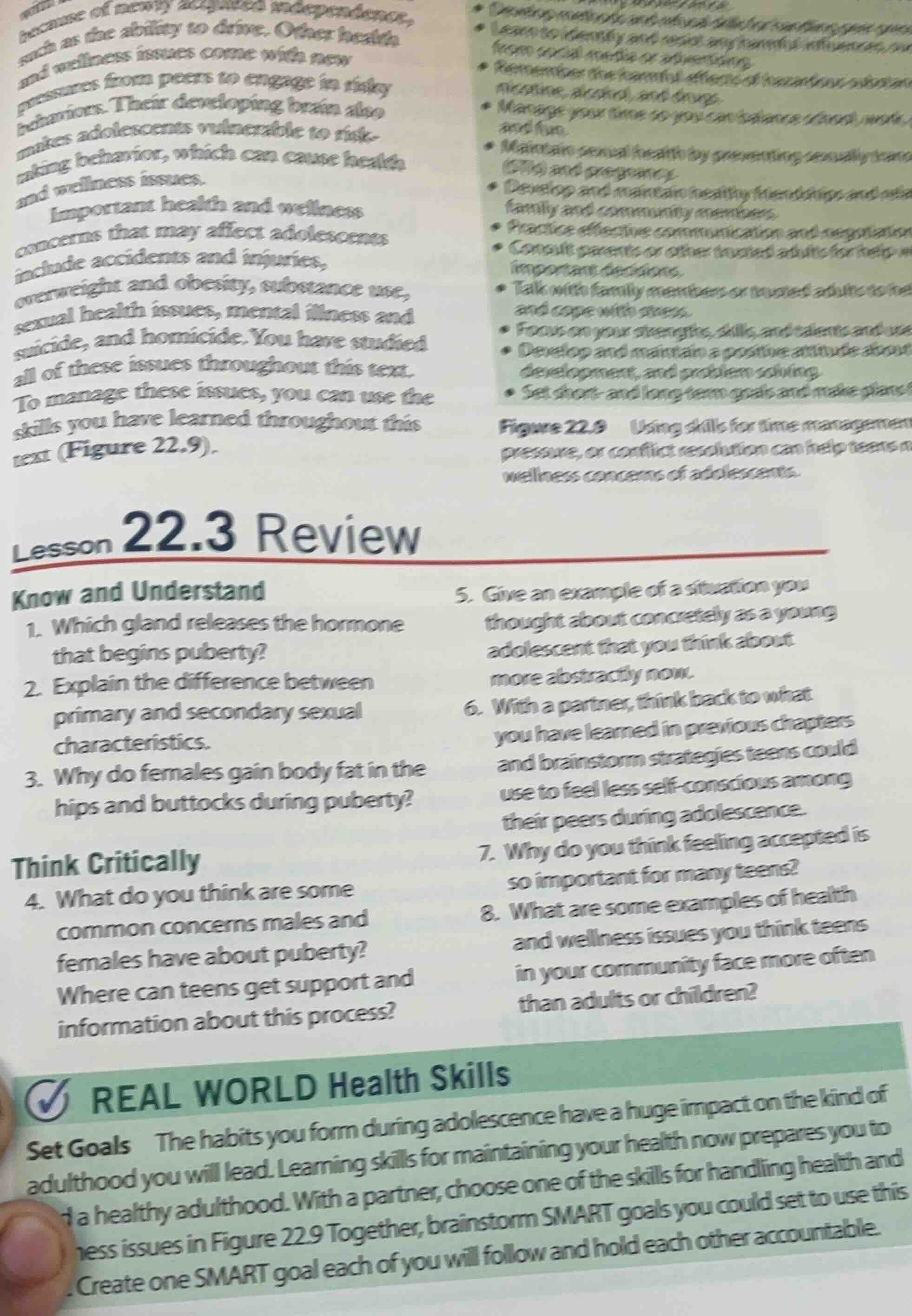
because of newly acquired independence, such as the ability to drive. other health and wellness issues come with new pressures from peers to engage in risky behaviors. their developing brain also makes adolescents vulnerable to risk - taking behavior, which can cause health and wellness issues.
important health and wellness concerns that may affect adolescents include accidents and injuries, overweight and obesity, substance use, sexual health issues, mental illness and suicide, and homicide. you have studied all of these issues throughout this text. to manage these issues, you can use the skills you have learned throughout this text (figure 22.9).
lesson 22.3 review
know and understand
- which gland releases the hormone that begins puberty?
- explain the difference between primary and secondary sexual characteristics.
- why do females gain body fat in the hips and buttocks during puberty?
think critically
- what do you think are some common concerns males and females have about puberty? where can teens get support and information about this process?
- give an example of a situation you thought about concretely as a young adolescent that you think about more abstractly now.
- with a partner, think back to what you have learned in previous chapters and brainstorm strategies teens could use to feel less self - conscious among their peers during adolescence.
- why do you think feeling accepted is so important for many teens?
- what are some examples of health and wellness issues you think teens in your community face more often than adults or children?
real world health skills
set goals the habits you form during adolescence have a huge impact on the kind of adulthood you will lead. learning skills for maintaining your health now prepares you to a healthy adulthood. with a partner, choose one of the skills for handling health and ness issues in figure 22.9 together, brainstorm smart goals you could set to use this
create one smart goal each of you will follow and hold each other accountable.
To answer these questions, we'll address each one based on health and puberty knowledge:
Question 1:
The hypothalamus signals the pituitary gland, but the gland that releases the hormone (gonadotropin - releasing hormone starts the process, but the pituitary gland releases LH and FSH which then act on gonads. However, the hypothalamus initiates, but the pituitary gland is the key gland that releases hormones to start puberty. Wait, actually, the hypothalamus secretes GnRH, which stimulates the anterior pituitary to release LH and FSH. But the question is which gland releases the hormone that begins puberty. The pituitary gland (anterior pituitary) releases luteinizing hormone (LH) and follicle - stimulating hormone (FSH) which then stimulate the gonads (testes in males, ovaries in females) to start producing sex hormones, thus beginning puberty.
Primary sexual characteristics are related to the reproductive organs themselves. They are present at birth (in a latent form) and develop during puberty. For example, in males, the growth and development of the testes and penis; in females, the growth and development of the ovaries, uterus, and vagina. Secondary sexual characteristics are the physical features that develop during puberty and are not directly related to reproduction. In males, this includes facial hair growth, deepening of the voice, and broad shoulders. In females, it includes breast development, widening of the hips, and growth of pubic hair.
During puberty, females experience an increase in estrogen. Estrogen is responsible for the development of secondary sexual characteristics and also for the deposition of fat in the hips and buttocks. This fat deposition is part of the female body's preparation for potential pregnancy and childbirth, as it provides energy reserves and also helps in the development of the pelvic region to support a growing fetus.

Snap & solve any problem in the app
Get step-by-step solutions on Sovi AI
Photo-based solutions with guided steps
Explore more problems and detailed explanations
The pituitary gland (anterior pituitary) releases hormones (luteinizing hormone and follicle - stimulating hormone) that begin puberty.