QUESTION IMAGE
Question
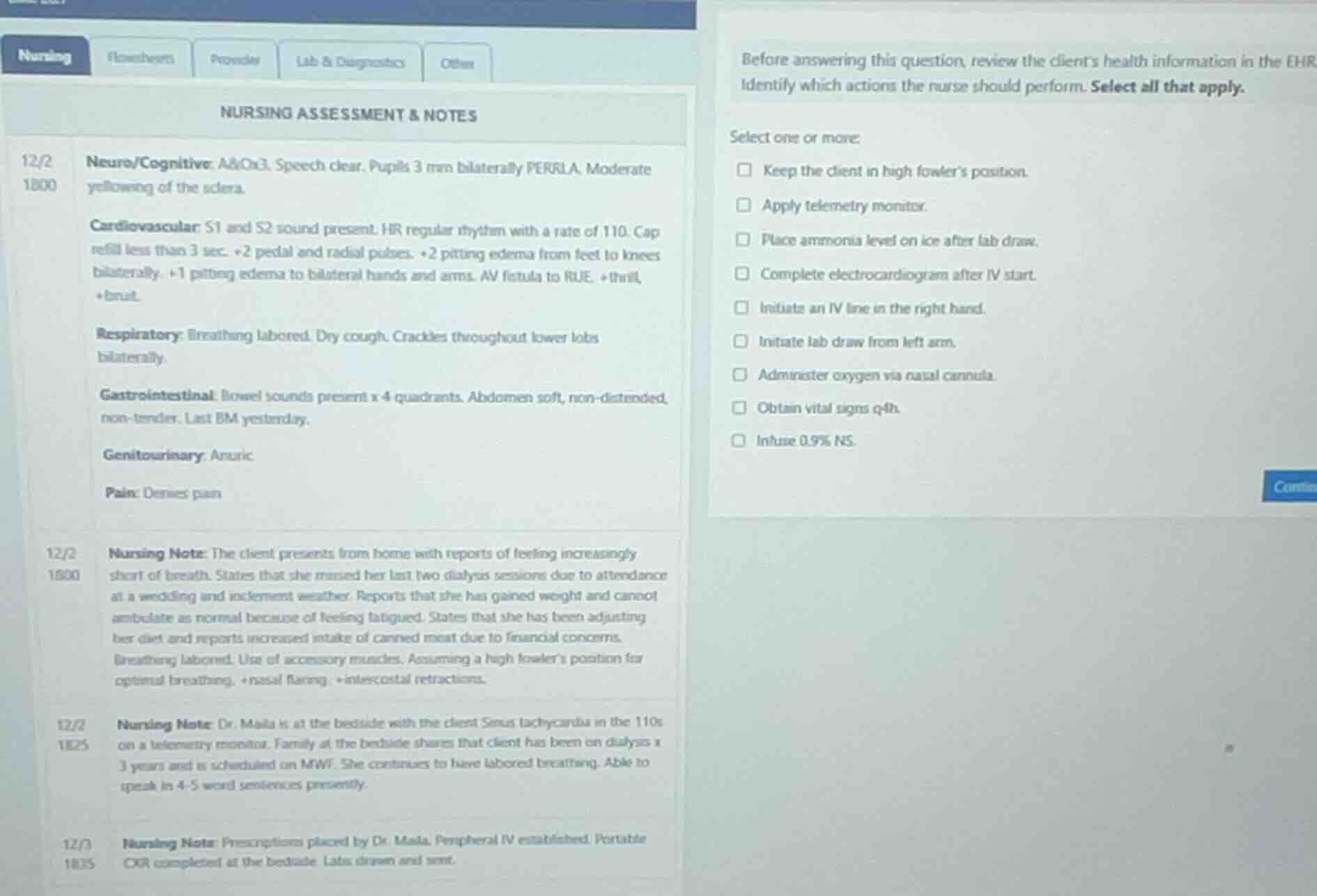
before answering this question, review the clients health information in the ehr identify which actions the nurse should perform. select all that apply. select one or more: keep the client in high fowlers position. apply telemetry monitor. place ammonia level on ice after lab draw. complete electrocardiogram after iv start. initiate an iv line in the right hand. initiate lab draw from left arm. administer oxygen via nasal cannula. obtain vital signs q4h. infuse 0.9% ns. nursing assessment & notes 12/2 1000 neuro/cognitive: a&ox3. speech clear. pupils 3 mm bilaterally perrla. moderate yellowing of the sclera. cardiovascular: s1 and s2 sound present. hr regular rhythm with a rate of 110. cap refill less than 3 sec. +2 pedal and radial pulses. +2 pitting edema from feet to knees bilaterally. +1 pitting edema to bilateral hands and arms. av fistula to rue. +thrill, +bruit. respiratory: breathing labored. dry cough. crackles throughout lower lobes bilaterally. gastrointestinal: bowel sounds present x 4 quadrants. abdomen soft, non-distended, non-tender. last bm yesterday. genitourinary: anuric. pain: denies pain 12/2 1500 nursing note: the client presents from home with reports of feeling increasingly short of breath. states that she missed her last two dialysis sessions due to attendance at a wedding and inclement weather. reports that she has gained weight and cannot ambulate as normal because of feeling fatigued. states that she has been adjusting her diet and reports increased intake of canned meat due to financial concerns. breathing labored. use of accessory muscles. assuming a high fowlers position for optimal breathing. +nasal flaring. +intercostal retractions. 12/2 1525 nursing note: dr. maia is at the bedside with the client. sinus tachycardia in the 110s on a telemetry monitor. family at the bedside shares that client has been on dialysis x 3 years and is scheduled on mwf. she continues to have labored breathing. able to speak in 4-5 word sentences presently. 12/2 1535 nursing note: prescriptions placed by dr. maia. peripheral iv established. portable cxr completed at the bedside. labs drawn and sent.
- Keep the client in high fowler's position: The client has labored breathing, and this position optimizes lung expansion to ease respiratory distress, which is already noted as their current positioning for comfort.
- Apply telemetry monitor: The client has sinus tachycardia (HR 110-110s) and a history of renal failure, so cardiac monitoring is necessary to track rhythm and rate changes.
- Place ammonia level on ice after lab draw: Ammonia levels degrade quickly at room temperature; placing the sample on ice preserves its integrity for accurate results, relevant for a client with renal dysfunction and jaundice.
- Initiate lab draw from left arm: The client has an AV fistula in the right upper extremity (RUE), which must be protected—no blood draws or IVs should be done on that arm, so the left arm is the correct site.
- Administer oxygen via nasal cannula: The client has labored breathing, crackles, and is using accessory muscles, indicating impaired gas exchange that requires supplemental oxygen.
- Obtain vital signs q4h: The client has unstable respiratory and cardiac status (tachycardia, labored breathing), so frequent vital sign monitoring is needed to track their condition.
Actions to avoid: The client has renal failure (anuric, missed dialysis, edema) so infusing 0.9% NS would worsen fluid overload. An IV should not be placed in the right hand due to the RUE AV fistula. An ECG is already completed per the notes, so repeating it after IV start is not needed at this time.

Snap & solve any problem in the app
Get step-by-step solutions on Sovi AI
Photo-based solutions with guided steps
Explore more problems and detailed explanations
- Keep the client in high fowler's position.
- Apply telemetry monitor.
- Place ammonia level on ice after lab draw.
- Initiate lab draw from left arm.
- Administer oxygen via nasal cannula.
- Obtain vital signs q4h.