QUESTION IMAGE
Question
bell work - thursday, jan. 8, 2026
write the letters of the correct answers on the lines at left.
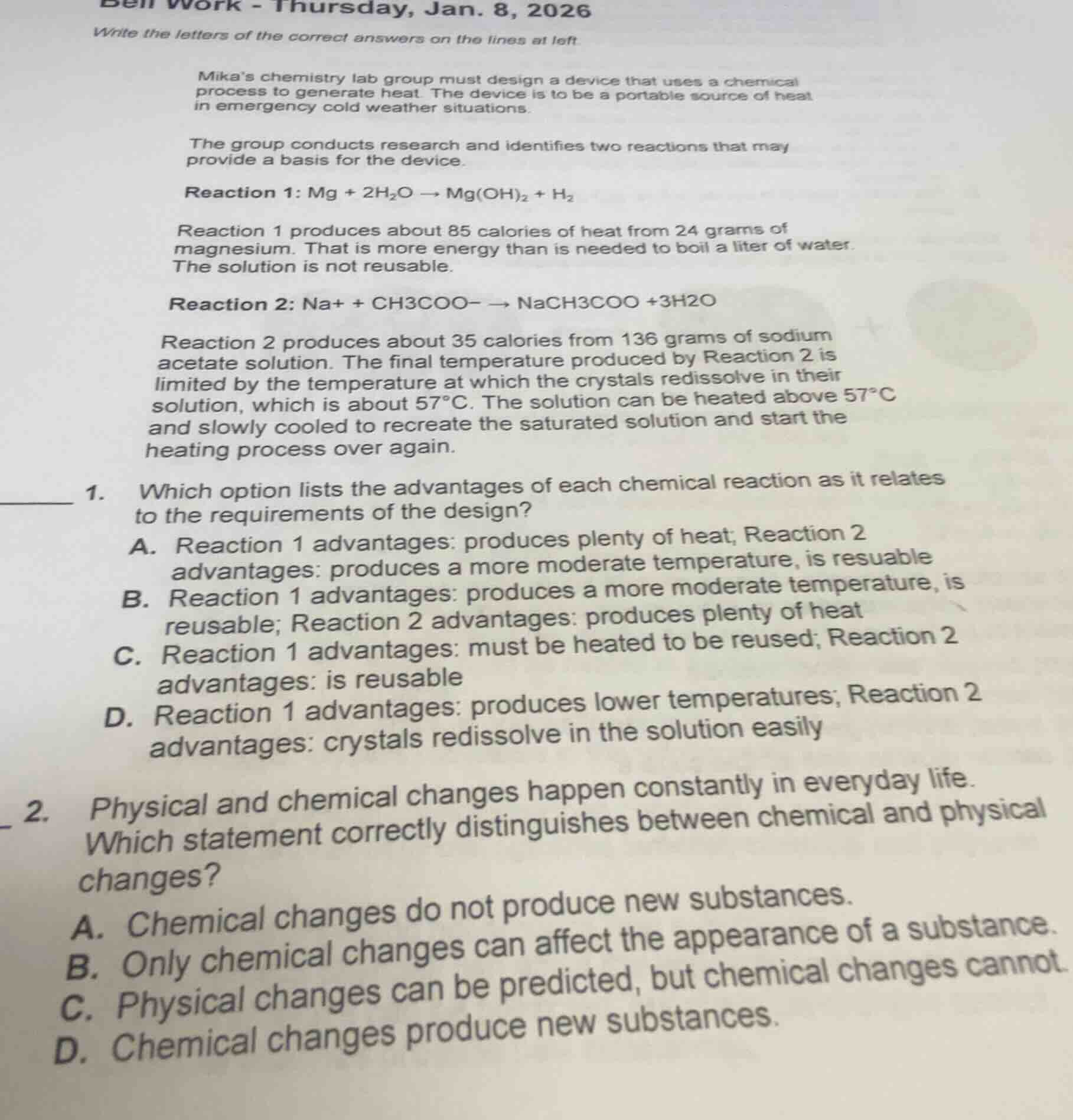
mika’s chemistry lab group must design a device that uses a chemical
process to generate heat. the device is to be a portable source of heat
in emergency cold weather situations.
the group conducts research and identifies two reactions that may
provide a basis for the device.
reaction 1: mg + 2h₂o → mg(oh)₂ + h₂
reaction 1 produces about 85 calories of heat from 24 grams of
magnesium. that is more energy than is needed to boil a liter of water.
the solution is not reusable.
reaction 2: na⁺ + ch₃coo⁻ → nach₃coo + 3h₂o
reaction 2 produces about 35 calories from 136 grams of sodium
acetate solution. the final temperature produced by reaction 2 is
limited by the temperature at which the crystals redissolve in their
solution, which is about 57°c. the solution can be heated above 57°c
and slowly cooled to recreate the saturated solution and start the
heating process over again.
- which option lists the advantages of each chemical reaction as it relates
to the requirements of the design?
a. reaction 1 advantages: produces plenty of heat; reaction 2
advantages: produces a more moderate temperature, is resuable
b. reaction 1 advantages: produces a more moderate temperature, is
reusable; reaction 2 advantages: produces plenty of heat
c. reaction 1 advantages: must be heated to be reused; reaction 2
advantages: is reusable
d. reaction 1 advantages: produces lower temperatures; reaction 2
advantages: crystals redissolve in the solution easily
- physical and chemical changes happen constantly in everyday life.
which statement correctly distinguishes between chemical and physical
changes?
a. chemical changes do not produce new substances.
b. only chemical changes can affect the appearance of a substance.
c. physical changes can be predicted, but chemical changes cannot.
d. chemical changes produce new substances.
- For question 1: Reaction 1 produces ~85 calories (more than enough to boil water, so plenty of heat) and is not reusable. Reaction 2 produces ~35 calories (moderate heat, capped at 57°C) and is reusable by reheating/cooling. Option A matches these advantages.
- For question 2: The key distinction between chemical and physical changes is that chemical changes form new substances, while physical changes only alter appearance/state without creating new matter. Option D states this correctly.

Snap & solve any problem in the app
Get step-by-step solutions on Sovi AI
Photo-based solutions with guided steps
Explore more problems and detailed explanations
- A. Reaction 1 advantages: produces plenty of heat; Reaction 2 advantages: produces a more moderate temperature, is resuable
- D. Chemical changes produce new substances.