QUESTION IMAGE
Question
on black friday, jack waited in line for hours to get a new tv. he ended up getting an awesome deal on a 70 - inch - wide tv. jacks new tv is n inches wider than his old tv, which was 50 inches wide. he cant wait to watch a movie on the huge screen!
which diagram models the story?
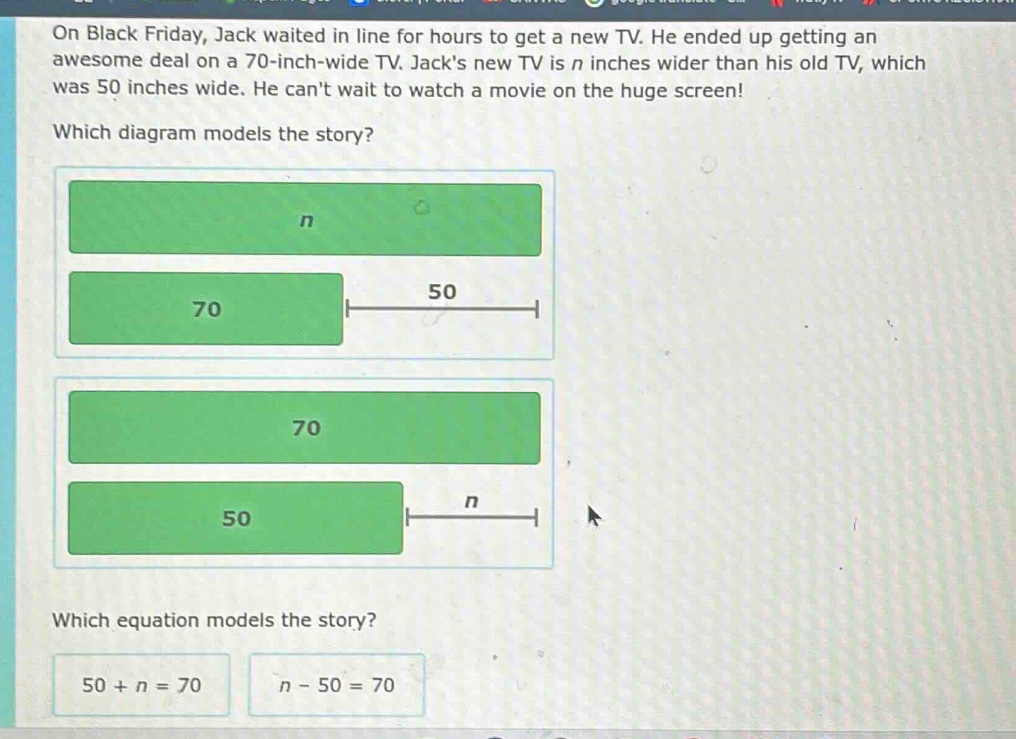
two sets of diagrams are shown, the first set has a green rectangle labeled n on top, and a green rectangle labeled 70 with a segment labeled 50 next to it below; the second set has a green rectangle labeled 70 on top, and a green rectangle labeled 50 with a segment labeled n next to it below
which equation models the story?
$50 + n = 70$ $n - 50 = 70$
Part 1: Which diagram models the story?
The old TV is 50 inches wide, and the new TV (70 inches) is \( n \) inches wider than the old one. So the diagram should show the old TV (50) with an extension of \( n \) to reach the new TV (70). The second diagram has the 50 - inch bar with an \( n \) - inch extension to match the 70 - inch bar, which fits the story. The first diagram incorrectly shows 70 and 50 as parts of \( n \).
Step1: Define the relationship
The old TV's width is 50 inches. The new TV is \( n \) inches wider than the old one, so we add \( n \) to the old width to get the new width (70 inches).
Step2: Form the equation
Mathematically, this is \( 50 + n = 70 \). The other equation \( n - 50 = 70 \) would imply the new TV is 50 inches narrower than \( n \), which does not match the story.

Snap & solve any problem in the app
Get step-by-step solutions on Sovi AI
Photo-based solutions with guided steps
Explore more problems and detailed explanations
The second diagram (with the 50 - inch bar and an \( n \) - inch extension to the 70 - inch bar)