QUESTION IMAGE
Question
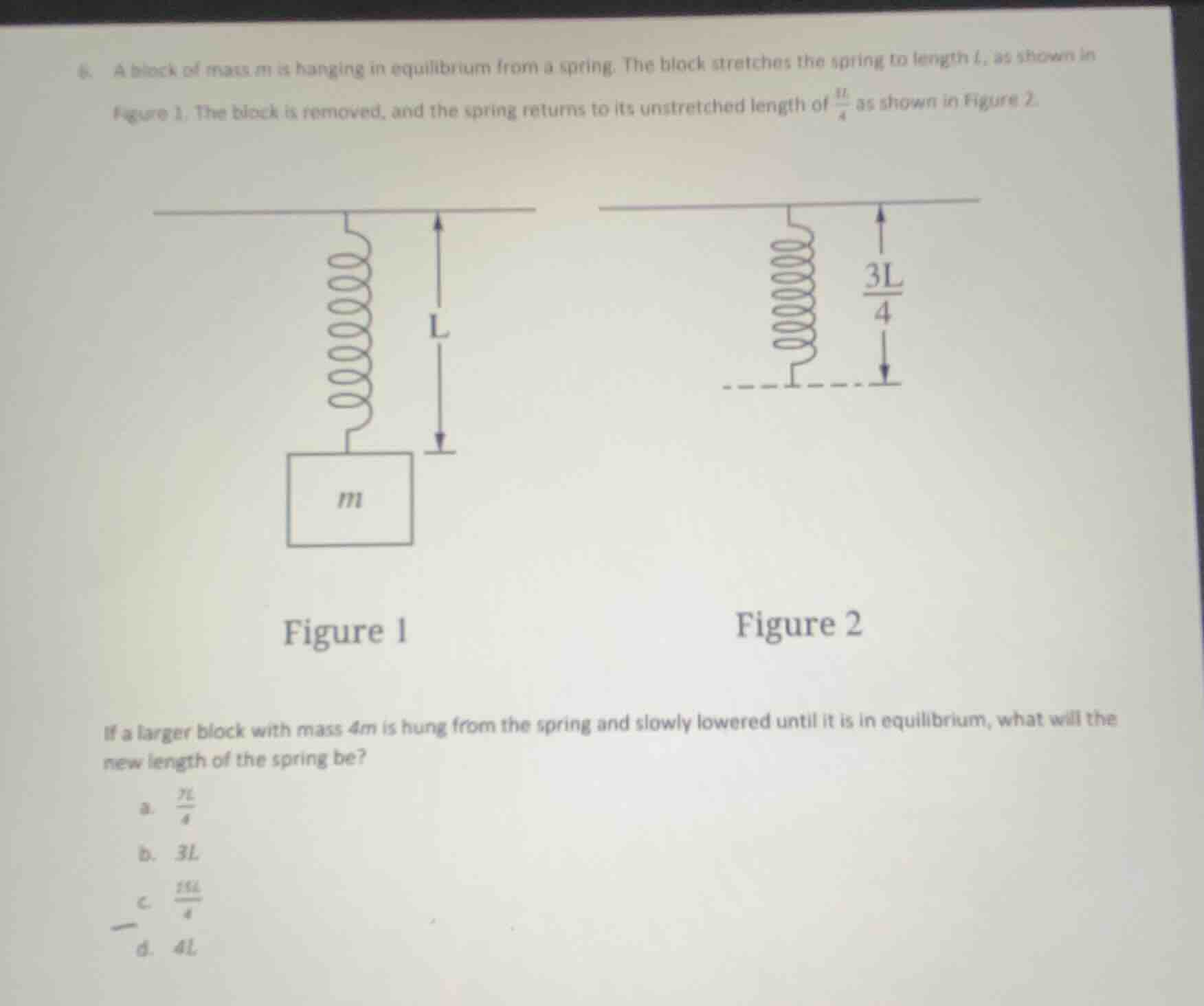
- a block of mass m is hanging in equilibrium from a spring. the block stretches the spring to length l, as shown in figure 1. the block is removed, and the spring returns to its unstretched length of \\(\frac{l}{4}\\) as shown in figure 2.
two figures of springs, one with mass m (figure 1) and one without (figure 2) with length markings
if a larger block with mass 4m is hung from the spring and slowly lowered until it is in equilibrium, what will the new length of the spring be?
a. \\(\frac{l}{4}\\)
b. 3l
c. \\(\frac{13l}{4}\\)
d. 4l
Step1: Find the spring constant \( k \)
When the mass \( m \) is hanging, the spring is stretched. The unstretched length is \( \frac{L}{4} \), and the stretched length is \( L \), so the extension \( x_1 = L - \frac{L}{4}=\frac{3L}{4} \). At equilibrium, the spring force equals the weight: \( kx_1 = mg \), so \( k\times\frac{3L}{4}=mg \), which gives \( k = \frac{4mg}{3L} \).
Step2: Find the extension for mass \( 4m \)
For mass \( 4m \), let the extension be \( x_2 \). At equilibrium, \( kx_2 = 4mg \). Substitute \( k \): \( \frac{4mg}{3L}\times x_2 = 4mg \). Solving for \( x_2 \), we get \( x_2 = 3L \). Wait, no, that can't be. Wait, no, the unstretched length is \( \frac{L}{4} \), wait, maybe I messed up the initial length. Wait, Figure 2 shows the unstretched length is \( \frac{3L}{4} \)? Wait, no, the problem says: "the spring returns to its unstretched length of \( \frac{L}{4} \)". Wait, Figure 1: the length from the top to the block is \( L \), Figure 2: the length from the top to the unstretched spring's end is \( \frac{3L}{4} \)? Wait, no, the problem says: "the spring returns to its unstretched length of \( \frac{L}{4} \)". Wait, maybe the initial stretched length is \( L \), unstretched is \( \frac{L}{4} \), so extension \( x_1 = L - \frac{L}{4}=\frac{3L}{4} \). Then for mass \( m \), \( kx_1 = mg \implies k = \frac{mg}{x_1}=\frac{mg}{\frac{3L}{4}}=\frac{4mg}{3L} \). Now for mass \( 4m \), \( kx_2 = 4mg \implies x_2 = \frac{4mg}{k}=\frac{4mg}{\frac{4mg}{3L}} = 3L \). Wait, but the unstretched length is \( \frac{L}{4} \), so the new length is unstretched length plus extension: \( \frac{L}{4}+3L=\frac{13L}{4} \)? No, that's not an option. Wait, maybe I misread the unstretched length. Wait, the problem says: "the spring returns to its unstretched length of \( \frac{L}{4} \)". Wait, Figure 1: the length is \( L \) (from top to the block), Figure 2: the length from top to the spring's end (unstretched) is \( \frac{3L}{4} \)? No, the problem says "unstretched length of \( \frac{L}{4} \)". Wait, maybe the initial length \( L \) is the stretched length, unstretched is \( \frac{L}{4} \), so extension \( \Delta L_1 = L - \frac{L}{4}=\frac{3L}{4} \). Then \( F = k\Delta L_1 = mg \implies k = \frac{mg}{\frac{3L}{4}}=\frac{4mg}{3L} \). For \( 4m \), \( F = 4mg = k\Delta L_2 \implies \Delta L_2 = \frac{4mg}{k}=\frac{4mg}{\frac{4mg}{3L}} = 3L \). Then new length is unstretched length \( \frac{L}{4} \) plus \( \Delta L_2 \): \( \frac{L}{4}+3L=\frac{13L}{4} \)? But option c is \( \frac{13L}{4} \). Wait, yes, option c is \( \frac{13L}{4} \).

Snap & solve any problem in the app
Get step-by-step solutions on Sovi AI
Photo-based solutions with guided steps
Explore more problems and detailed explanations
c. \( \frac{13L}{4} \)