QUESTION IMAGE
Question
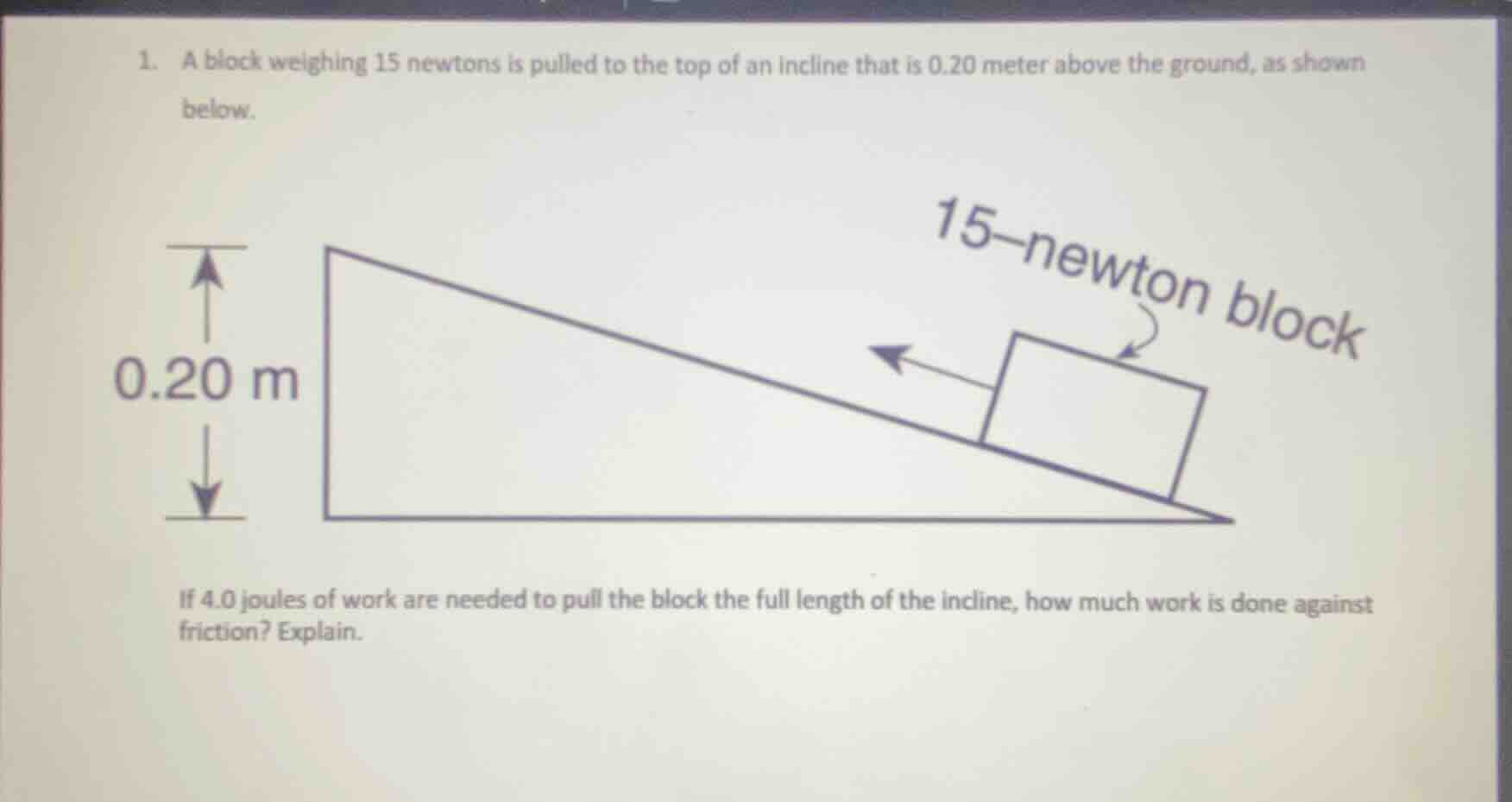
- a block weighing 15 newtons is pulled to the top of an incline that is 0.20 meter above the ground, as shown below. if 4.0 joules of work are needed to pull the block the full length of the incline, how much work is done against friction? explain.
Step1: Calculate work done against gravity
The work done against gravity is given by the formula \( W_{gravity} = F \times d \), where \( F \) is the weight of the block (15 N) and \( d \) is the vertical distance (0.20 m). So, \( W_{gravity} = 15 \, \text{N} \times 0.20 \, \text{m} = 3.0 \, \text{J} \).
Step2: Determine work done against friction
The total work done to pull the block (\( W_{total} = 4.0 \, \text{J} \)) is the sum of the work done against gravity (\( W_{gravity} \)) and the work done against friction (\( W_{friction} \)). So, \( W_{total} = W_{gravity} + W_{friction} \). Rearranging for \( W_{friction} \), we get \( W_{friction} = W_{total} - W_{gravity} \). Substituting the values, \( W_{friction} = 4.0 \, \text{J} - 3.0 \, \text{J} = 1.0 \, \text{J} \).

Snap & solve any problem in the app
Get step-by-step solutions on Sovi AI
Photo-based solutions with guided steps
Explore more problems and detailed explanations
The work done against friction is \( 1.0 \) joules.