QUESTION IMAGE
Question
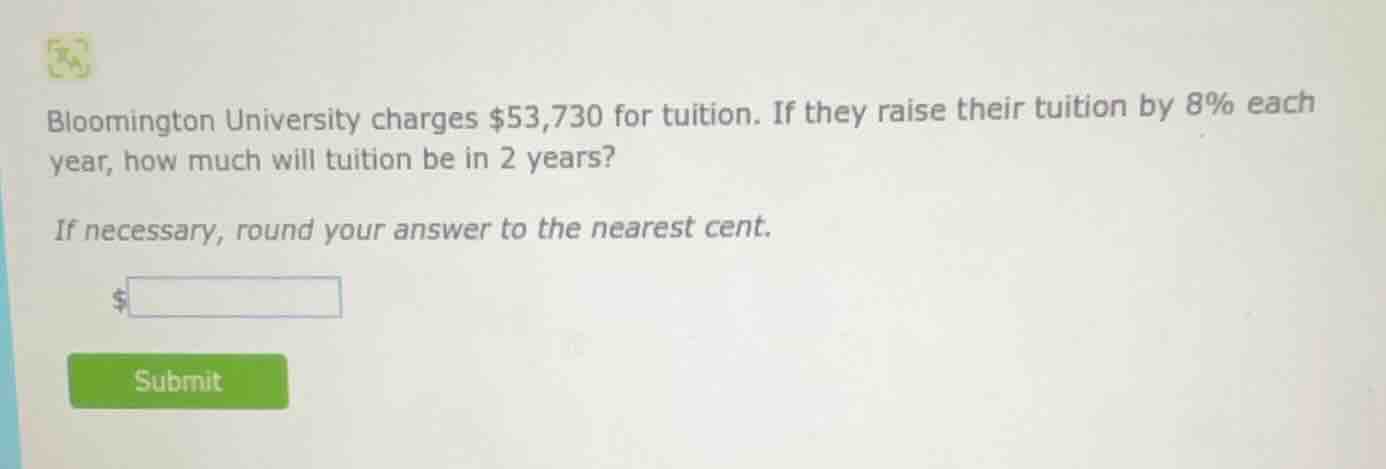
bloomington university charges $53,730 for tuition. if they raise their tuition by 8% each year, how much will tuition be in 2 years? if necessary, round your answer to the nearest cent.
Step1: Identify the formula for compound growth
The formula for compound growth is $A = P(1 + r)^t$, where $P$ is the principal amount, $r$ is the annual interest rate (as a decimal), and $t$ is the number of years.
Here, $P = 53730$, $r = 0.08$ (since 8% = 0.08), and $t = 2$.
Step2: Calculate the amount after 1 year
First, calculate the amount after the first year. Using the formula for one year: $A_1 = P(1 + r) = 53730(1 + 0.08)$.
$A_1 = 53730\times1.08 = 53730\times1 + 53730\times0.08 = 53730 + 4298.4 = 58028.4$.
Step3: Calculate the amount after 2 years
Now, use the amount after the first year as the principal for the second year. So, $A_2 = A_1(1 + r) = 58028.4(1 + 0.08)$.
Alternatively, using the compound growth formula directly: $A = 53730(1 + 0.08)^2$.
First, calculate $(1 + 0.08)^2 = 1.08^2 = 1.1664$.
Then, $A = 53730\times1.1664$.
$53730\times1.1664 = 53730\times1 + 53730\times0.1664 = 53730 + 53730\times0.1664$.
Calculate $53730\times0.1664$: $53730\times0.1 = 5373$, $53730\times0.06 = 3223.8$, $53730\times0.0064 = 343.872$. Adding these together: $5373 + 3223.8 + 343.872 = 8940.672$.
Then, $53730 + 8940.672 = 62670.672$.
Step4: Round to the nearest cent
The amount is $62670.672$, which rounds to $62670.67$ when rounded to the nearest cent. Wait, no, actually, $62670.672$ rounded to the nearest cent is $62670.67$? Wait, no, 0.672 is closer to 0.67 or 0.68? Wait, 0.672 - 0.67 = 0.002, and 0.68 - 0.672 = 0.008. So it's closer to 0.67? Wait, no, wait, 62670.672: the third decimal is 2, which is less than 5, so we round down the second decimal. Wait, no, the number is 62670.672, so the cents are the hundredths place. So 0.672 dollars is 67.2 cents, so when rounding to the nearest cent (hundredth of a dollar), we look at the thousandths place, which is 2. Since 2 < 5, we keep the hundredths place as 7. So $62670.67$. Wait, but let's recalculate the multiplication correctly.
Wait, $53730\times1.1664$: let's do the multiplication properly.
$53730\times1.1664$:
First, $53730\times1 = 53730$
$53730\times0.1 = 5373$
$53730\times0.06 = 3223.8$
$53730\times0.006 = 322.38$
$53730\times0.0004 = 21.492$
Now, add these together:
$53730 + 5373 = 59103$
$59103 + 3223.8 = 62326.8$
$62326.8 + 322.38 = 62649.18$
$62649.18 + 21.492 = 62670.672$
Yes, so that's correct. So $62670.672$ dollars, which is $62670.67$ when rounded to the nearest cent? Wait, no, 0.672 is 67.2 cents, so the nearest cent is 67 cents? Wait, no, 0.672: the hundredths place is 7, the thousandths place is 2. Since 2 < 5, we don't round up the hundredths place. So it's $62670.67$? Wait, but let's check with the formula again.
Wait, the formula is $A = P(1 + r)^t$. So $P = 53730$, $r = 0.08$, $t = 2$. So $(1 + 0.08)^2 = 1.1664$. Then $53730\times1.1664 = 53730\times1.1664$. Let's do this multiplication:
$53730\times1.1664$:
First, $53730\times1 = 53730$
$53730\times0.1 = 5373$
$53730\times0.06 = 3223.8$
$53730\times0.006 = 322.38$
$53730\times0.0004 = 21.492$
Now, sum these:
$53730 + 5373 = 59103$
$59103 + 3223.8 = 62326.8$
$62326.8 + 322.38 = 62649.18$
$62649.18 + 21.492 = 62670.672$
So, $62670.672$ dollars. Rounded to the nearest cent (two decimal places), since the third decimal is 2, which is less than 5, we round down the second decimal. So $62670.67$? Wait, no, 0.672 is 67.2 cents, so the nearest cent is 67 cents, so $62670.67$. Wait, but let me check with another approach.
First year: 53730 1.08 = 53730 + 537300.08 = 53730 + 4298.4 = 58028.4
Second year: 58028.4 1.08 = 58028.4 + 58028.40.08 = 58028.4 + 4642.272 = 62670.672
Yes, same…

Snap & solve any problem in the app
Get step-by-step solutions on Sovi AI
Photo-based solutions with guided steps
Explore more problems and detailed explanations
\$62670.67