QUESTION IMAGE
Question
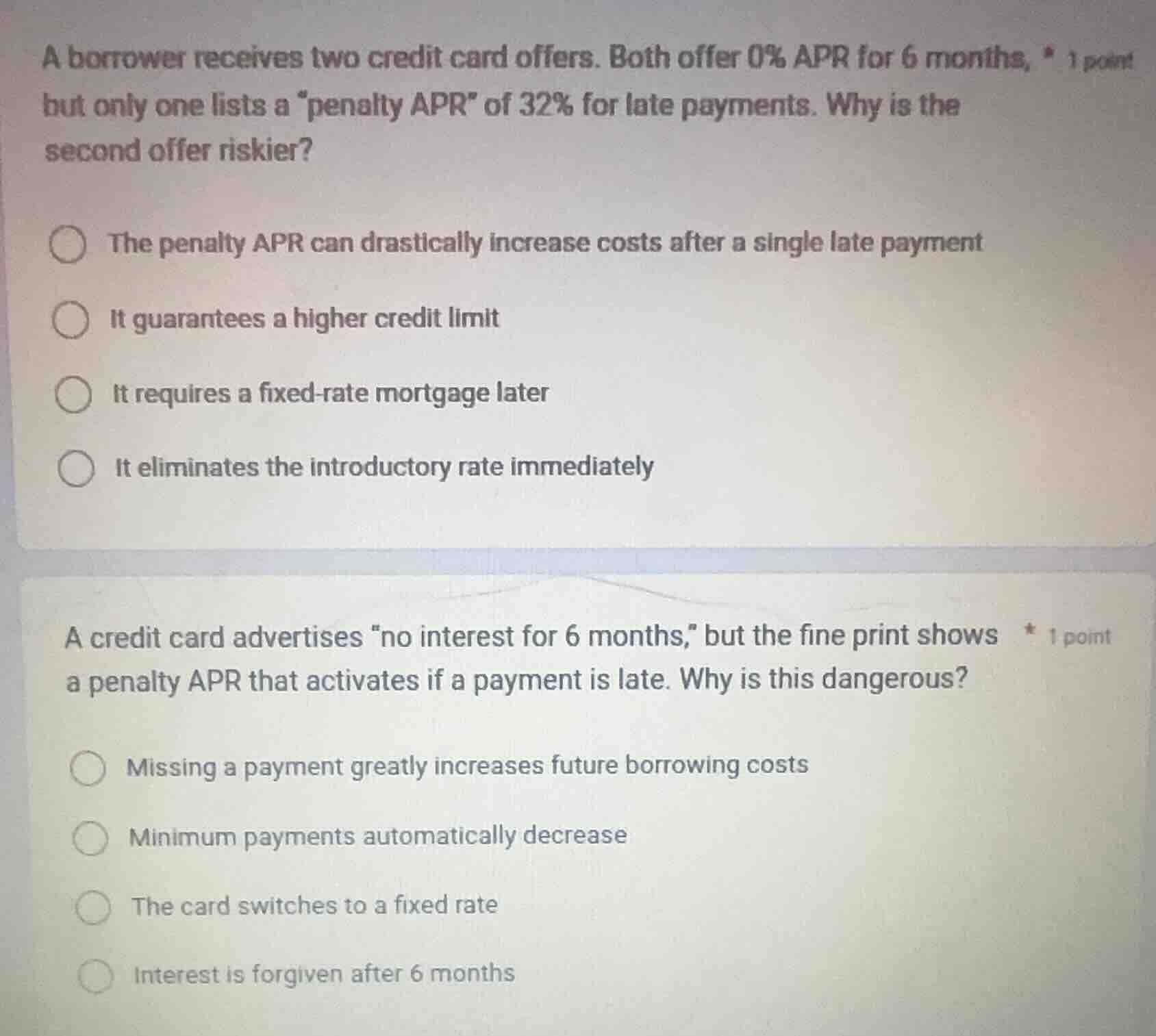
a borrower receives two credit card offers. both offer 0% apr for 6 months, but only one lists a \penalty apr\ of 32% for late payments. why is the second offer riskier?
the penalty apr can drastically increase costs after a single late payment
it guarantees a higher credit limit
it requires a fixed-rate mortgage later
it eliminates the introductory rate immediately
a credit card advertises
o interest for 6 months,\ but the fine print shows a penalty apr that activates if a payment is late. why is this dangerous?
missing a payment greatly increases future borrowing costs
minimum payments automatically decrease
the card switches to a fixed rate
interest is forgiven after 6 months
First Question
- Analyze each option:
- Option 1: A penalty APR of 32% means that if a payment is late, the interest rate (and thus costs) will jump significantly. This makes the offer riskier as a single late payment can lead to much higher costs.
- Option 2: A higher credit limit doesn't make an offer riskier in terms of penalty APR; it's unrelated.
- Option 3: The question is about credit card offers, not mortgages, so this is irrelevant.
- Option 4: The introductory rate (0% APR for 6 months) is not eliminated immediately by the penalty APR; the penalty is for late payments, not for the introductory rate's duration.
- Analyze each option:
- Option 1: If a payment is late, the penalty APR activates, which means the interest rate (and borrowing costs) will increase a lot. So missing a payment leads to higher future borrowing costs, making it dangerous.
- Option 2: Minimum payments decreasing is not related to the penalty APR for late payments and doesn't make the offer dangerous in this context.
- Option 3: The card has a 0% introductory rate and a penalty APR for late payments, not a switch to a fixed rate due to late payments (the penalty is a high APR, not a fixed - rate switch).
- Option 4: The “no interest for 6 months” is the introductory rate; the penalty APR is for late payments, and interest is not forgiven in the sense that late payments trigger a high APR, so this is incorrect.

Snap & solve any problem in the app
Get step-by-step solutions on Sovi AI
Photo-based solutions with guided steps
Explore more problems and detailed explanations
A. The penalty APR can drastically increase costs after a single late payment