QUESTION IMAGE
Question
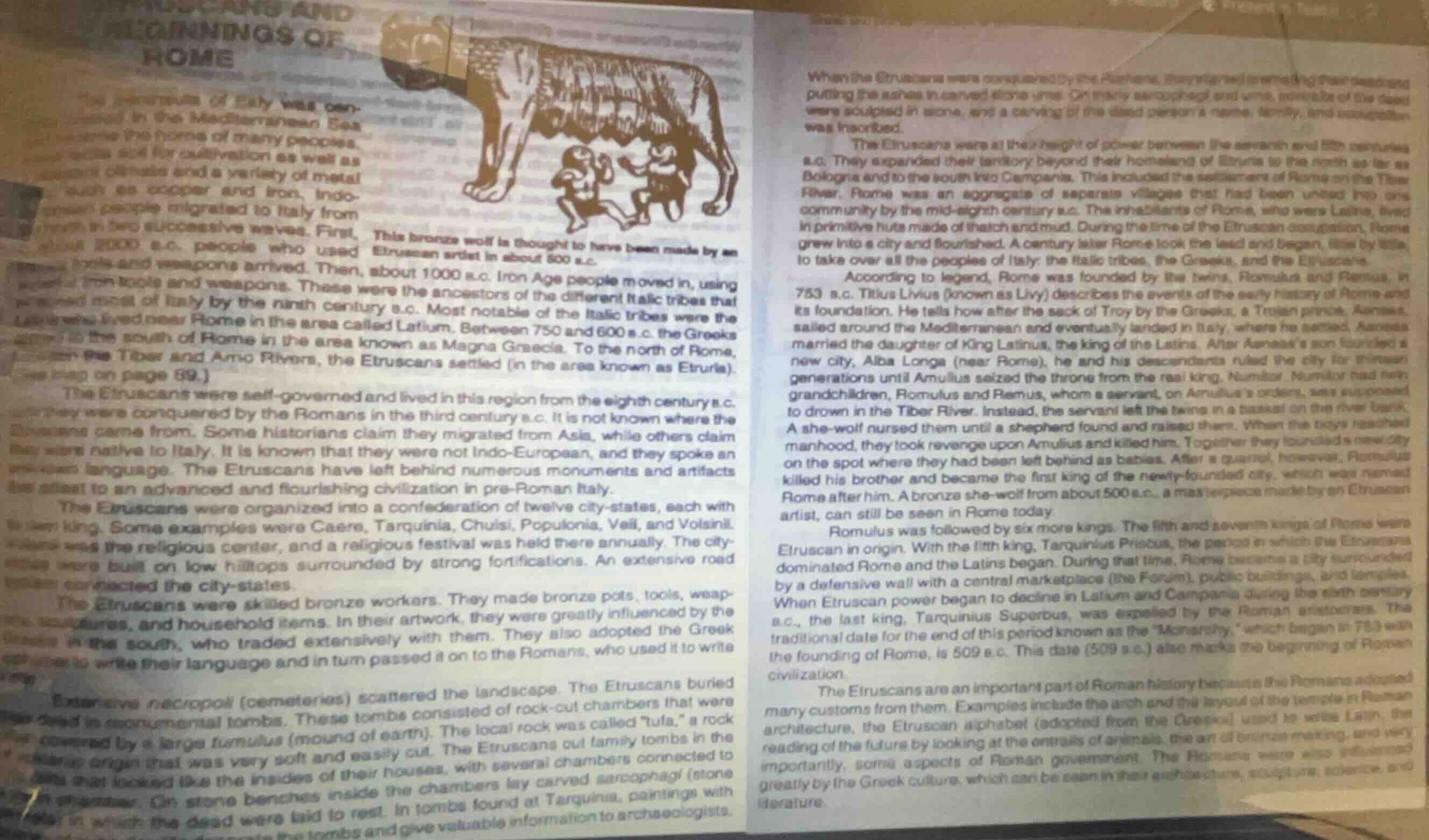
this bronze wolf is thought to have been made by an etruscan artist in about 500 b.c. the peninsula of italy was centered in the mediterranean sea, home to the homes of many peoples, and for cultivation as well as climate and a variety of metal such as copper and iron. indo - european people migrated to italy from north in two successive waves. first, about 1000 b.c. peoples who used bronze tools and weapons arrived. then, about 1000 b.c. iron age people moved in, using iron tools and weapons. these were the ancestors of the different italic tribes that populated most of italy by the ninth century b.c. most notable of the italic tribes were the latins who lived near rome in the area called latium. between 750 and 600 b.c. the greeks settled to the south of rome in the area known as magna graecia. to the north of rome, between the tiber and arno rivers, the etruscans settled (in the area known as etruria). (see map on page 59.) the etruscans were self - governed and lived in this region from the eighth century b.c. until they were conquered by the romans in the third century b.c. it is not known where the etruscans came from. some historians claim they migrated from asia, while others claim they were native to italy. it is known that they were not indo - european, and they spoke an unknown language. the etruscans have left behind numerous monuments and artifacts that attest to an advanced and flourishing civilization in pre - roman italy. the etruscans were organized into a confederation of twelve city - states, each with its own king. some examples were caere, tarquinia, chiusi, populonia, veii, and volsinii. each city - state was the religious center, and a religious festival was held there annually. the city - states were built on low hilltops surrounded by strong fortifications. an extensive road system connected the city - states. the etruscans were skilled bronze workers. they made bronze pots, tools, weapons, and household items. in their artwork, they were greatly influenced by the greeks in the south, who traded extensively with them. they also adopted the greek alphabet to write their language and in turn passed it on to the romans, who used it to write latin. extensive necropoli (cemeteries) scattered the landscape. the etruscans buried their dead in monumental tombs. these tombs consisted of rock - cut chambers that were covered by a large tumulus (mound of earth). the local rock was called “tufa,” a rock of volcanic origin that was very soft and easily cut. the etruscans cut family tombs in the tufa that looked like the insides of their houses, with several chambers connected to a central chamber. on stone benches inside the chambers lay carved sarcophagi (stone coffins) in which the dead were laid to rest. in tombs found at tarquinia, paintings with scenes of banquets, dances, and games decorate the tombs and give valuable information to archaeologists. when the etruscans were conquered by the romans, they started something that became part of roman custom: putting the ashes in carved stone urns. on many sarcophagi and urns, portraits of the dead were sculpted in stone, and a carving of the dead person’s name, family, and occupation was inscribed. the etruscans were at their height of power between the seventh and fifth centuries b.c. they expanded their territory beyond their homeland of etruria to the north as far as bologna and to the south into campania. this included the settlement of rome on the tiber river. rome was an aggregate of separate villages that had been united into one community by the mid - eighth century b.c. the inhabitants of rome, who were latins, lived in primitive huts made of thatch and mud. during the time of the etruscan domination, rome grew into a city and flourished. a century later rome took the lead and began, little by little, to take over all the peoples of italy: the italic tribes, the greeks, and the etruscans. according to legend, rome was founded by the twins, romulus and remus, in 753 b.c. titus livius (known as livy) describes the events of the early history of rome and its foundation. he tells how after the sack of troy by the greeks, a trojan prince, aeneas, sailed around the mediterranean and eventually landed in italy, where he settled. aeneas married the daughter of king latinus, the king of the latins. after aeneas’s son founded a new city, alba longa (near rome), he and his descendants ruled the city for thirteen generations until amulius seized the throne from the rightful king, numitor. numitor had two grandchildren, romulus and remus, whom a servant, on amulius’s orders, was supposed to drown in the tiber river. instead, the servant left the twins in a basket on the river bank. a she - wolf nursed them until a shepherd found and raised them. when the boys reached manhood, they took revenge upon amulius and killed him. together they founded a new city on the spot where they had been left behind as babies. after a quarrel, however, romulus killed his brother and became the first king of the newly - founded city, which was named rome after him. a bronze she - wolf from about 500 b.c., a masterpiece made by an etruscan artist, can still be seen in rome today. romulus was followed by six more kings. the fifth and seventh kings of rome were etruscan in origin. with the fifth king, tarquinius priscus, the period in which the etruscans dominated rome and the latins began. during that time, rome became a city surrounded by a defensive wall with a central marketplace (the forum), public buildings, and temples. when etruscan power began to decline in latium and campania during the sixth century b.c., the last king, tarquinius superbus, was expelled by the roman aristocrats. the traditional date for the end of this period known as the “monarchy,” which began in 753 with the founding of rome, is 509 b.c. this date (509 b.c.) also marks the beginning of roman civilization. the etruscans are an important part of roman history because the romans adopted many customs from them. examples include the arch and the layout of the temple in roman architecture, the etruscan alphabet (adopted from the greeks) used to write latin, the reading of the future by looking at the entrails of animals (the art of divination), and very importantly, some aspects of roman government. the romans were also influenced greatly by the greek culture, which can be seen in their architecture, sculpture, science, and literature.
Since no specific question is provided about this text (e.g., a question about the Etruscans, Roman history, or a detail from the passage), it's not possible to give a targeted answer. If you have a question like "What was the Etruscans' origin according to some historians?" or "How did the Etruscans influence Rome?", please share it, and I'll be able to assist using the appropriate format (Answer - Explanation or Step - by - Step depending on the question type).

Snap & solve any problem in the app
Get step-by-step solutions on Sovi AI
Photo-based solutions with guided steps
Explore more problems and detailed explanations
Since no specific question is provided about this text (e.g., a question about the Etruscans, Roman history, or a detail from the passage), it's not possible to give a targeted answer. If you have a question like "What was the Etruscans' origin according to some historians?" or "How did the Etruscans influence Rome?", please share it, and I'll be able to assist using the appropriate format (Answer - Explanation or Step - by - Step depending on the question type).