QUESTION IMAGE
Question
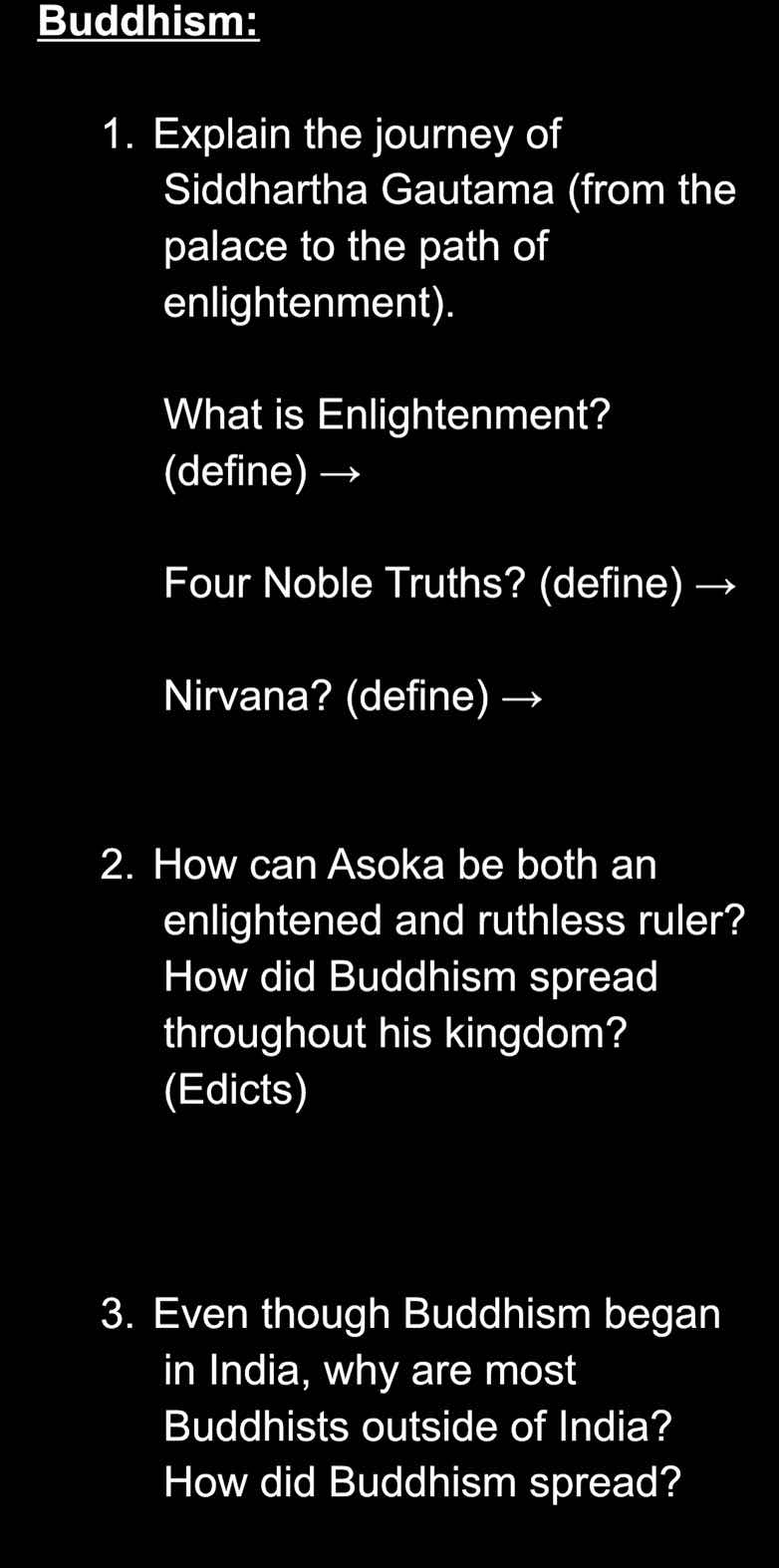
buddhism:
- explain the journey of
siddhartha gautama (from the
palace to the path of
enlightenment).
what is enlightenment?
(define) →
four noble truths? (define) →
nirvana? (define) →
- how can asoka be both an
enlightened and ruthless ruler?
how did buddhism spread
throughout his kingdom?
(edicts)
- even though buddhism began
in india, why are most
buddhists outside of india?
how did buddhism spread?
Brief Explanations
- For Siddhartha Gautama's journey: He was a sheltered prince who encountered suffering (old age, sickness, death, a mendicant) outside his palace. He renounced his royal life to seek answers, practiced extreme asceticism, then chose the Middle Way. He meditated under the Bodhi Tree and attained enlightenment.
- Enlightenment: In Buddhism, it is the state of perfect wisdom, where one breaks the cycle of samsara by overcoming ignorance and craving, gaining full understanding of the nature of reality.
- Four Noble Truths: Core Buddhist teachings: 1. Dukkha (life is filled with suffering); 2. Samudaya (suffering arises from craving/attachment); 3. Nirodha (suffering can be ended by letting go of craving); 4. Magga (the Eightfold Path is the way to end suffering).
- Nirvana: The ultimate spiritual goal, a state of complete liberation from suffering, craving, and the cycle of birth and death; it is a state of peace, emptiness, and freedom from all attachments.
- Ashoka was ruthless early in his reign (e.g., the brutal Kalinga War) to expand his empire. After witnessing the war's carnage, he converted to Buddhism, adopting enlightened policies like non-violence, religious tolerance, and public welfare. He spread Buddhism across his kingdom via rock and pillar edicts inscribed with Buddhist teachings, moral guidelines, and his own conversion story; he also sent Buddhist missionaries to different regions of his empire.
- Buddhism declined in India over time due to factors like the rise of Hinduism with devotional movements (Bhakti), Muslim invasions that destroyed Buddhist monasteries, and absorption of Buddhist ideas into Hinduism. It spread beyond India through: missionaries sent by Ashoka to Sri Lanka, Southeast Asia, and Central Asia; trade routes (Silk Road) that carried monks and teachings to China, Korea, and Japan; and royal patronage in these regions that supported the establishment of monasteries and Buddhist communities.

Snap & solve any problem in the app
Get step-by-step solutions on Sovi AI
Photo-based solutions with guided steps
Explore more problems and detailed explanations
- - Siddhartha Gautama's journey: Sheltered prince → encountered suffering → renounced royal life → practiced asceticism → adopted Middle Way → meditated under Bodhi Tree → attained enlightenment.
- Enlightenment: State of perfect wisdom, breaking samsara via ending ignorance/craving.
- Four Noble Truths: 1. Life has suffering (Dukkha); 2. Suffering comes from craving (Samudaya); 3. Suffering can end (Nirodha); 4. Eightfold Path ends suffering (Magga).
- Nirvana: Liberation from suffering, samsara, and all attachments; a state of perfect peace.
- - Ashoka was ruthless early to expand his empire (e.g., Kalinga War); post-war, he converted to Buddhism, adopting enlightened non-violent, welfare-focused policies.
- He spread Buddhism via inscribed rock/pillar edicts with Buddhist teachings and moral rules, distributed across his kingdom.
- - Buddhism declined in India due to Hindu Bhakti movements, Muslim invasions, and absorption of Buddhist ideas into Hinduism.
- It spread via Ashoka's missionaries to Sri Lanka/Southeast Asia; Silk Road trade routes to East Asia; and royal patronage in new regions supporting Buddhist institutions.