QUESTION IMAGE
Question
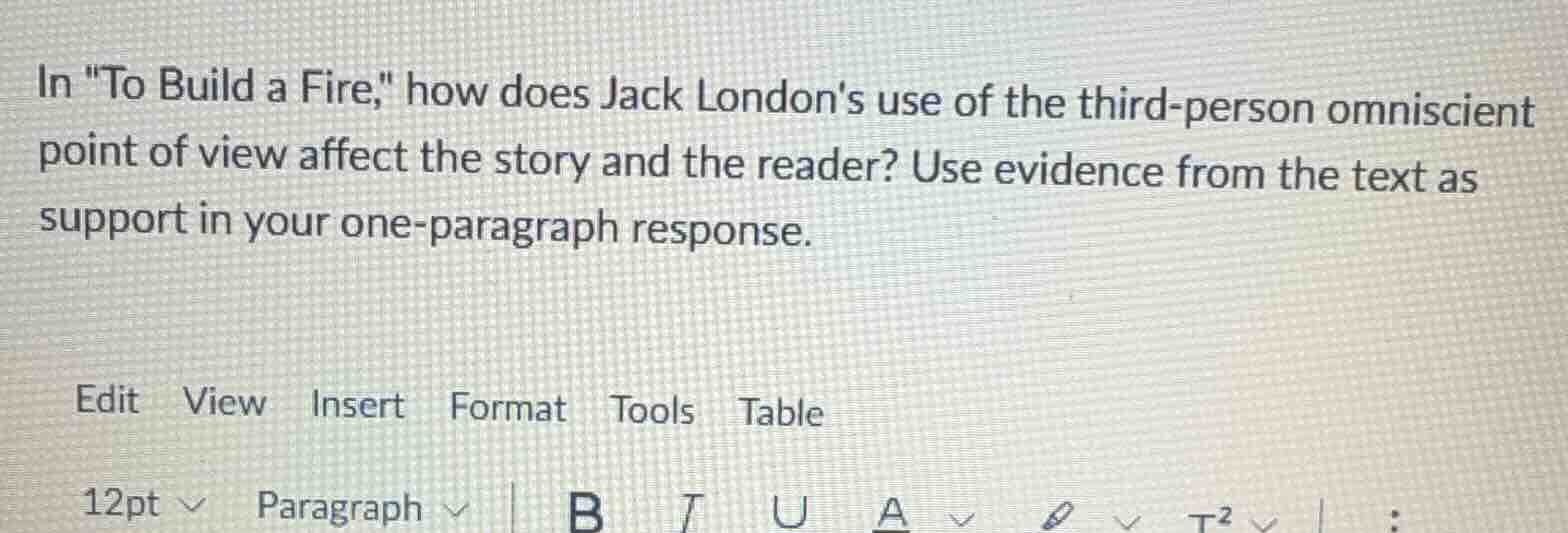
in \to build a fire,\ how does jack londons use of the third - person omniscient point of view affect the story and the reader? use evidence from the text as support in your one - paragraph response.
Jack London's third-person omniscient point of view in To Build a Fire lets readers access both the man's limited, overconfident perspective and the unforgiving, objective reality of the Yukon environment. For example, the narrator reveals the man's dismissal of the old-timer's warning about traveling alone in -50°F weather ("he was without imagination. He was quick and alert in the things of life, but only in the things, and not in the significances") while also detailing the brutal, factual conditions: "the spit crackled and spitted in the air, and before it could fall to the snow, the spit had frozen." This dual insight creates dramatic irony—readers know the man is walking toward disaster long before he recognizes the danger—building tension and forcing readers to confront the harsh contrast between human arrogance and nature's indifference. The omniscient perspective also allows London to frame the man's fate as a universal lesson about humility in the face of nature, rather than just a personal tragedy, by shifting focus to the broader, unyielding landscape after the man's death ("the dog turned and trotted up the trail in the direction of the camp it knew, where were the other food-providers and fire-providers").

Snap & solve any problem in the app
Get step-by-step solutions on Sovi AI
Photo-based solutions with guided steps
Explore more problems and detailed explanations
Jack London’s third-person omniscient point of view in To Build a Fire shapes the story and reader experience by creating dramatic irony, emphasizing the contrast between human overconfidence and nature's unforgiving power, and framing the man's fate as a universal cautionary lesson. The narrator reveals both the man's dismissive attitude toward the old-timer's warning ("he was without imagination. He was quick and alert in the things of life, but only in the things, and not in the significances") and the objective, deadly reality of the Yukon, such as the detail that "the spit crackled and spitted in the air, and before it could fall to the snow, the spit had frozen." This dual perspective lets readers recognize the man's impending doom long before he does, building sustained tension, and after his death, the narrator shifts focus to the dog’s instinctual drive toward survival, reinforcing nature's indifference to human struggle and driving home the story’s core theme of humility in the face of the natural world.