QUESTION IMAGE
Question
butanol thermodynamics
enthalpy of formation reaction
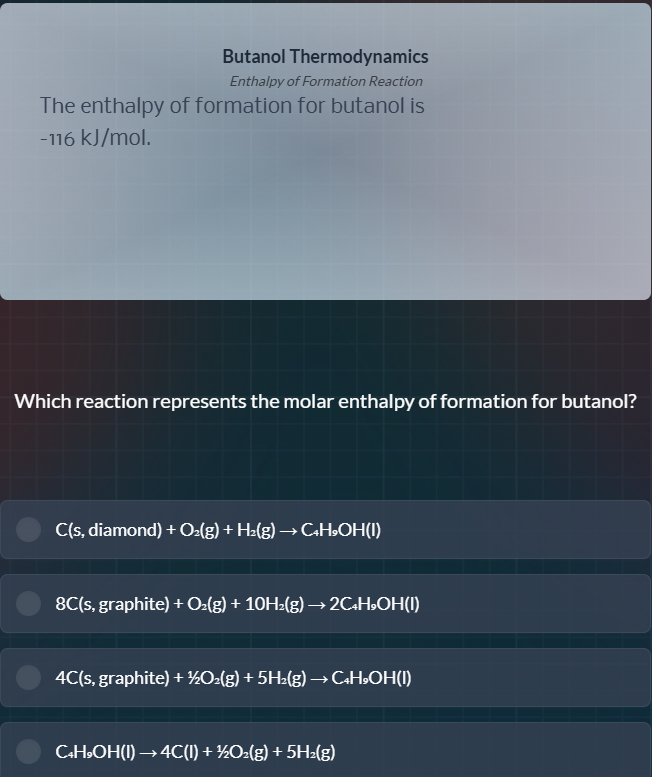
the enthalpy of formation for butanol is
-116 kj/mol.
which reaction represents the molar enthalpy of formation for butanol?
c(s, diamond) + o₂(g) + h₂(g) → c₄h₉oh(l)
8c(s, graphite) + o₂(g) + 10h₂(g) → 2c₄h₉oh(l)
4c(s, graphite) + ½o₂(g) + 5h₂(g) → c₄h₉oh(l)
c₄h₉oh(l) → 4c(l) + ½o₂(g) + 5h₂(g)
Step1: Recall enthalpy of formation definition
The molar enthalpy of formation (\(\Delta H_f\)) is the enthalpy change when 1 mole of a compound is formed from its most stable elemental forms in their standard states (e.g., C as graphite, \(O_2\) gas, \(H_2\) gas) under standard conditions.
Step2: Analyze each option
- Option 1: C is in diamond form (not the most stable; graphite is more stable). Eliminate.
- Option 2: Produces 2 moles of butanol. Enthalpy of formation is for 1 mole. Eliminate.
- Option 3: Forms 1 mole of \(C_4H_9OH(l)\) from stable elements: 4 moles of C (graphite), \(\frac{1}{2}\) mole of \(O_2(g)\), and 5 moles of \(H_2(g)\) (all standard states). Matches the definition.
- Option 4: This is the reverse reaction (decomposition), not formation. Eliminate.

Snap & solve any problem in the app
Get step-by-step solutions on Sovi AI
Photo-based solutions with guided steps
Explore more problems and detailed explanations
4C(s, graphite) + ½O₂(g) + 5H₂(g) → C₄H₉OH(l) (the third option)