QUESTION IMAGE
Question
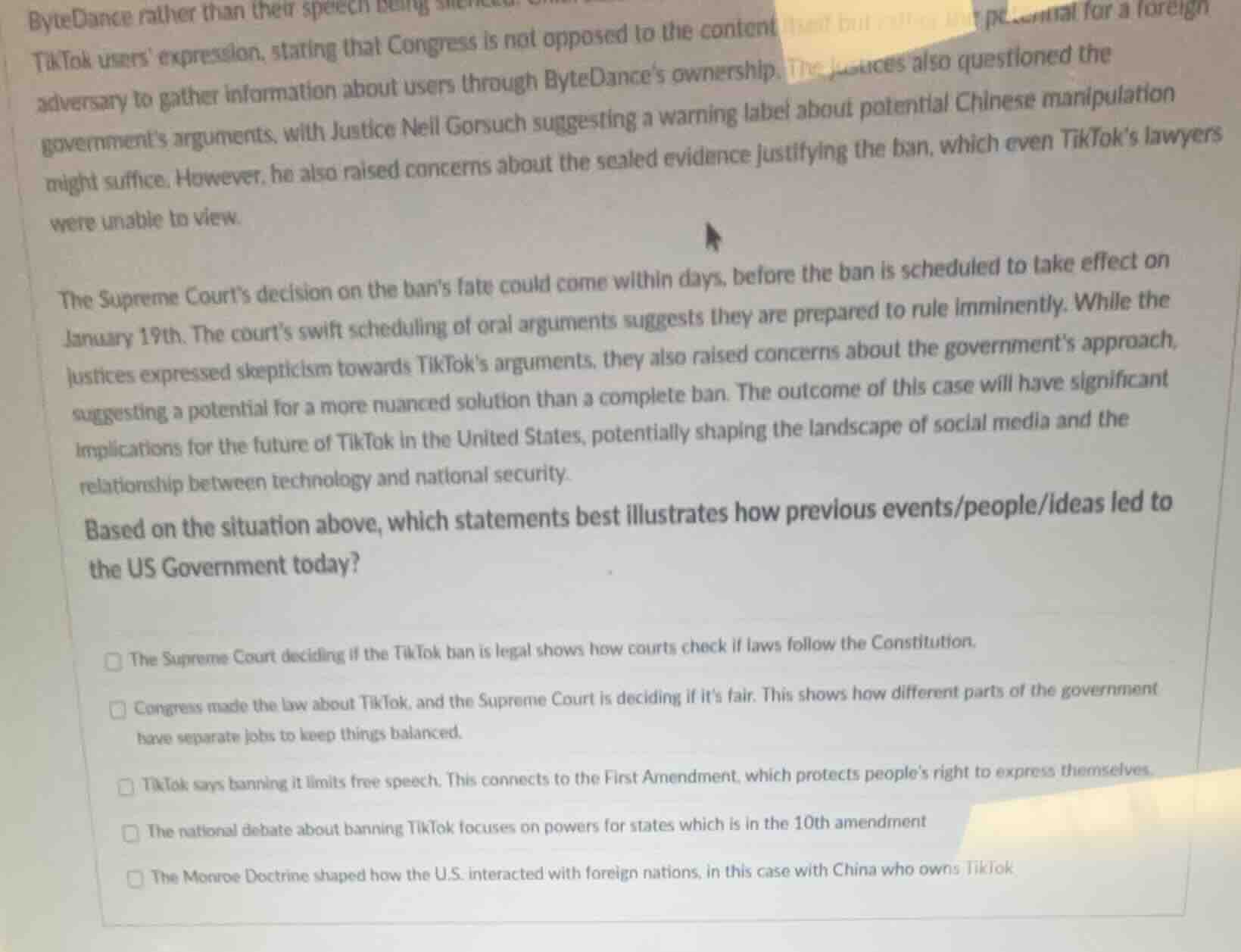
bytedance rather than their speech being silenced. tiktok users expression, stating that congress is not opposed to the content itself but rather the potential for a foreign adversary to gather information about users through bytedances ownership. the justices also questioned the governments arguments, with justice neil gorsuch suggesting a warning label about potential chinese manipulation might suffice. however, he also raised concerns about the sealed evidence justifying the ban, which even tiktoks lawyers were unable to view.
the supreme courts decision on the bans fate could come within days, before the ban is scheduled to take effect on january 19th. the courts swift scheduling of oral arguments suggests they are prepared to rule imminently. while the justices expressed skepticism towards tiktoks arguments, they also raised concerns about the governments approach, suggesting a potential for a more nuanced solution than a complete ban. the outcome of this case will have significant implications for the future of tiktok in the united states, potentially shaping the landscape of social media and the relationship between technology and national security.
based on the situation above, which statements best illustrates how previous events/people/ideas led to the us government today?
- the supreme court deciding if the tiktok ban is legal shows how courts check if laws follow the constitution.
- congress made the law about tiktok, and the supreme court is deciding if its fair. this shows how different parts of the government have separate jobs to keep things balanced.
- tiktok says banning it limits free speech. this connects to the first amendment, which protects peoples right to express themselves.
- the national debate about banning tiktok focuses on powers for states which is in the 10th amendment
- the monroe doctrine shaped how the u.s. interacted with foreign nations, in this case with china who owns tiktok
- First option: The Supreme Court reviewing the TikTok ban's legality directly reflects its constitutional role of judicial review, checking if government actions align with the Constitution, which is a core feature of the U.S. government system.
- Second option: Congress creating legislation and the Supreme Court reviewing it demonstrates the separation of powers and checks and balances, a foundational structure of the U.S. government to prevent concentrated power.
- Third option: TikTok's free speech argument ties to the First Amendment, a key constitutional protection that defines individual rights against government overreach, a central part of U.S. governance.
- Fourth option: The TikTok debate centers on federal national security powers, not state powers under the 10th Amendment, so this is incorrect.
- Fifth option: The Monroe Doctrine focused on European interference in the Americas, not modern U.S.-China tech relations, so this is irrelevant.

Snap & solve any problem in the app
Get step-by-step solutions on Sovi AI
Photo-based solutions with guided steps
Explore more problems and detailed explanations
- The Supreme Court deciding if the TikTok ban is legal shows how courts check if laws follow the Constitution.
- Congress made the law about TikTok, and the Supreme Court is deciding if it's fair. This shows how different parts of the government have separate jobs to keep things balanced.
- TikTok says banning it limits free speech. This connects to the First Amendment, which protects people's right to express themselves.