QUESTION IMAGE
Question
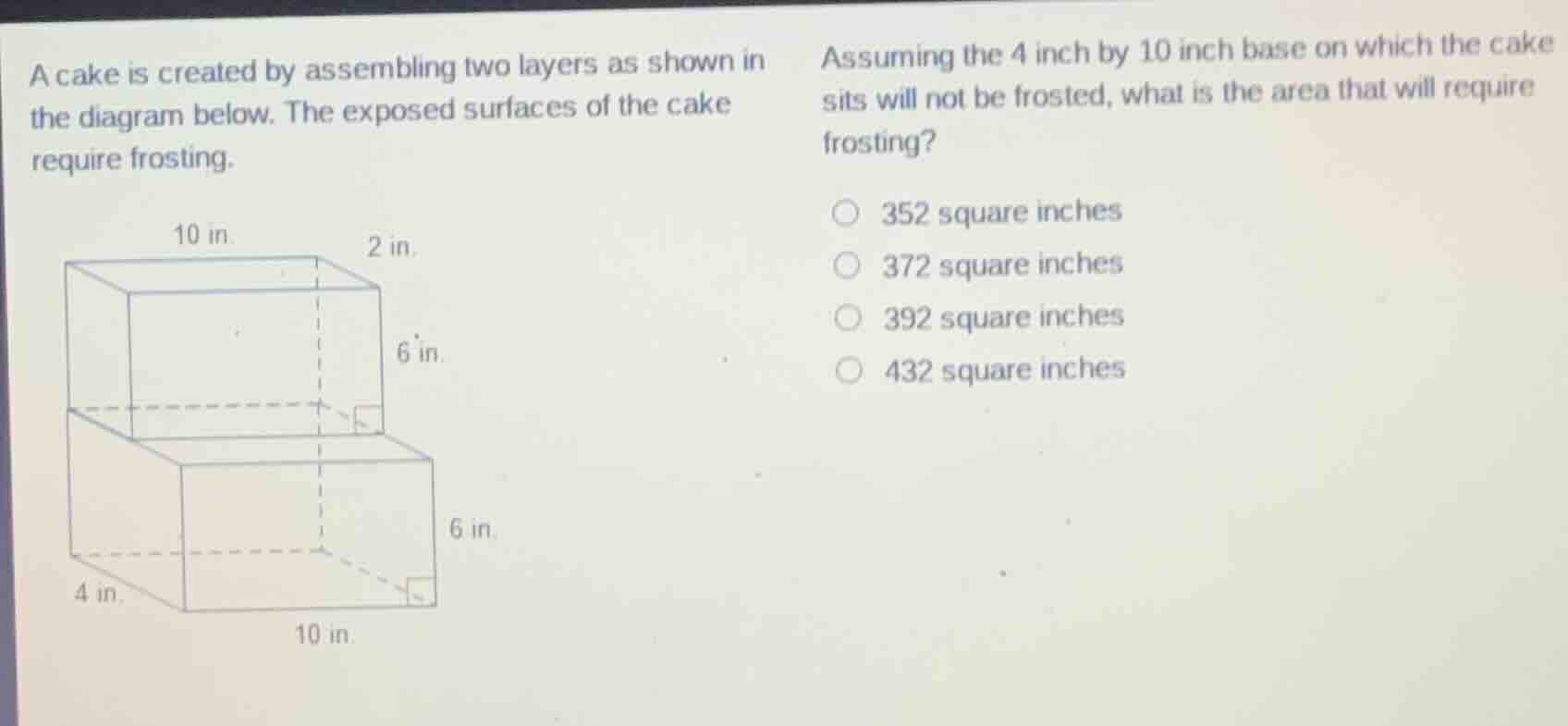
a cake is created by assembling two layers as shown in the diagram below. the exposed surfaces of the cake require frosting. assuming the 4 inch by 10 inch base on which the cake sits will not be frosted, what is the area that will require frosting? 352 square inches 372 square inches 392 square inches 432 square inches
Step1: Calculate bottom layer surface area
First, find the total surface area of the bottom rectangular prism, then subtract the base area (since it's not frosted) and the area where the top layer sits.
Total surface area of bottom prism: $2(lw + lh + wh) = 2(10\times4 + 10\times6 + 4\times6) = 2(40+60+24)=2\times124=248$ square inches.
Subtract base area ($10\times4=40$) and the area covered by top layer ($10\times2=20$):
$248 - 40 - 20 = 188$ square inches.
Step2: Calculate top layer surface area
Find the total surface area of the top rectangular prism, then subtract the area that sits on the bottom layer.
Total surface area of top prism: $2(lw + lh + wh) = 2(10\times2 + 10\times6 + 2\times6)=2(20+60+12)=2\times92=184$ square inches.
Subtract the bottom area of top layer ($10\times2=20$):
$184 - 20 = 164$ square inches.
Step3: Sum the frosted areas
Add the frosted area of the bottom layer and the top layer.
$188 + 164 = 352$ square inches.

Snap & solve any problem in the app
Get step-by-step solutions on Sovi AI
Photo-based solutions with guided steps
Explore more problems and detailed explanations
352 square inches