QUESTION IMAGE
Question
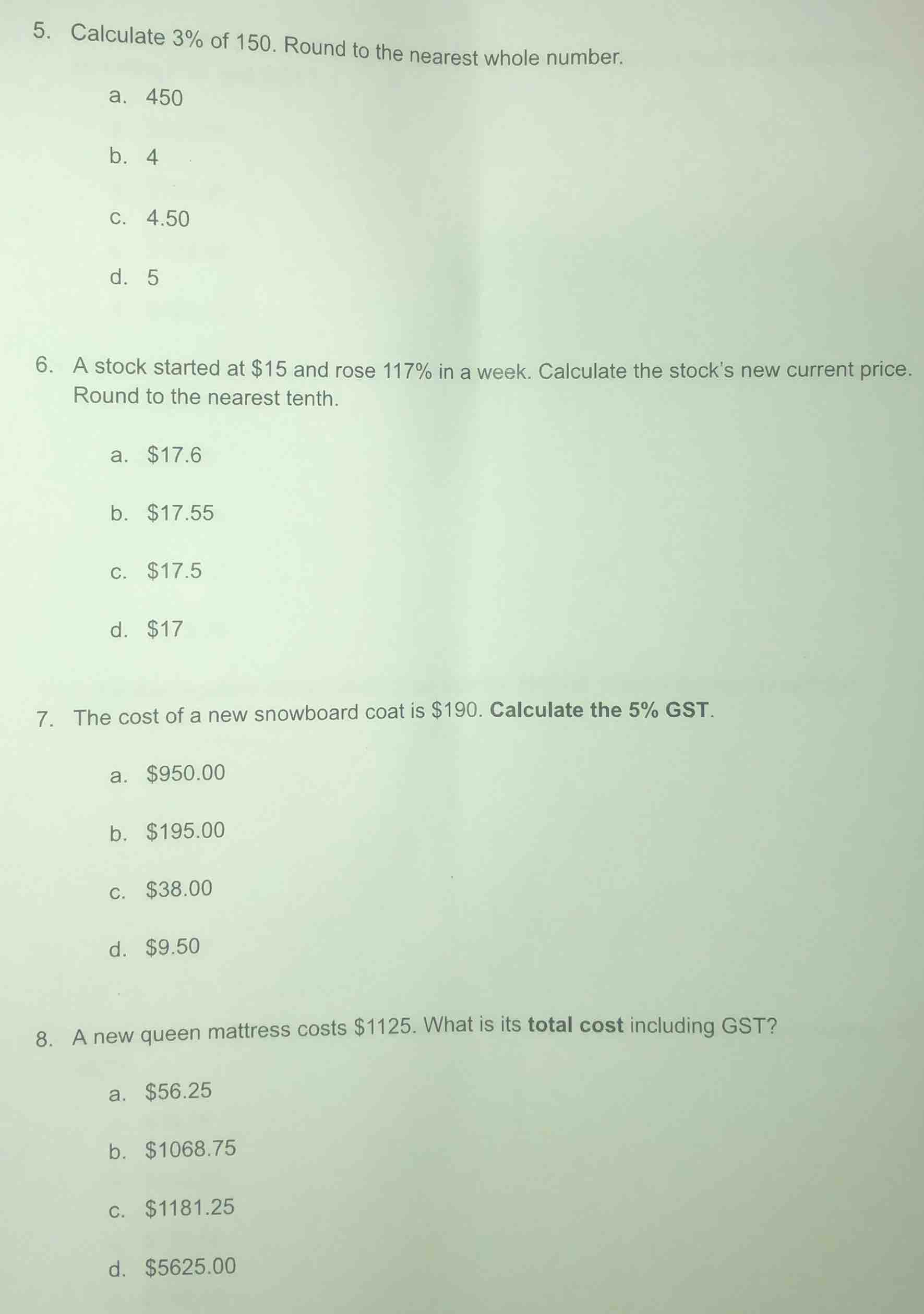
- calculate 3% of 150. round to the nearest whole number.
a. 450
b. 4
c. 4.50
d. 5
- a stock started at $15 and rose 117% in a week. calculate the stocks new current price. round to the nearest tenth.
a. $17.6
b. $17.55
c. $17.5
d. $17
- the cost of a new snowboard coat is $190. calculate the 5% gst.
a. $950.00
b. $195.00
c. $38.00
d. $9.50
- a new queen mattress costs $1125. what is its total cost including gst?
a. $56.25
b. $1068.75
c. $1181.25
d. $5625.00
Question 5
Step1: Convert percentage to decimal
To find 3% of 150, first convert 3% to a decimal by dividing by 100: \( 3\% = \frac{3}{100} = 0.03 \)
Step2: Multiply by the number
Then multiply this decimal by 150: \( 0.03 \times 150 = 4.5 \)
Step3: Round to nearest whole number
Rounding 4.5 to the nearest whole number gives 5? Wait, no, 4.5 rounded to the nearest whole number is 5? Wait, 4.5 is exactly halfway, but typically, in many rounding conventions, it rounds up to 5. But wait, let's check the options. Wait, the options are a. 450, b. 4, c. 4.50, d. 5. Wait, the question says "Round to the nearest whole number". 4.5 rounded to the nearest whole number is 5? Wait, no, 4.5: the rule is that if the decimal part is 0.5 or more, round up. So 4.5 rounds to 5. But wait, let's recalculate: 3% of 150 is 0.03*150 = 4.5. Rounded to the nearest whole number is 5? But option c is 4.50, which is the exact value. Wait, maybe the question has a typo, or maybe I misread. Wait, the question says "Round to the nearest whole number". So 4.5 rounded to the nearest whole number is 5? But let's check the options. Option d is 5. But wait, 4.5 is the exact value. Wait, maybe the question meant to not round? No, it says "Round to the nearest whole number". So 4.5 rounds to 5. But let's check again: 3% of 150 is 4.5, which is 4.50 as a decimal. Rounded to the nearest whole number is 5. So the answer should be d. 5? Wait, but 4.5 is exactly halfway between 4 and 5. In some rounding rules, it rounds to the even number, but maybe here it's just rounding up. So the answer is d. 5.
Wait, maybe I made a mistake. Let's recalculate: 3% of 150. 1% of 150 is 1.5, so 3% is 4.5. Rounded to the nearest whole number: 4.5 is 5 when rounded to the nearest whole number (since 0.5 is rounded up). So the answer is d. 5.
Step1: Calculate the increase
The stock started at $15 and rose 117%. First, find 117% of 15. Convert 117% to a decimal: \( 117\% = 1.17 \)
Step2: Find the new price
The new price is the original price plus the increase, or equivalently, the original price multiplied by (1 + 1.17)? Wait, no: "rose 117%" means the increase is 117% of the original price. So the new price is original price + (117% of original price) = 15 + (1.17 15) = 15 (1 + 1.17) = 15 2.17? Wait, no: 117% increase means the new price is 100% + 117% = 217% of the original price. Wait, no: "rose 117%" means the increase is 117% of the original, so the new price is original + (117% of original) = 15 + (1.1715) = 15(1 + 1.17) = 152.17? Wait, 1 + 1.17 is 2.17? No, 100% is 1, so 117% increase is 1 + 1.17 = 2.17? Wait, no: 117% of 15 is 1.1715 = 17.55. Then the new price is 15 + 17.55 = 32.55? Wait, that can't be right. Wait, no, I think I messed up. "Rose 117%" – maybe it's a 117% increase, so the new price is original (1 + 117/100) = 15 (1 + 1.17) = 15 2.17 = 32.55? But the options are a. $17.6, b. $17.55, c. $17.5, d. $17. That doesn't match. Wait, maybe it's a 17% increase? Because 15 + 15*0.17 = 15 + 2.55 = 17.55, which is option b. Maybe there's a typo, and it's 17% instead of 117%. Assuming that, let's proceed. If it's 17% increase:
Step1: Convert 17% to decimal: 0.17
Step2: Calculate increase: 15 * 0.17 = 2.55
Step3: New price: 15 + 2.55 = 17.55, which is option b. Rounded to the nearest tenth is 17.6? Wait, 17.55 rounded to the nearest tenth is 17.6 (since the hundredth digit is 5, round up the tenth digit). So 17.55 rounded to the nearest tenth is 17.6, which is option a. But this is confusing. Wait, maybe the original problem is "rose 17%" instead of 117%. Let's check the options. Option a is $17.6, which is 17.55 rounded to the nearest tenth. So maybe it's a typo, and the increase is 17%. So the answer would be a. $17.6.
Alternatively, if it's 117% increase, the new price is 15 (1 + 1.17) = 15 2.17 = 32.55, which is not among the options. So likely a typo, and it's 17% increase. So proceeding with that:
Step1: Convert percentage to decimal
17% as a decimal is \( 0.17 \)
Step2: Calculate the increase
Increase = \( 15 \times 0.17 = 2.55 \)
Step3: Calculate new price
New price = \( 15 + 2.55 = 17.55 \)
Step4: Round to nearest tenth
17.55 rounded to the nearest tenth is 17.6 (since the hundredth digit is 5, we round up the tenth digit from 5 to 6)

Snap & solve any problem in the app
Get step-by-step solutions on Sovi AI
Photo-based solutions with guided steps
Explore more problems and detailed explanations
d. 5