QUESTION IMAGE
Question
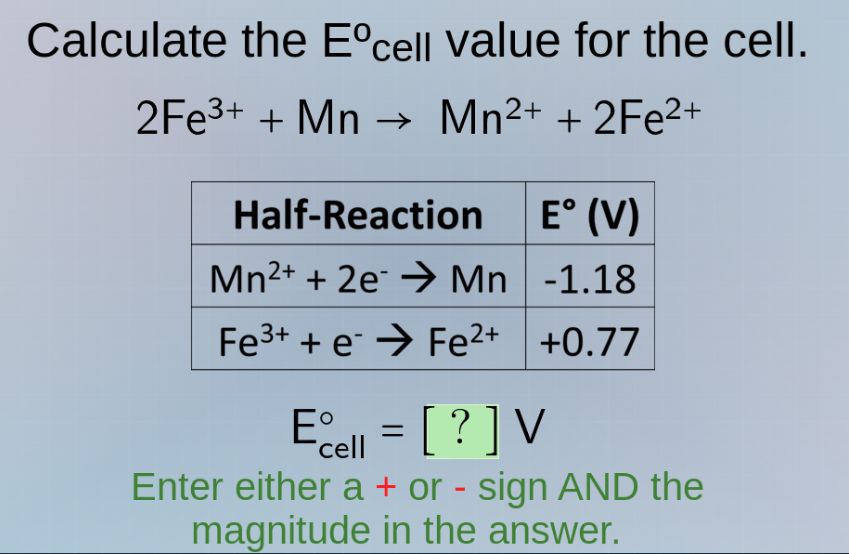
calculate the e⁰_cell value for the cell.
2fe³⁺ + mn → mn²⁺ + 2fe²⁺
half-reaction | e⁰ (v)
mn²⁺ + 2e⁻ → mn | -1.18
fe³⁺ + e⁻ → fe²⁺ | +0.77
e⁰_cell = ? v
enter either a + or - sign and the magnitude in the answer.
Step1: Identify oxidation and reduction half - reactions
In the overall reaction \(2Fe^{3+}+Mn
ightarrow Mn^{2+}+2Fe^{2+}\), for the reduction half - reaction, we look for the gain of electrons. The half - reaction \(Fe^{3+}+e^{-}
ightarrow Fe^{2+}\) is a reduction (gain of 1 electron per \(Fe^{3+}\)). For the oxidation half - reaction, we look for the loss of electrons. The given half - reaction for \(Mn\) is \(Mn^{2+}+2e^{-}
ightarrow Mn\) with \(E^{\circ}=- 1.18\ V\). The reverse of this reaction is the oxidation of \(Mn\): \(Mn
ightarrow Mn^{2+}+2e^{-}\), and the standard reduction potential for the reverse (oxidation) will have the opposite sign, so \(E^{\circ}_{oxidation} = 1.18\ V\) (since oxidation is the reverse of reduction). The reduction half - reaction is \(2\times(Fe^{3+}+e^{-}
ightarrow Fe^{2+})\) (we multiply by 2 to balance the electrons with the oxidation half - reaction), and \(E^{\circ}_{reduction}=0.77\ V\) (the potential does not change when we multiply the reaction by a coefficient to balance electrons).
Step2: Calculate \(E^{\circ}_{cell}\)
The formula for the standard cell potential is \(E^{\circ}_{cell}=E^{\circ}_{reduction}-E^{\circ}_{oxidation}\) (or \(E^{\circ}_{cell}=E^{\circ}_{cathode}-E^{\circ}_{anode}\), where cathode is the reduction site and anode is the oxidation site). Here, the reduction half - reaction (cathode) is \(Fe^{3+}+e^{-}
ightarrow Fe^{2+}\) with \(E^{\circ}_{cathode} = 0.77\ V\), and the oxidation half - reaction (anode) is the reverse of \(Mn^{2+}+2e^{-}
ightarrow Mn\), so the standard reduction potential for the anode half - reaction (if we consider it as a reduction) is \(E^{\circ}_{anode}=- 1.18\ V\). Using the formula \(E^{\circ}_{cell}=E^{\circ}_{cathode}-E^{\circ}_{anode}\), we substitute the values: \(E^{\circ}_{cell}=0.77\ V-(- 1.18\ V)\) (because for the anode, the reduction potential is \(- 1.18\ V\), and we use \(E^{\circ}_{cell}=E^{\circ}_{cathode}+E^{\circ}_{anode}\) in terms of oxidation and reduction potentials? Wait, actually, the correct formula is \(E^{\circ}_{cell}=E^{\circ}_{reduction\ of\ cathode}-E^{\circ}_{reduction\ of\ anode}\). The reduction of cathode: \(Fe^{3+}+e^{-}
ightarrow Fe^{2+}\), \(E^{\circ}_{cathode}=0.77\ V\). The reduction of anode: \(Mn^{2+}+2e^{-}
ightarrow Mn\), \(E^{\circ}_{anode}=- 1.18\ V\). So \(E^{\circ}_{cell}=E^{\circ}_{cathode}-E^{\circ}_{anode}=0.77\ V-(- 1.18\ V)=0.77 + 1.18=1.95\ V\).
Wait, another way: The two half - reactions:
Oxidation: \(Mn
ightarrow Mn^{2+}+2e^{-}\), \(E^{\circ}_{oxidation}=1.18\ V\) (since reduction of \(Mn^{2+}\) is \(- 1.18\ V\), oxidation is reverse)
Reduction: \(2Fe^{3+}+2e^{-}
ightarrow 2Fe^{2+}\), \(E^{\circ}_{reduction}=0.77\ V\) (multiplying the reaction by 2 to balance electrons, potential remains same)
Then \(E^{\circ}_{cell}=E^{\circ}_{reduction}+E^{\circ}_{oxidation}=0.77\ V + 1.18\ V = 1.95\ V\)

Snap & solve any problem in the app
Get step-by-step solutions on Sovi AI
Photo-based solutions with guided steps
Explore more problems and detailed explanations
\(+1.95\)