QUESTION IMAGE
Question
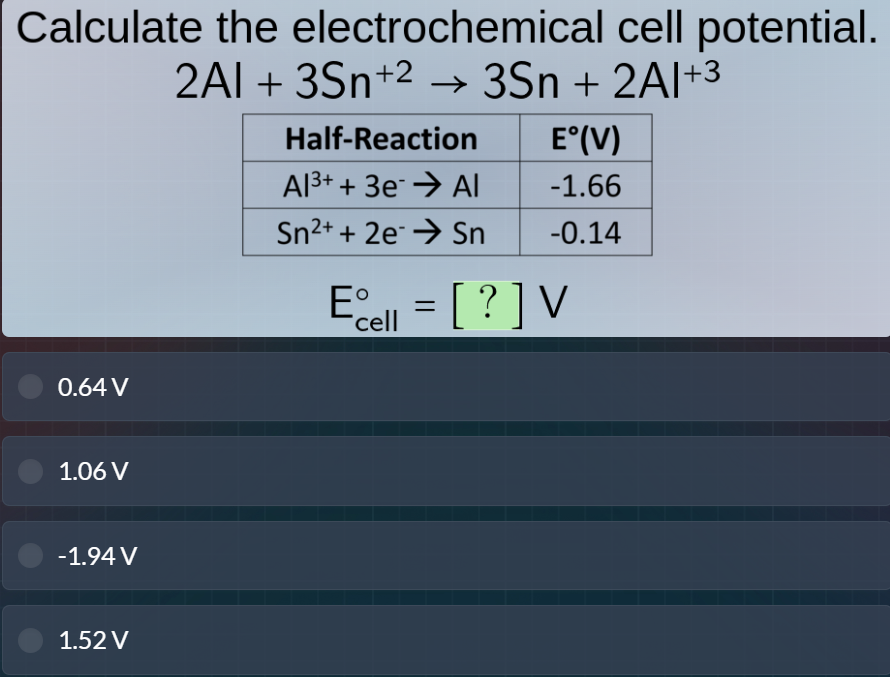
calculate the electrochemical cell potential.
$2\text{al} + 3\text{sn}^{+2} \
ightarrow 3\text{sn} + 2\text{al}^{+3}$
| half-reaction | $\text{e}^\circ$(v) |
|---|
| $\text{al}^{3+} + 3\text{e}^- \
ightarrow \text{al}$ | -1.66 |
| $\text{sn}^{2+} + 2\text{e}^- \
ightarrow \text{sn}$ | -0.14 |
$\text{e}^\circ_{\text{cell}} = ? \text{ v}$
0.64 v
1.06 v
-1.94 v
1.52 v
Step1: Identify Oxidation and Reduction
In the reaction \(2\text{Al} + 3\text{Sn}^{+2}
ightarrow 3\text{Sn} + 2\text{Al}^{+3}\), Al is oxidized (loses electrons: \(\text{Al}
ightarrow \text{Al}^{3+} + 3e^-\)) and \(\text{Sn}^{2+}\) is reduced (gains electrons: \(\text{Sn}^{2+} + 2e^-
ightarrow \text{Sn}\)).
For the oxidation half - reaction, we reverse the given reduction half - reaction of \(\text{Al}^{3+}+3e^-
ightarrow\text{Al}\). The standard reduction potential for the reverse reaction (oxidation) will have the opposite sign. So the oxidation potential \(E_{ox}^o=-E_{red}^o\) for \(\text{Al}\) oxidation. The given \(E_{red}^o\) for \(\text{Al}^{3+}+3e^-
ightarrow\text{Al}\) is \(- 1.66\) V, so \(E_{ox}^o = 1.66\) V.
The reduction potential for \(\text{Sn}^{2+}+2e^-
ightarrow\text{Sn}\) is \(E_{red}^o=-0.14\) V.
Step2: Calculate Cell Potential
The formula for the standard cell potential \(E_{cell}^o\) is \(E_{cell}^o = E_{red}^o+E_{ox}^o\) (where \(E_{red}^o\) is the reduction potential of the cathode and \(E_{ox}^o\) is the oxidation potential of the anode).
Substitute the values: \(E_{cell}^o=E_{red}^o(\text{Sn}^{2+}\text{ reduction})+E_{ox}^o(\text{Al oxidation})\)
\(E_{red}^o(\text{Sn}^{2+}\text{ reduction})=- 0.14\) V and \(E_{ox}^o(\text{Al oxidation}) = 1.66\) V.
\(E_{cell}^o=-0.14 + 1.66=1.52\) V? Wait, no, wait. Wait, the correct formula is \(E_{cell}^o=E_{cathode}^o - E_{anode}^o\) (where \(E_{cathode}^o\) is the reduction potential of the cathode and \(E_{anode}^o\) is the reduction potential of the anode). Let's use this formula.
The cathode is where reduction occurs (\(\text{Sn}^{2+}\) reduction), so \(E_{cathode}^o=-0.14\) V. The anode is where oxidation occurs, and the reduction potential of the anode (the reverse of oxidation) is \(E_{anode}^o=-1.66\) V.
\(E_{cell}^o = E_{cathode}^o-E_{anode}^o\)
Substitute the values: \(E_{cell}^o=-0.14-(-1.66)=- 0.14 + 1.66 = 1.52\) V? Wait, no, let's re - check.
Wait, the two half - reactions:
Reduction (cathode): \(\text{Sn}^{2+}+2e^-
ightarrow\text{Sn}\), \(E_{cathode}^o=-0.14\) V
Oxidation (anode): \(\text{Al}
ightarrow\text{Al}^{3+}+3e^-\), the reverse of \(\text{Al}^{3+}+3e^-
ightarrow\text{Al}\), so \(E_{anode}^o = 1.66\) V (since \(E_{ox}^o=-E_{red}^o\))
And \(E_{cell}^o=E_{cathode}^o + E_{anode}^o\) (because \(E_{cell}^o = E_{reduction\ at\ cathode}+E_{oxidation\ at\ anode}\))
So \(E_{cell}^o=-0.14+1.66 = 1.52\) V? Wait, no, the correct formula is \(E_{cell}^o=E_{cathode\ reduction}-E_{anode\ reduction}\). The anode reduction potential is \(-1.66\) V (for \(\text{Al}^{3+}+3e^-
ightarrow\text{Al}\)), and the cathode reduction potential is \(-0.14\) V (for \(\text{Sn}^{2+}+2e^-
ightarrow\text{Sn}\)).
So \(E_{cell}^o=E_{cathode\ reduction}-E_{anode\ reduction}=-0.14-(-1.66)=-0.14 + 1.66 = 1.52\) V? Wait, but let's check again.
Wait, the standard cell potential is calculated as \(E_{cell}^o = E_{reduction\ of\ cathode}-E_{reduction\ of\ anode}\). The cathode is the site of reduction (Sn²⁺ to Sn), so its reduction potential is \(-0.14\) V. The anode is the site of oxidation (Al to Al³⁺), and the reduction potential of the anode's half - reaction (the reverse of oxidation) is \(-1.66\) V.
So \(E_{cell}^o=-0.14-(-1.66)=1.52\) V. Wait, but let's check with another approach.
The two half - reactions:
Oxidation: \(\text{Al}
ightarrow\text{Al}^{3+}+3e^-\), \(E_{ox}^o = 1.66\) V (since reverse of \(E_{red}^o=-1.66\) V)
Reduction: \(\text{Sn}^{2+}+2e^-
ightarrow\text{Sn}\), \(E_{red}^o=-0.14\) V
To balance electrons, the oxidation reaction occurs 2 times a…

Snap & solve any problem in the app
Get step-by-step solutions on Sovi AI
Photo-based solutions with guided steps
Explore more problems and detailed explanations
1.52 V