QUESTION IMAGE
Question
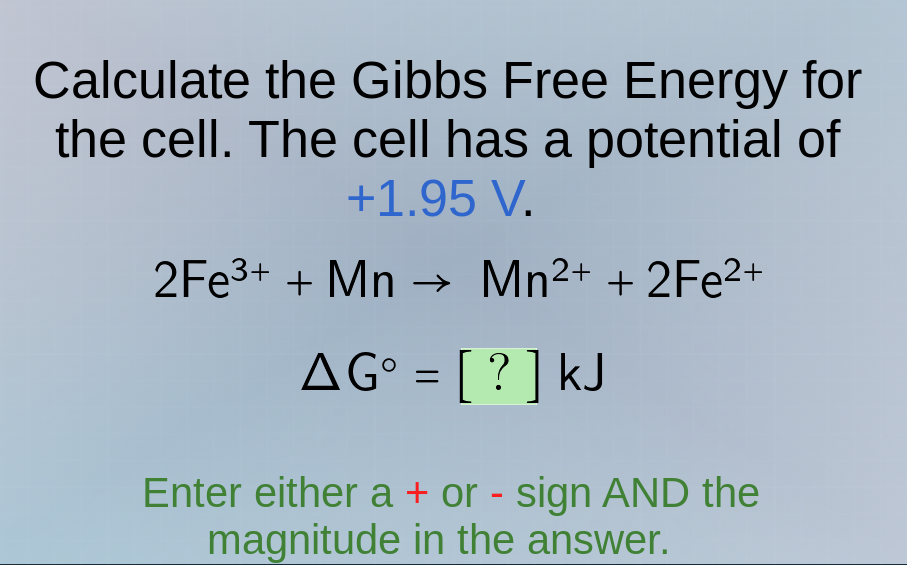
calculate the gibbs free energy for the cell. the cell has a potential of +1.95 v. 2fe³⁺ + mn → mn²⁺ + 2fe²⁺ δg° = ? kj enter either a + or - sign and the magnitude in the answer.
Step1: Recall the formula for Gibbs Free Energy
The formula relating Gibbs Free Energy change ($\Delta G^\circ$) to cell potential ($E^\circ_{cell}$) is $\Delta G^\circ = -nFE^\circ_{cell}$, where $n$ is the number of moles of electrons transferred, $F$ is Faraday's constant ($F = 96485\ C/mol\ e^-$), and $E^\circ_{cell}$ is the cell potential.
First, determine the number of moles of electrons transferred ($n$).
For the reaction $2Fe^{3+} + Mn
ightarrow Mn^{2+} + 2Fe^{2+}$:
- Fe goes from +3 to +2, so each Fe gains 1 electron. There are 2 Fe atoms, so total gain of $2\times1 = 2$ electrons.
- Mn goes from 0 to +2, so it loses 2 electrons.
Thus, $n = 2$ moles of electrons.
Step2: Plug in the values into the formula
We know $n = 2$, $F = 96485\ C/mol\ e^-$, $E^\circ_{cell} = 1.95\ V$ (since $1\ V = 1\ J/C$).
First, calculate $\Delta G^\circ$ in joules:
$\Delta G^\circ = -nFE^\circ_{cell} = -2\ mol\ e^- \times 96485\ C/mol\ e^- \times 1.95\ V$
Calculate the product:
$2\times96485\times1.95 = 2\times96485\times\frac{39}{20} = 96485\times\frac{39}{10} = 96485\times3.9 = 376291.5$
So, $\Delta G^\circ = - 376291.5\ J$
Step3: Convert joules to kilojoules
Since $1\ kJ = 1000\ J$, divide by 1000:
$\Delta G^\circ = \frac{-376291.5\ J}{1000} = -376.2915\ kJ \approx -376\ kJ$ (or more precisely, -376.3 kJ, but we can round appropriately)

Snap & solve any problem in the app
Get step-by-step solutions on Sovi AI
Photo-based solutions with guided steps
Explore more problems and detailed explanations
-376 (or -376.3, depending on rounding; the exact calculation gives -376291.5 J = -376.2915 kJ, so approximately -376 kJ)